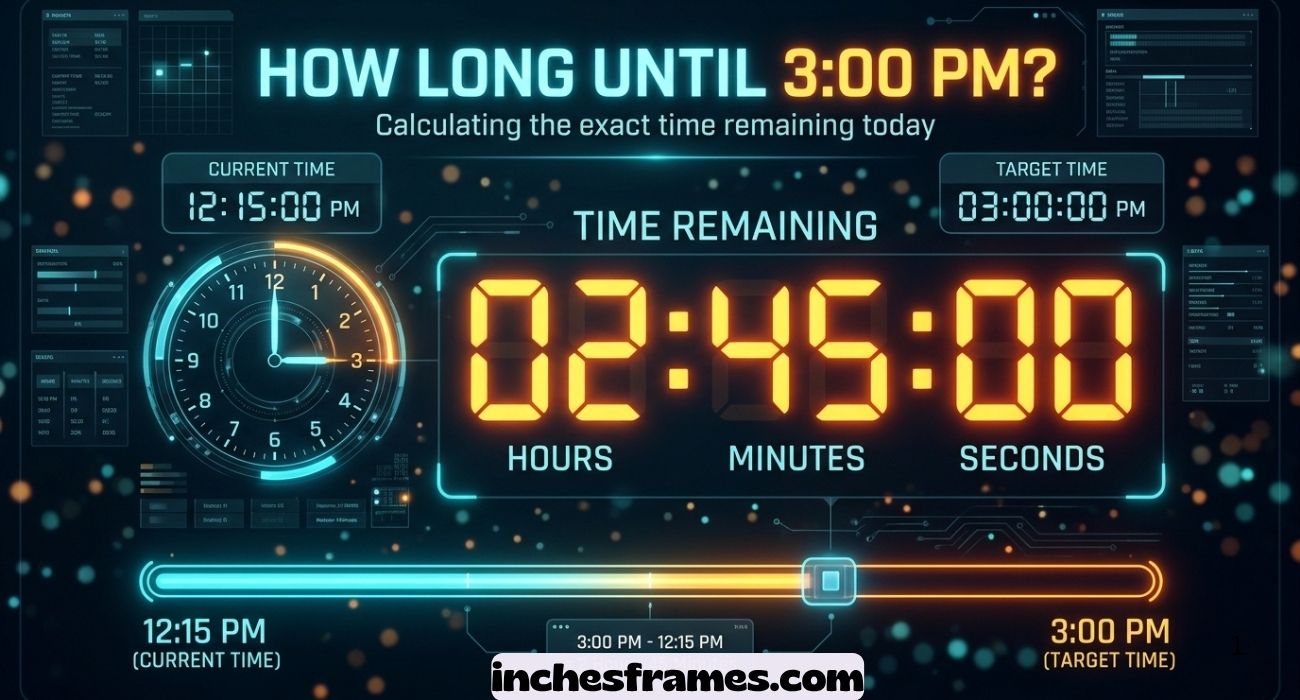
How Long Until 3:00 PM? Calculate the Exact Time Remaining Today
How long until 3:00 PM depends on your current local time. If it is 1:00 PM, you have 2 hours left. If it is 2:30 PM, you have 30 minutes remaining. At 2:45 PM, only 15 minutes remain before 3:00 PM.
You can calculate the time remaining by subtracting the current time from 3:00 PM. This simple method helps you plan work, school activities, appointments, meetings, and afternoon tasks. A countdown timer can also track the remaining hours, minutes, and seconds automatically.
This guide explains how long until 3:00 PM at different times of day, how to calculate the exact time difference, and how to handle time zones and situations when 3 PM has already passed.
Quick Answer: How Long Until 3:00 PM?
The time remaining until 3:00 PM changes throughout the day. The following table shows common examples for the same day.
| Current time | Time remaining until 3:00 PM |
|---|---|
| 8:00 AM | 7 hours |
| 9:00 AM | 6 hours |
| 10:00 AM | 5 hours |
| 11:00 AM | 4 hours |
| 12:00 PM | 3 hours |
| 12:30 PM | 2 hours 30 minutes |
| 1:00 PM | 2 hours |
| 1:15 PM | 1 hour 45 minutes |
| 1:30 PM | 1 hour 30 minutes |
| 2:00 PM | 1 hour |
| 2:15 PM | 45 minutes |
| 2:30 PM | 30 minutes |
| 2:45 PM | 15 minutes |
| 2:55 PM | 5 minutes |
| 3:00 PM | 0 minutes |
These examples assume the listed current time occurs on the same day before 3 PM. For an exact answer, use your current local time, including the minutes and seconds.
If it is already past 3:00 PM, the next 3 PM will occur tomorrow. If you want to know how long ago 3 PM occurred today, calculate the time elapsed since that point instead.
Why Do So Many People Wonder: How Long Until 3:00 PM?
Three o’clock in the afternoon is a useful reference point for many daily activities. People may have a work break, a school dismissal, a business meeting, or an appointment scheduled for this time. Knowing the remaining time helps them decide what they can finish before the next commitment.
The question also comes up when people are waiting for a scheduled event. A student may want to know how much study time remains before leaving school. An employee may need to complete a report before a 3 PM meeting. Someone waiting for a delivery or an online appointment may want a quick estimate of the remaining minutes.
3 PM Is a Common Time for Work and School
Many people divide their day into morning, afternoon, and evening periods. Three PM falls well into the afternoon, making it a convenient reference point for work schedules, classes, and personal plans.
For example, a person who starts a task at 1:30 PM has 90 minutes before 3 PM. That time may be enough to complete a short assignment, prepare meeting notes, or organize a list of errands. The exact amount of useful working time depends on the task and any breaks needed.
Afternoon Appointments and Daily Responsibilities
A scheduled appointment requires more than knowing its start time. You may also need to prepare documents, travel to a location, or finish another task beforehand. Calculating the time until 3 PM gives you a clear deadline for those preparations.
For example, if an appointment begins at 3 PM and it is currently 2:20 PM, you have 40 minutes left. If travel takes 25 minutes, you have only 15 minutes available for preparation before leaving, assuming the travel estimate is accurate.
Why an Exact Countdown Matters
A rough estimate can help with general planning, but an exact time difference is more useful when a deadline is close. Knowing that 3 PM is 17 minutes away gives you a better idea of what you can reasonably complete than simply knowing that the afternoon is almost over.
An accurate time remaining calculation also reduces confusion between hours and minutes. This is especially helpful when the current time includes an unusual minute value, such as 1:47 PM or 2:38 PM.
Understanding the Countdown to 3 PM
A countdown to 3 PM measures the time between the present moment and the target time. It can show the remaining duration in hours, minutes, and seconds.
For example, if the current time is 2:20 PM, the countdown is 40 minutes. At 2:20:30 PM, the remaining time is 39 minutes and 30 seconds. As time passes, the countdown decreases until it reaches zero at 3:00 PM.
What Does 3:00 PM Mean?
The abbreviation PM comes from the Latin phrase post meridiem, meaning after midday. On a standard 12-hour clock, 3:00 PM means three hours after 12 noon.
The equivalent time in the 24-hour clock is 15:00. This format counts hours from 00:00 through 23:59, so it avoids confusion between AM and PM.
| Time format | Representation |
|---|---|
| 12-hour clock | 3:00 PM |
| 24-hour clock | 15:00 |
| Minutes after noon | 180 minutes |
| Seconds after noon | 10,800 seconds |
Both clock formats represent the same moment. The 24-hour format is common in transportation, scheduling systems, and some workplaces, while the 12-hour format is widely used in everyday American conversation.
How a Countdown to 3 PM Works
A countdown compares the target time with the current time. If the target occurs later on the same day, the difference gives the remaining duration.
Suppose the current time is 1:40 PM. From 1:40 PM to 2:00 PM is 20 minutes. From 2:00 PM to 3:00 PM is another hour. The total remaining time is therefore 1 hour and 20 minutes.
A digital countdown performs this calculation automatically. A manual calculation uses the same principle, but you must account for the current minutes and seconds to obtain a precise result.
The Difference Between a Clock and a Countdown Timer
A clock tells you the current time. A countdown timer tells you how much time remains before a particular target or event.
For example, a clock may show 2:35 PM, while a timer set for 3 PM displays 25 minutes remaining. Both are useful, but they answer different questions.
A clock is useful for checking schedules throughout the day. A timer is more convenient when you want to focus on one deadline without repeatedly calculating the difference.
Does the Countdown to 3 PM Change Every Second?
Yes. The remaining duration decreases continuously as real time passes. If 10 minutes remain, one minute later, approximately 9 minutes remain.
The display may update every second, every minute, or at another interval depending on the tool. A countdown that updates every second provides a more detailed display, but the accuracy still depends on the device clock, the timer implementation, and whether the display updates correctly.
How Long Until 3:00 PM Today Depends on the Current Time
The answer to How Long Until 3:00 PM depends on the exact time where you are. A person checking the clock in the morning may have several hours left, while someone checking it shortly before 3 PM may have only a few minutes.
Your local clock provides the starting point for the calculation. Check the hour first, then compare the minutes with the target time. If the current time is before 3 PM, subtract it from 15:00 using either the 12-hour or 24-hour clock.
How Long Until 3 PM in the Morning?
When the current time is in the morning, you must count the time remaining until noon and then add the three hours from noon to 3 PM.
For example, at 10:30 AM, you have 1 hour and 30 minutes until noon. Another 3 hours remain between noon and 3 PM. The total is 4 hours and 30 minutes.
This approach works well for morning planning because it breaks a longer period into smaller parts. At 8:15 AM, for example, the remaining time until 3 PM is 6 hours and 45 minutes.
How Long Until 3 PM in the Afternoon?
Afternoon calculations are often simpler because the target time is closer. You can subtract the current time directly from 3 PM.
At 12:45 PM, the remaining time is 2 hours and 15 minutes. At 1:20 PM, it is 1 hour and 40 minutes. At 2:40 PM, only 20 minutes remain.
When the minutes on the current clock are greater than zero, avoid subtracting only the hour numbers. For instance, 2:40 PM is not one hour before 3 PM. It is 20 minutes before the target.
What If It Is Exactly 3 PM?
At exactly 3:00 PM, the countdown to that day’s target reaches zero. The event is due now, rather than in the future.
If you mean the next occurrence of 3 PM, the answer becomes 24 hours on a normal day after exactly 3 PM has passed. In locations where a daylight saving time change affects the local clock, the elapsed time until the next local 3 PM can differ from 24 hours.
What If 3 PM Has Already Passed Today?
If the current time is 4 PM, today’s 3 PM has already occurred. There are two possible interpretations of the question: how long ago 3 PM was, or how long remains until 3 PM tomorrow.
At 4 PM, 3 PM occurred one hour ago. The next 3 PM is ordinarily 23 hours away. At 8 PM, the next 3 PM is ordinarily 19 hours away.
This distinction matters for countdowns because a timer should not silently treat a past target as a future one unless it is designed to count toward the next occurrence.
See Also : How Long Until 2:45 PM? Calculate the Time Remaining Today
The Mathematics Behind a Time Difference
Calculating the time until 3 PM uses basic subtraction. The main challenge is handling the hour and minute values correctly.
One hour contains 60 minutes, and one minute contains 60 seconds. Therefore, 90 minutes equals 1 hour and 30 minutes, while 45 minutes equals three-quarters of an hour.
How to Calculate the Time Until 3 PM Manually
Use the following method when the current time is earlier than 3 PM.
- Write down the current time, including AM or PM.
- Express 3 PM as 15:00 if you prefer the 24-hour clock.
- Subtract the current time from the target time.
- Convert the result into hours, minutes, and seconds when needed.
- Check the answer to make sure it represents the remaining time rather than the time already elapsed.
For example, suppose the current time is 1:25 PM. In 24-hour format, that is 13:25. Subtracting 13:25 from 15:00 gives 1 hour and 35 minutes.
The calculation can also be done in two steps. From 1:25 PM to 2:00 PM is 35 minutes. From 2:00 PM to 3:00 PM is 1 hour. Together, these intervals equal 1 hour and 35 minutes.
Calculate Time Remaining in Minutes
Converting both times into minutes after midnight makes subtraction easier when you need a single number.
Three PM equals 15 × 60, or 900 minutes after midnight. If the current time is 1:30 PM, it equals 13 × 60 + 30, or 810 minutes after midnight.
Subtracting 810 from 900 gives 90 minutes. That is the same as 1 hour and 30 minutes.
This method is useful for spreadsheets, scheduling programs, and a time difference calculator. It also makes it easier to compare durations without switching between hour and minute values repeatedly.
Calculate Time Remaining in Seconds
For a more precise countdown, include seconds in the calculation. Each minute contains 60 seconds, so 15 minutes equal 900 seconds.
Suppose the current time is 2:45 PM exactly. Fifteen minutes remain until 3 PM, which equals 900 seconds. If the current time is 2:45:20 PM, the remaining time is 14 minutes and 40 seconds, or 880 seconds.
A second-by-second countdown can be helpful for timed activities. However, everyday appointments and work schedules usually require only hours and minutes.
Common Time Calculation Mistakes
One common mistake is subtracting the hour values while ignoring the minutes. If the time is 2:35 PM, the answer is 25 minutes, not one hour.
Another mistake is confusing noon with midnight. Noon is 12 PM, while midnight is 12 AM. Because 3 PM occurs three hours after noon, the target is in the afternoon rather than the early morning.
A third mistake occurs when the target has already passed. A calculation must distinguish between time elapsed since today’s 3 PM and time remaining until tomorrow’s 3 PM.
H2: Popular Countdown Times Around 3 PM
People often check other times near 3 PM when planning a work session, school activity, appointment, or afternoon break. These related countdowns can help divide the afternoon into manageable periods.
How Long Until 2:30 PM?
If the current time is before 2:30 PM, calculate the difference between the current time and 2:30 PM. If it is 2:00 PM, 30 minutes remain. If it is 1:30 PM, one hour remains.
If it is already past 2:30 PM, the next occurrence is tomorrow, unless you want to calculate how long ago it happened today.
How Long Until 2:45 PM?
At 2:15 PM, there are 30 minutes until 2:45 PM. At 2:30 PM, there are 15 minutes remaining. This target can be useful when you want to finish a task shortly before a 3 PM commitment.
How Long Until 3:15 PM?
Three fifteen is 15 minutes after 3 PM. If the current time is 2:30 PM, 45 minutes remain until 3:15 PM. If it is 3:00 PM, the wait is 15 minutes.
This target is useful when a meeting begins shortly after the hour or when an event has a scheduled start time of 3:15 PM.
How Long Until 3:30 PM?
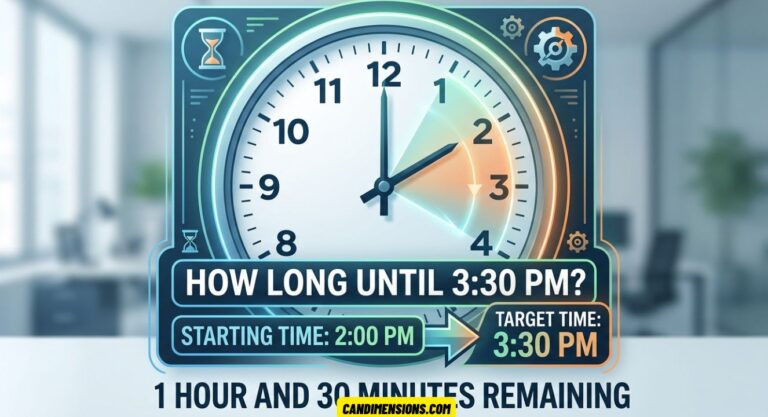
Three thirty is half an hour after 3 PM. At 2:00 PM, the time remaining is 1 hour and 30 minutes. At 3:00 PM, 30 minutes remain.
Comparing nearby times helps you create a more flexible schedule. For example, you could aim to finish preparation by 2:45 PM, attend a meeting at 3 PM, and start another task at 3:30 PM.
How Long Until 4 PM?
Four PM is one hour after 3 PM. If it is currently 2 PM, two hours remain until 4 PM. If it is 3:30 PM, the remaining time is 30 minutes.
These examples use the same subtraction method. Only the target time changes.
Best Tools for Tracking the Time Until 3 PM
A manual calculation works well when you need a quick answer. A digital tool is more useful when you want a countdown that continues updating without repeated calculations.
The best option depends on whether you need a simple estimate, a live display, or a reminder that alerts you when the target time arrives.
Online Countdown Timers
An online countdown timer lets you set a target duration or, in some tools, a specific clock time. A timer set for a particular duration is not always the same as a timer set for 3 PM, so choose the correct option.
For example, if it is 2:20 PM and you set a 40-minute timer, it should reach zero at 3 PM if it starts immediately and runs normally. If you set a 60-minute timer instead, it will finish at 3:20 PM.
Smartphone Clocks and Alarms
Most smartphones include clock applications with alarms and timers. You can set an alarm for 3 PM to receive an alert when that time arrives.
An alarm is different from a countdown. An alarm notifies you at a chosen clock time, while a countdown shows the remaining duration. Use an alarm when you need a reminder and a countdown when you want to monitor the time left.
Computer Clocks and Calendar Reminders
A computer clock is convenient when you work at a desk. You can check the current time and calculate the difference without opening another application.
A calendar reminder is more suitable for meetings and appointments. Set the event for 3 PM and add an earlier reminder if you need time to prepare. Remember to verify the calendar’s time zone when an event involves people in different locations.
Productivity Timers
A productivity timer can help you divide the time before 3 PM into focused work periods. For example, if you have 60 minutes available, you might spend 25 minutes on a task, take a short break, and use the remaining time for review.
The exact structure should fit the task. A countdown can help you stay aware of the deadline, but it cannot determine how long a task will take or guarantee that you finish on time.
Choosing the Right Countdown Tool
For a quick calculation, a clock and basic subtraction are enough. For an ongoing display, use a timer that supports a target time. For scheduled commitments, use an alarm or calendar reminder.
Check that the tool uses the correct local time and updates reliably. If seconds matter, use a timer that displays them. If the goal is simply to arrive at a meeting on time, an alarm with enough preparation time may be more practical.
How Long Until 3 PM and Productivity
Knowing how long until 3 PM can make an afternoon easier to manage. A clear deadline helps you decide which tasks need immediate attention and which can wait. Instead of checking the clock repeatedly, you can use the remaining time to set realistic goals.
For example, if you have 90 minutes before 3 PM, you might use the first hour to complete an important assignment and the final 30 minutes to review your work. The plan should match the task’s difficulty and your available resources.
Plan Your Tasks Around the Remaining Time
Start by checking how much time remains. Then compare that duration with the work you need to complete. A task that needs 20 minutes may fit comfortably into a 45-minute window, while a longer project may require a different deadline.
If it is 2:00 PM, you have one hour before 3 PM. You could spend 40 minutes on a priority task and reserve 20 minutes for checking your progress or preparing for your next commitment. This approach leaves some flexibility if the task takes longer than expected.
Use Short Time Blocks to Stay Focused
Short work periods can help you pay attention to one task at a time. If 30 minutes remain before 3 PM, choose one clear goal rather than starting several unrelated activities.
A timer can mark the beginning and end of that work period. When the timer finishes, review what you completed and decide what to do next. The purpose is to create structure, not to rush through work that needs careful attention.
Avoid Last-Minute Scheduling Problems
A deadline at 3 PM does not mean you should plan to finish every task at exactly 3 PM. You may need extra time to save a file, travel to a meeting, collect materials, or review the final result.
For instance, if a meeting starts at 3 PM, aim to finish your preparation before the meeting time. Building a small buffer into your schedule can help you handle unexpected delays without missing the appointment.
See Also ; How Long Until 2:15? Simple Time Calculation Guide
Scheduling Around 3:00 PM
Three PM can serve as a useful anchor for an afternoon schedule. You can plan backward from the target time to decide when to begin preparation, finish a task, or leave for an appointment.
Work and Business Meetings
If a business meeting begins at 3 PM, identify the steps you need to complete beforehand. These might include reviewing documents, checking the meeting link, preparing questions, or finishing a report.
Suppose your preparation takes 30 minutes. Starting at 2:15 PM gives you 45 minutes before the meeting, leaving a 15-minute buffer after preparation. This is a more practical plan than waiting until 2:30 PM and using the entire remaining period for preparation.
School, Homework, and Study Sessions
Students can use 3 PM as a reference point for the end of a class, the beginning of an activity, or a planned study session. Knowing the remaining time helps them divide their work into smaller tasks.
For example, if a study session ends at 3 PM and the current time is 1:45 PM, there are 75 minutes available. A student could spend 45 minutes on a difficult subject and use the final 30 minutes to practice questions or review notes.
Travel and Personal Appointments
Travel planning requires more than calculating the time until an appointment. You must also consider the journey, possible delays, and any preparation required before leaving.
If an appointment starts at 3 PM and the estimated journey takes 20 minutes, leaving at 2:40 PM may provide no extra travel buffer. Leaving earlier gives you more room for traffic or other delays. Always use the actual travel estimate for your route rather than assuming every journey takes the same amount of time.
Build a Flexible Afternoon Schedule
A useful schedule allows some tasks to finish early and others to take a little longer. Instead of filling every minute before 3 PM, leave space for unexpected work.
For example, a person with two hours remaining could schedule one important task, a short break, and a final preparation period. This creates a clear plan while leaving room to adjust when circumstances change.
Cultural Rituals of Afternoon Time
Three PM is not a universal break time, but it can act as a familiar point in daily routines. In some workplaces, it falls near an afternoon break. In schools, it may be close to dismissal or after-school activities. In homes, it may mark a time for errands, snacks, or other responsibilities.
These patterns differ across families, workplaces, schools, and regions. Some people follow fixed schedules, while others work flexible hours. The usefulness of a 3 PM countdown comes from the role that time plays in a person’s own routine.
Afternoon Breaks and Daily Habits
People sometimes use a particular clock time to remind themselves to pause, stretch, get a drink, or review their progress. A 3 PM reminder can help make such habits more consistent.
However, the best break time depends on the person’s schedule. Someone working an early shift may need a break before 3 PM, while someone working later may not reach the middle of their workday until then.
Different Schedules Across the United States
The United States includes many time zones and a wide range of work and school schedules. Three PM in New York does not occur at the same moment as 3 PM in California.
A person attending a meeting with colleagues across the country should confirm which time zone the invitation uses. This avoids confusion when a schedule refers to Eastern, Central, Mountain, or Pacific Time.
Waiting Is More Emotional Than Mathematical
A countdown gives an objective measurement of time, but the wait can feel different depending on what you are doing. Ten minutes spent waiting for an appointment may feel longer than ten minutes spent on an interesting task.
The clock continues to measure time in the same way. Your attention, expectations, and level of activity can change how quickly the period seems to pass.
Why the Last Few Minutes Can Feel Long
When you are waiting for a meeting, a break, or an important announcement, you may check the clock frequently. Each check draws attention to the remaining time, which can make the wait feel more noticeable.
A simple way to manage this is to choose a small task that fits the available period. If 15 minutes remain before 3 PM, you could organize your desk, review a short document, or prepare the materials you need for your next activity.
Use the Countdown Without Becoming Distracted
A countdown is most useful when it supports your plan rather than interrupting it. Constantly checking a timer can distract you from the task you are trying to finish.
Set a reminder when you need one, then focus on your work. Check the countdown again when you reach a natural stopping point or when the deadline becomes important.
How Digital Countdown Systems Work
A digital countdown calculates the difference between a target time and the current time. The result can be displayed as hours, minutes, and seconds. Some systems calculate the remaining duration from the clock whenever they update, while others use a timer that counts down from an initial duration.
How a Digital Clock Measures Time
A computer or smartphone relies on its system clock to represent the current date and time. The operating system maintains time information and makes it available to applications.
A countdown application compares that time information with the selected target. If the current time is 2:10 PM and the target is 3 PM on the same day, the difference is 50 minutes.
Why Countdown Accuracy Can Vary
A countdown may display an incorrect result if the device clock is wrong, the selected time zone is incorrect, or the application fails to update properly. Network delays can also affect web-based tools, depending on how they calculate and display time.
For ordinary planning, a correctly set device clock is generally sufficient. For a meeting involving several locations, confirm the scheduled time and time zone rather than relying on an unverified countdown display.
Local Time, Time Zones, and Daylight Saving Time
The phrase “3 PM” refers to a local clock time unless another time zone is specified. For example, a meeting scheduled for 3 PM Eastern Time may occur at a different local clock time for someone in California.
Daylight saving time adds another detail. Some US locations move their clocks forward in spring and backward in autumn, while others do not observe these changes. When a countdown crosses a clock change, the actual elapsed duration may differ from a simple assumption of 24 hours per calendar day.
For an ordinary same-day countdown to 3 PM, use the current local time and the target time on the same local clock. For a future event in another location, use the event’s stated time zone.
Everyday Situations Where a 3 PM Countdown Helps
A countdown to 3 PM can support many everyday activities. Its main benefit is that it turns an unclear period of waiting into a specific amount of time.
Finishing a Work Assignment
An employee who needs to submit a report by 3 PM can calculate the available time and choose which parts to complete first. If 45 minutes remain, the employee can focus on the most important unfinished sections and leave time to check the document.
Preparing for an Appointment
Someone with a 3 PM appointment can work backward from the scheduled start. They can estimate preparation time, travel time, and a reasonable buffer to reduce the risk of arriving late.
Managing Online Meetings
Remote workers may use countdowns to prepare a presentation, test their microphone, or open the required files before a 3 PM meeting. A calendar alert can provide a reminder, while a countdown shows the time remaining.
Organizing Household Tasks
A person waiting for a delivery or planning to leave home at 3 PM can use the remaining time to finish small chores. The countdown helps set a practical stopping point so that household tasks do not interfere with the next commitment.
Planning Exercise and Personal Activities
Someone planning an afternoon walk, workout, or hobby session can use 3 PM as a start or finish time. If 60 minutes remain, they can select an activity that fits that window instead of beginning something that is unlikely to finish before the next scheduled event.
Frequently Asked Questions
How long until 3:00 PM if it is 1:30 PM?
There are 1 hour and 30 minutes until 3:00 PM. From 1:30 PM to 2:00 PM is 30 minutes, followed by another hour until 3 PM.
How many minutes are left until 3 PM if it is 2:15 PM?
There are 45 minutes until 3 PM. This equals three-quarters of an hour.
How long until 3 PM if it is 2:45 PM?
There are 15 minutes remaining. If the current time is exactly 2:45 PM, the countdown to 3 PM is 900 seconds.
How do I calculate how long until 3 PM without a calculator?
Subtract the current time from 3 PM. For example, from 1:40 PM to 2 PM is 20 minutes, and from 2 PM to 3 PM is one hour. The total is 1 hour and 20 minutes.
Is 3 PM the same as 15:00?
Yes. 3:00 PM equals 15:00 in the 24-hour clock system. Both represent the same time in the afternoon.
What if it is already 3 PM?
The countdown to the current day’s 3 PM has reached zero. If you mean the next occurrence, tomorrow’s 3 PM is ordinarily 24 hours away from exactly 3 PM, although daylight saving time changes can affect the elapsed duration.
Does a countdown to 3 PM work in every time zone?
Yes, provided the tool uses the correct local time and target time zone. The countdown to 3 PM in one location may differ from the countdown in another location because local clocks do not always show the same time.
Can I use an alarm instead of a countdown timer?
Yes. An alarm can notify you when 3 PM arrives, while a countdown timer shows how much time remains before that moment. Use an alarm for a reminder and a countdown when you want to monitor the remaining duration.
Why does my countdown show a different time from another device?
The devices may have different clock settings, time zones, or countdown methods. Check that both devices display the correct local time and use the same target time before comparing their results.
How long until 3 PM tomorrow if it is 8 PM today?
Under ordinary conditions, there are 19 hours until 3 PM tomorrow. From 8 PM to midnight is four hours, and from midnight to 3 PM is another 15 hours. The total is 19 hours, assuming no daylight saving time change affects the interval.
Conclusion
Knowing how long until 3:00 PM helps you plan your day, manage deadlines, and prepare for scheduled activities. The exact answer depends on your current local time. At 1 PM, two hours remain; at 2:30 PM, 30 minutes remain; and at 2:45 PM, only 15 minutes remain.
You can calculate the time difference manually or use a countdown timer, smartphone alarm, or calendar reminder. Remember to check AM and PM, account for the minutes, and consider time zones when planning events across locations. If 3 PM has already passed, decide whether you want to know how long ago it occurred or how long remains until tomorrow’s 3 PM.