How Long Until 2:15? Simple Time Calculation Guide
How long until 2:15 depends on your current local time and whether you mean 2:15 AM or 2:15 PM. For example, if it is 1:00 PM, you have 1 hour and 15 minutes until 2:15 PM. If it is 2:00 PM, only 15 minutes remain. You can calculate the time remaining by subtracting the current time from your target time.
Knowing how much time remains until 2:15 can help you prepare for meetings, organize study sessions, set alarms, and manage daily activities. This guide explains how to calculate the time difference, convert hours into minutes, handle AM and PM, and work out the countdown when the target falls on the next day.
1. Meaning / Definition
The phrase “How Long Until 2:15?” asks how much time remains between the current time and the next intended occurrence of 2:15. The answer represents a time difference, which measures the duration between two points on a clock.
The target can refer to 2:15 AM or 2:15 PM. These times occur 12 hours apart, so choosing the correct one is necessary for an accurate calculation. For example, if the current time is 1:15 PM and the target is 2:15 PM, exactly one hour remains. If the target is 2:15 AM the following morning, the calculation will be different.
You can express the remaining time in hours and minutes, total minutes, or even seconds. A countdown timer can display this duration continuously, while a manual calculation provides the answer for a specific starting time.
The basic relationship is simple:
Time remaining = Target time − Current time
When the target time has already passed, you must decide whether you mean an earlier time today or the next occurrence on the following day. This distinction prevents errors when calculating time across midnight.
2. Meaning in Simple Words
In simple words, “How Long Until 2:15?” means counting how much time is left before the clock reaches 2:15.
Imagine that your clock shows 1:45 PM. You have 15 minutes until 2:00 PM and another 15 minutes until 2:15 PM. Therefore, the total waiting time is 30 minutes.
The answer changes as the clock moves forward. At 2:00 PM, you have 15 minutes left. At 2:10 PM, you have only five minutes remaining. The closer you get to the target, the shorter the countdown becomes.
This calculation works for both morning and afternoon. You only need to identify the current time, select the correct target, and measure the difference between them.
Quick Answer
How long until 2:15? The exact answer depends on your current local time and whether your target is 2:15 AM or 2:15 PM.
Here are some common examples for a target of 2:15 PM:
| Current time | Time remaining until 2:15 PM |
|---|---|
| 12:00 PM | 2 hours 15 minutes |
| 1:00 PM | 1 hour 15 minutes |
| 1:15 PM | 1 hour |
| 1:30 PM | 45 minutes |
| 1:45 PM | 30 minutes |
| 2:00 PM | 15 minutes |
| 2:10 PM | 5 minutes |
| 2:14 PM | 1 minute |
If it is 11:00 PM and you mean 2:15 AM the next morning, the remaining time is 3 hours and 15 minutes.
These examples provide a quick way to understand the calculation. For a precise result, check the current time on your device and confirm whether the target falls today or tomorrow.
3. Real-Life Examples
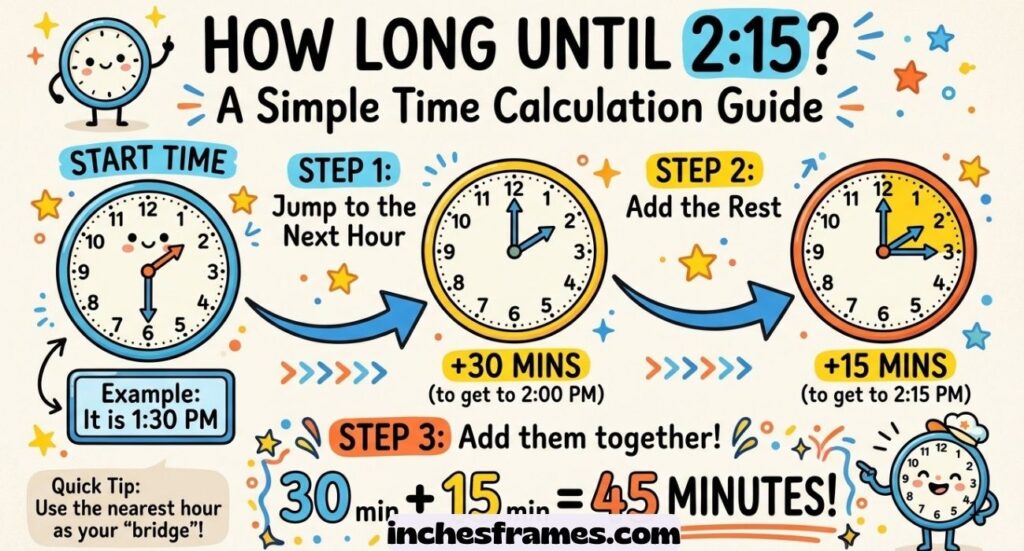
Different starting times produce different countdowns. The following examples show how to calculate the duration until 2:15 in everyday situations.
Example 1: It Is 1:00 PM
Suppose you have an appointment at 2:15 PM, and your clock shows 1:00 PM. First, count one hour from 1:00 PM to 2:00 PM. Then add 15 minutes to reach the appointment time.
The calculation is:
1 hour + 15 minutes = 1 hour and 15 minutes.
Answer: 1 hour and 15 minutes, or 75 minutes.
This method is useful when you need to prepare documents, travel to an appointment, or finish a task before a scheduled meeting.
Example 2: It Is 1:15 PM
If the current time is 1:15 PM and your target is 2:15 PM, the minute values match. You only need to compare the hours.
From 1:15 PM to 2:15 PM, exactly one hour passes.
Answer: 1 hour, or 60 minutes.
This example is especially easy because the minutes do not change. You can use the same method whenever the current time and target time have matching minute values.
Example 3: It Is 1:45 PM
Suppose the clock shows 1:45 PM. You want to know how long until 2:15 PM.
From 1:45 PM to 2:00 PM is 15 minutes. From 2:00 PM to 2:15 PM is another 15 minutes. Add both parts together to find the total.
15 minutes + 15 minutes = 30 minutes.
Answer: 30 minutes.
Breaking the calculation into smaller intervals makes it easier to work out the answer without a calculator. It can also help when planning a short study session or preparing for an event.
Example 4: It Is 2:00 PM
If it is 2:00 PM, the target time is only 15 minutes away.
Subtract the current minute value from the target minute value:
15 − 0 = 15 minutes.
Answer: 15 minutes.
For example, if an online class starts at 2:15 PM, you have 15 minutes to open your laptop, check your internet connection, and get ready.
Example 5: It Is 2:10 PM
When the clock shows 2:10 PM, only five minutes remain until 2:15 PM.
The calculation is straightforward:
15 − 10 = 5 minutes.
Answer: 5 minutes.
This short interval shows why checking the exact minutes matters. An estimate of 10 or 15 minutes would be inaccurate and could cause you to miss a scheduled activity.
Example 6: It Is 12:00 PM
The time 12:00 PM means noon. If you want to calculate the time until 2:15 PM, count two hours from noon to 2:00 PM and add another 15 minutes.
2 hours + 15 minutes = 2 hours and 15 minutes.
Answer: 2 hours and 15 minutes, or 135 minutes.
Remember that 12:00 PM is noon, while 12:00 AM is midnight. Confusing these two times can change the result significantly.
Example 7: It Is 11:00 PM
Suppose it is 11:00 PM, and you want to know how long until 2:15 AM. Because 2:15 AM occurs after midnight, the calculation crosses into the next calendar day.
From 11:00 PM to midnight is one hour. From midnight to 2:15 AM is another two hours and 15 minutes.
1 hour + 2 hours 15 minutes = 3 hours 15 minutes.
Answer: 3 hours and 15 minutes, or 195 minutes.
This example is useful when planning an overnight trip, preparing for an early flight, or setting an alarm for the following morning.
If you instead mean 2:15 PM the next day, the answer is 15 hours and 15 minutes. Always confirm which target you intend.
Example 8: It Is 3:00 PM
Suppose it is 3:00 PM, and you want to know how long until the next 2:15 PM. Today’s 2:15 PM has already passed, so you must calculate the time until tomorrow’s target.
From 3:00 PM to midnight is nine hours. From midnight to 2:15 PM the following day is 14 hours and 15 minutes.
9 hours + 14 hours 15 minutes = 23 hours 15 minutes.
Answer: 23 hours and 15 minutes, or 1,395 minutes.
However, if you mean 2:15 AM the next morning, the answer is 11 hours and 15 minutes. This example shows why the intended AM or PM period matters just as much as the clock time.
See Also ; How Long Until 2:40? Countdown Timer & Exact Time Remaining
4. Synonyms and Related Terms
People may use different phrases when searching for the time remaining until a specific hour and minute. These phrases usually describe the same basic calculation, but some focus on the duration, while others refer to a timer or a particular unit of measurement.
Time Until 2:15
“Time until 2:15” refers to the duration between the current time and the intended target. It can describe the countdown to 2:15 AM or 2:15 PM.
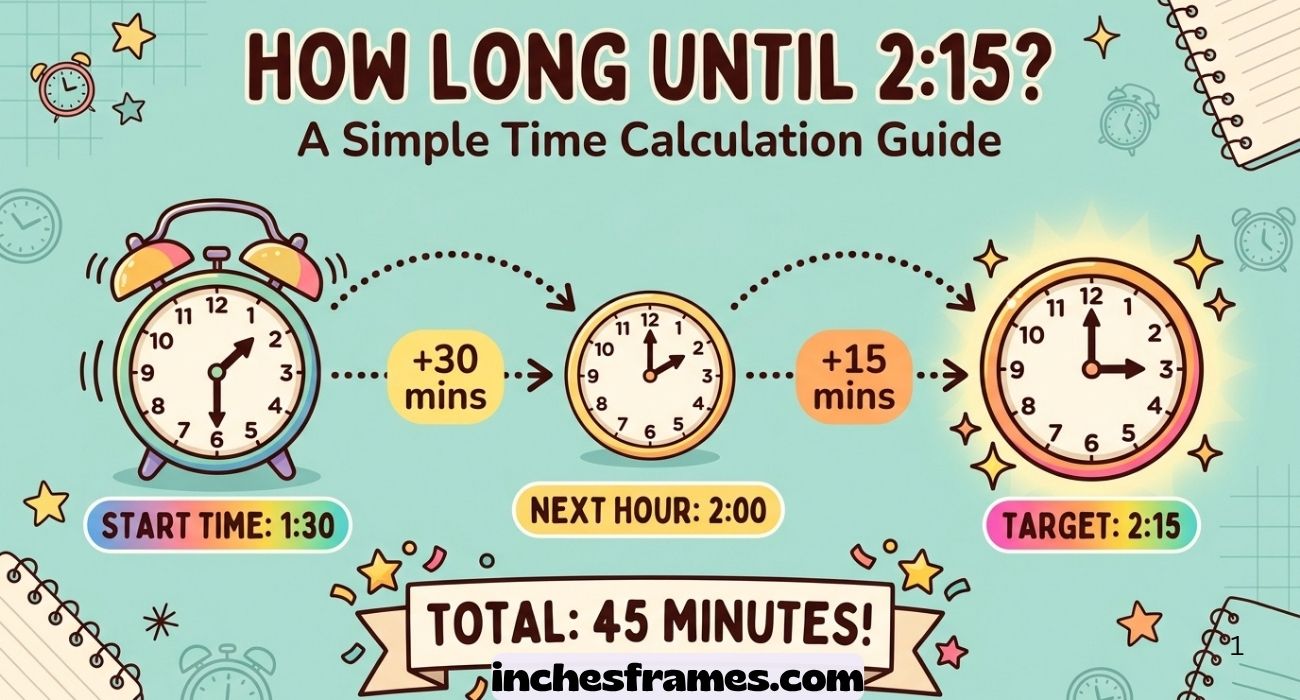
For example, if it is 1:30 PM, the time until 2:15 PM is 45 minutes. The result changes as the current time changes.
Time Remaining Until 2:15
“Time remaining until 2:15” focuses on the amount of time left before the target arrives. This phrase is useful when planning a task, waiting for an appointment, or preparing for a scheduled event.
If the current time is 2:00 PM, the remaining time until 2:15 PM is 15 minutes. Once the clock reaches 2:15 PM, no time remains before that occurrence of the target.
Countdown to 2:15
A countdown to 2:15 measures the time left before a particular clock time or event. You can calculate it manually or use a digital timer that updates the display.
A countdown is especially helpful when you need to track seconds as well as hours and minutes. For a scheduled event, make sure the countdown uses the correct date and time zone.
How Many Hours Until 2:15?
This question asks for the duration in hours, sometimes with additional minutes.
If it is 1:00 PM, the answer is 1 hour and 15 minutes. In decimal hours, this equals 1.25 hours because 15 minutes is one-quarter of an hour.
Converting the duration into hours can help with schedules and time records, but hours and minutes are usually easier to understand for everyday planning.
How Many Minutes Until 2:15?
To calculate the total number of minutes, multiply the number of complete hours by 60 and add any remaining minutes.
For example, if the current time is 1:00 PM, the remaining duration is 1 hour and 15 minutes.
60 + 15 = 75 minutes.
The same formula works for longer durations. Two hours and 15 minutes equal 135 minutes because two hours contain 120 minutes.
2:15 Countdown
A 2:15 countdown can refer to the time remaining until 2:15 AM or 2:15 PM. It can also refer to a countdown set for an event scheduled at that time.
A live countdown needs an accurate current clock and the correct target date. A manual calculation, by comparison, gives the time difference at the moment you perform it.
Related Time Terms
Several related terms help explain how time calculations work.
Time difference means the duration between two clock times. A time calculator helps determine this duration automatically. A 12-hour clock uses AM and PM, while a 24-hour clock uses hours from 00 through 23. A countdown timer tracks the time remaining before a target, and elapsed time describes how much time has passed since an event began.
Understanding these terms makes it easier to solve other time-related questions, such as how long until 3:00 PM or how many minutes remain before a deadline.
5. When to Use
Calculating how long until 2:15 can make daily planning easier. It helps you understand the time available before a commitment and decide what you can reasonably complete.
Planning a Meeting
If a meeting starts at 2:15 PM, calculating the remaining time helps you prepare beforehand. You can estimate how long you have to review notes, gather documents, or travel to the meeting location.
For example, if it is 1:45 PM, you have 30 minutes until the meeting begins. You should also allow time for travel, technical problems, or other unexpected delays.
For remote meetings, confirm the time zone used in the invitation. A meeting scheduled for 2:15 PM Eastern Time does not necessarily begin at 2:15 PM on a device set to Pacific Time.
Managing Study Time
Students can use the countdown to organize homework, revision, and scheduled classes. Knowing the available time helps them choose a realistic task instead of starting work they cannot finish before the next commitment.
If it is 1:30 PM and a study session begins at 2:15 PM, there are 45 minutes available. A student could use that period to review notes, solve practice questions, and prepare study materials.
The key is to plan around the actual time remaining rather than assuming that every minute will be available for focused work.
Waiting for an Event
A countdown can help when you are waiting for a sports broadcast, online presentation, appointment, or family event. Knowing the remaining duration makes it easier to decide when to get ready.
For example, if an online event begins at 2:15 PM and it is currently 2:00 PM, you have 15 minutes to prepare. You can use this time to open the event link and check your equipment.
If the event is listed in another time zone, convert the scheduled time to your local time before calculating the countdown.
Setting an Alarm
You may want to set an alarm for 2:15 AM or 2:15 PM. Calculating the time remaining helps you understand how long you have before the alarm sounds.
Before saving the alarm, check the AM/PM setting and confirm the intended day. An alarm set for 2:15 AM will sound at a different time from one set for 2:15 PM.
If you use a phone or digital clock, review the saved alarm rather than relying only on your mental calculation.
Managing Daily Tasks
Time calculations can help with cooking, household chores, work breaks, errands, and other daily activities. When you know how long until 2:15, you can decide which tasks fit into the available period.
For instance, if you have 45 minutes before leaving for an appointment, you might have enough time to finish a short task and prepare to leave. A longer task may need to wait until later.
A useful approach is to include a small buffer for unexpected delays. This makes your schedule more practical and reduces the risk of running late.
6. When NOT to Use
A basic time calculation works well when the starting time and target are clear. However, you should not rely on a simple calculation when important details are missing or when the clock time does not match the intended date or location.
Do Not Forget AM and PM
The time 2:15 AM refers to the early morning, while 2:15 PM refers to the afternoon. These times are separated by 12 hours.
If you need to attend an appointment at 2:15 PM but calculate the time until 2:15 AM, your result will not match the intended schedule.
Always check whether the target is in the morning or afternoon before working out the duration.
Do Not Assume the Target Is Always Today
A clock time repeats every day. If it is already 3:00 PM, the next 2:15 PM occurs tomorrow, not later today.
For example, the duration from 3:00 PM today to 2:15 PM tomorrow is 23 hours and 15 minutes. If you mean 2:15 AM tomorrow, the duration is 11 hours and 15 minutes.
If a task or event has a specific date, use that date instead of automatically choosing the next occurrence of 2:15.
Do Not Ignore Minutes
Calculating only the hour difference can produce the wrong answer. If it is 2:10 PM, the target of 2:15 PM is five minutes away, not 15 minutes away.
Similarly, when it is 1:45 PM, the remaining time is 30 minutes. Accurate results require comparing both the hour and minute values.
When a deadline is close, checking the actual clock is more reliable than estimating the time mentally.
Do Not Ignore Time Zones
The same clock time can represent different moments in different locations. For example, 2:15 PM in New York and 2:15 PM in Los Angeles do not occur simultaneously.
This matters when calculating the time until a remote meeting, flight, online class, or international event. The time difference between locations can also change when daylight saving time begins or ends.
Use the event’s stated time zone or a reliable time-zone converter when planning across locations. Your device’s local clock may display a different time from the one listed by the organizer.
7. Common Mistakes
Even a simple time calculation can become confusing when the target has already passed, the date changes, or the minutes do not match. Understanding these common mistakes helps you calculate the time until 2:15 correctly.
Mistake 1: Confusing 2:15 AM With 2:15 PM
AM and PM identify different parts of the day. Confusing them can produce an answer that is 12 hours away from the intended target.
For example, if it is 1:00 PM, only 1 hour and 15 minutes remain until 2:15 PM. The next 2:15 AM is 12 hours and 45 minutes away.
Check the target carefully before calculating the remaining time.
Mistake 2: Forgetting the Next Day
When the target time has already passed, you must decide whether to calculate toward the next occurrence or use a specified future date.
If it is 3:00 PM, the next 2:15 PM is tomorrow. The correct duration is 23 hours and 15 minutes.
To avoid mistakes, divide the calculation at midnight. First, find the time from the current clock reading to midnight. Then calculate the time from midnight to the target.
Mistake 3: Ignoring the Exact Minutes
A difference of only a few minutes can matter when preparing for a meeting or catching transportation.
If it is 1:45 PM, 30 minutes remain until 2:15 PM. If it is 2:10 PM, only five minutes remain.
Do not subtract only the hour values. Compare both hours and minutes, or count forward in manageable intervals.
Mistake 4: Counting Backward Instead of Forward
A countdown asks how much time remains before a future event. It does not ask how long ago a time occurred.
For example, if it is 1:45 PM, count forward 30 minutes to reach 2:15 PM. If you instead calculate backward from 1:45 PM, you answer a different question.
Before doing the calculation, identify whether you want the time remaining until a target or the time elapsed since an earlier event.
Mistake 5: Confusing 12 AM and 12 PM
Midnight is 12:00 AM, and noon is 12:00 PM. These labels are easy to mix up because both use the number 12.
If it is 11:00 AM, the time until 2:15 PM is 3 hours and 15 minutes. If it is 11:00 PM, the time until 2:15 AM the next day is also 3 hours and 15 minutes, but the calculation crosses midnight.
Remember that the calendar date changes at midnight, not at noon.
Mistake 6: Assuming the Answer Is Fixed
The answer to “How Long Until 2:15?” changes continuously as time passes. A calculation made at 1:00 PM will no longer be correct at 1:30 PM.
A manual result represents the time difference at a particular moment. A live countdown updates as the seconds pass, provided it uses an accurate clock and the correct target.
For the best result, refresh your calculation or use a countdown tool when timing matters.
See Also ; How Long Until 5 PM? Calculate the Exact Time Remaining
8. Comparison with Similar Terms
Questions about time can sound similar but require different calculations. Understanding the difference between a countdown, an elapsed duration, and a current-time check helps you choose the right method.
| Term | What it means | Example |
|---|---|---|
| How Long Until 2:15? | Time remaining before the intended target | At 1:45 PM, 30 minutes remain |
| Time Remaining Until 2:15 | Duration left before the target | At 2:00 PM, 15 minutes remain |
| How Many Minutes Until 2:15? | Total duration expressed in minutes | At 1:00 PM, 75 minutes remain |
| How Many Hours Until 2:15? | Duration expressed in hours and minutes | At 1:00 PM, 1 hour and 15 minutes remain |
| What Time Is It? | The current clock reading | The clock shows 1:45 PM |
| What Time Was It Two Hours Ago? | A calculation into the past | Two hours before 1:45 PM was 11:45 AM |
| How Long Has It Been? | Time elapsed since an earlier event | From 1:15 PM to 1:45 PM, 30 minutes have passed |
| Countdown Timer | A tool that tracks time remaining | A countdown showing 30 minutes until an event |
The main difference is the direction of the calculation. A countdown measures forward toward a future target, while a past-time calculation moves backward from the current time. An elapsed-time calculation measures the duration between a starting event and a later point.
For example, if it is 1:45 PM, you can calculate that 30 minutes remain until 2:15 PM. If an event started at 1:15 PM, you can also calculate that 30 minutes have already passed. The durations are equal, but the questions describe different events.
Frequently Asked Questions
How long until 2:15 PM from now?
The answer depends on your current local time. If it is 1:00 PM, 1 hour and 15 minutes remain. If it is 1:45 PM, 30 minutes remain. Check your current clock and calculate the difference to get an accurate result.
How long until 2:15 AM?
The time remaining until 2:15 AM depends on the current time and date. If it is 11:00 PM, 3 hours and 15 minutes remain until 2:15 AM the next day. If 2:15 AM has already passed, use the next occurrence or your intended future date.
How many minutes are there until 2:15?
The number of minutes depends on the starting time. From 1:00 PM to 2:15 PM, there are 75 minutes. From 2:00 PM to 2:15 PM, there are 15 minutes. Multiply complete hours by 60, then add any remaining minutes.
How do I calculate the time until 2:15 manually?
Identify the current time and confirm whether the target is 2:15 AM or 2:15 PM. Then count forward to the target, accounting for the minutes and any change of date at midnight. Convert hours to minutes by multiplying the hours by 60.
What if it is already past 2:15?
If 2:15 has passed, determine whether you mean the next occurrence or a specific future date. For example, if it is 3:00 PM, the next 2:15 PM is 23 hours and 15 minutes away. The next 2:15 AM is 11 hours and 15 minutes away.
Does the countdown to 2:15 change every minute?
Yes. The remaining duration decreases as time passes. A manual calculation gives the answer for the moment you check it, while a live countdown can update every second. Its accuracy depends on the clock, target date, and time zone being correct.
How do time zones affect the countdown to 2:15?
Time zones affect the countdown when the target refers to an event in another location. An event scheduled for 2:15 PM in one US time zone may occur at a different local clock time elsewhere. Confirm the event’s time zone and date before calculating the duration.
Is 2:15 the same time on a 12-hour and a 24-hour clock?
No. A 12-hour clock uses AM and PM to distinguish morning from afternoon. On a 24-hour clock, 2:15 AM is written as 02:15, while 2:15 PM is written as 14:15. The 24-hour format makes the intended part of the day clearer.
Conclusion
Knowing how long until 2:15 helps you plan meetings, study sessions, appointments, and everyday tasks. The exact answer depends on the current time, whether you mean 2:15 AM or 2:15 PM, and whether the target falls today or tomorrow.
To calculate the time remaining, check your clock, confirm the intended target, and count the hours and minutes between the two times. Remember that one hour contains 60 minutes and that midnight marks the start of a new calendar day. For events in another location, verify the time zone as well.
The simplest rule is to use the current time and your intended target together. That way, you can work out how long until 2:15 accurately without confusing AM and PM or overlooking the minutes.