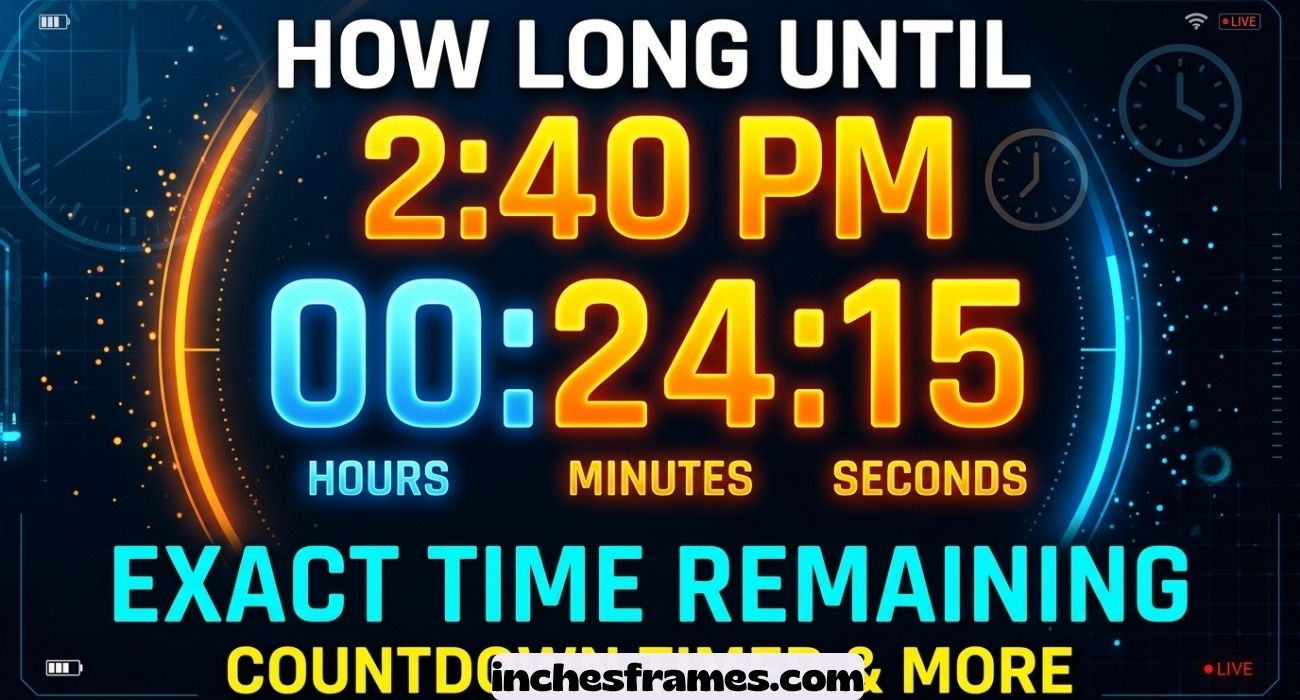
How Long Until 2:40? Countdown Timer & Exact Time Remaining
How long until 2:40? The exact time remaining depends on your current local time and whether you mean 2:40 AM or 2:40 PM. For example, if it is 1:00 PM now, you have 1 hour and 40 minutes until 2:40 PM. If it is 2:30 PM, only 10 minutes remain.
You can find the time remaining with a countdown timer, a digital clock, or a simple subtraction method. The calculation becomes slightly different when 2:40 has already passed or when your target time falls after midnight.
This guide explains how to calculate the time until 2:40 in hours, minutes, and seconds. It also covers AM and PM, 24-hour time, military time, time zones, and practical examples to help you find the correct answer.
How Long Until 2:40?
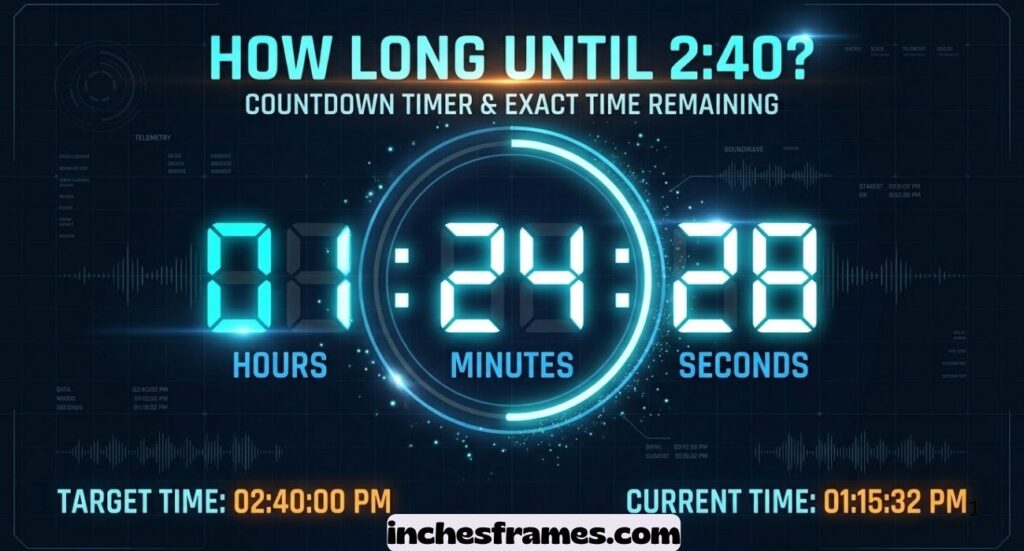
The time until 2:40 is the difference between your current local time and the next intended occurrence of 2:40. The answer changes throughout the day because every passing minute brings you closer to or farther from a different occurrence of the target time.
For example, if your current time is 12:30 PM, you have 2 hours and 10 minutes until 2:40 PM. If it is 2:15 PM, you have only 25 minutes left. If it is 3:00 PM, the afternoon target has already passed, so you must decide whether you mean the next 2:40 AM or the following 2:40 PM.
The following table shows how the countdown works for different starting times.
| Current time | Target time | Time remaining |
|---|---|---|
| 12:00 PM | 2:40 PM | 2 hours 40 minutes |
| 12:30 PM | 2:40 PM | 2 hours 10 minutes |
| 1:00 PM | 2:40 PM | 1 hour 40 minutes |
| 1:30 PM | 2:40 PM | 1 hour 10 minutes |
| 2:00 PM | 2:40 PM | 40 minutes |
| 2:15 PM | 2:40 PM | 25 minutes |
| 2:30 PM | 2:40 PM | 10 minutes |
| 2:35 PM | 2:40 PM | 5 minutes |
These examples assume that the target is 2:40 PM on the same day. If you need the exact remaining seconds, you must also know the current seconds on your clock.
How to Find the Exact Time Remaining Until 2:40
Start by checking the current time on your phone, computer, or watch. Next, decide whether your target is 2:40 AM or 2:40 PM. Subtract the current time from the target when both times fall on the same day.
For instance, if the current time is 1:45 PM, the difference between 1:45 PM and 2:40 PM is 55 minutes. You can calculate this by counting 15 minutes to 2:00 PM and another 40 minutes to 2:40 PM.
If your target is on the following day, include the time remaining until midnight and then add the time from midnight to 2:40 AM. This prevents errors when calculating an overnight countdown.
What Determines the Countdown to 2:40?
Three main factors determine the answer: your current time, the selected AM or PM period, and the date of the next target. Your time zone also matters when you are counting down to an event scheduled in another location.
A reliable countdown timer should use the correct local time and update automatically. A manual calculation works just as well when you know the current time and only need a quick answer.
What Does 2:40 Mean?
The time 2:40 means 40 minutes past the second hour of a 12-hour clock period. Depending on the AM or PM label, it represents either an early-morning time or an afternoon time.
On an analog clock, the minute hand points to the 8 because each number represents five minutes. The hour hand sits between 2 and 3 because the hour has already progressed by 40 minutes.
On a digital clock, the time appears as 2:40, often followed by AM or PM. The label matters because a standard 12-hour clock repeats its hour numbers twice during a full day.
Understanding 2:40 on a 12-Hour Clock
A 12-hour clock divides the day into two periods. AM covers the time from midnight until just before noon, while PM covers the time from noon until just before the next midnight.
Therefore, 2:40 AM occurs during the early morning, while 2:40 PM occurs during the afternoon. Both times have the same hour and minute numbers, but they refer to different moments.
Understanding this distinction helps you calculate the correct time difference. Without the AM or PM label, you may accidentally count toward the wrong occurrence of 2:40.
Why People Search for How Long Until 2:40
People often need to know the time remaining before a planned activity. A student might want to know how long until an afternoon class ends, while an employee may need to prepare for a meeting that begins at 2:40 PM.
The same calculation can help with travel planning, cooking, scheduled breaks, appointments, and personal routines. It can also help someone working overnight determine how much time remains before an early-morning deadline.
The purpose is simple: knowing the exact duration helps you organize the time available instead of repeatedly checking the clock.
How to Calculate How Long Until 2:40
You can calculate the time until 2:40 by subtracting the current time from the target time. When the target occurs later on the same day, ordinary time subtraction is enough. When the target falls on the next day, you must account for midnight.
Consider a current time of 1:15 PM and a target of 2:40 PM. From 1:15 PM to 2:15 PM is one hour. From 2:15 PM to 2:40 PM is another 25 minutes. The total remaining time is 1 hour and 25 minutes.
This method works because you can divide the calculation into smaller intervals that are easy to count.
Step-by-Step Calculation Example
Suppose you want to find how long until 2:40 PM when the current time is 12:50 PM.
First, calculate the time from 12:50 PM to 1:00 PM. That takes 10 minutes. Then calculate the time from 1:00 PM to 2:00 PM, which takes one hour. Finally, add the 40 minutes from 2:00 PM to 2:40 PM.
The total is 10 + 60 + 40 = 110 minutes, or 1 hour and 50 minutes.
Breaking the calculation into smaller parts makes it easier to check your answer and reduces mistakes when the current time includes an unusual number of minutes.
Calculate the Difference in Minutes
Another reliable approach is to convert both clock readings into minutes after midnight.
For example, 1:15 PM equals 13 hours and 15 minutes after midnight. Multiplying 13 by 60 and adding 15 gives 795 minutes. Similarly, 2:40 PM equals 14 hours and 40 minutes after midnight, which gives 880 minutes.
Subtract the current total from the target total:
880 − 795 = 85 minutes.
Since 60 minutes equal one hour, 85 minutes equals 1 hour and 25 minutes.
This approach is useful when you want to create a simple time calculator or solve more complicated time differences.
Calculate the Remaining Time When the Target Is Tomorrow
Suppose it is 10:00 PM, and you want to know how long until 2:40 AM the following day.
From 10:00 PM to midnight, two hours remain. From midnight to 2:40 AM, another two hours and 40 minutes remain. Add the two intervals to get 4 hours and 40 minutes.
You can also calculate this using minutes. The first interval is 120 minutes, and the second is 160 minutes. Together, they equal 280 minutes, which converts to 4 hours and 40 minutes.
The key is to treat midnight as the boundary between two calendar days rather than subtracting the clock readings as if they belonged to the same day.
How Many Hours Until 2:40?
The number of hours until 2:40 depends on the current time. You can express the result as whole hours and minutes or as decimal hours when you need a numerical duration for scheduling or calculations.
For example, if it is 12:00 PM, there are 2 hours and 40 minutes until 2:40 PM. If it is 1:00 PM, there are 1 hour and 40 minutes left. At 2:00 PM, the remaining duration is only 40 minutes.
| Current time | Target time | Hours and minutes remaining |
|---|---|---|
| 11:00 AM | 2:40 PM | 3 hours 40 minutes |
| 12:00 PM | 2:40 PM | 2 hours 40 minutes |
| 1:00 PM | 2:40 PM | 1 hour 40 minutes |
| 1:30 PM | 2:40 PM | 1 hour 10 minutes |
| 2:00 PM | 2:40 PM | 40 minutes |
| 2:20 PM | 2:40 PM | 20 minutes |
Convert the Remaining Time Into Decimal Hours
Decimal hours express a duration as a single number instead of separating hours and minutes. To calculate decimal hours, divide the number of minutes by 60.
For example, 30 minutes equals 0.5 hours, while 15 minutes equals 0.25 hours. If you have 1 hour and 30 minutes remaining, the total is 1.5 hours.
The same method applies to the time until 2:40. If 90 minutes remain, you can express the duration as 1.5 hours. If 40 minutes remain, divide 40 by 60 to get approximately 0.67 hours.
Decimal hours are helpful for work schedules, timesheets, project planning, and other situations where you need a duration in numerical form.
See Also : How Long Until 5 PM? Calculate the Exact Time Remaining
How Many Minutes Until 2:40?
To calculate the number of minutes until 2:40, convert any remaining hours into minutes and add the remaining minutes. Because one hour contains 60 minutes, the calculation is straightforward.
For example, if the current time is 1:40 PM, exactly 60 minutes remain until 2:40 PM. If it is 2:10 PM, only 30 minutes remain. At 2:35 PM, the countdown has reached its final five minutes.
The table below provides quick examples for the final hour before 2:40 PM.
| Current time | Target time | Minutes remaining |
|---|---|---|
| 1:40 PM | 2:40 PM | 60 |
| 1:50 PM | 2:40 PM | 50 |
| 2:00 PM | 2:40 PM | 40 |
| 2:10 PM | 2:40 PM | 30 |
| 2:15 PM | 2:40 PM | 25 |
| 2:20 PM | 2:40 PM | 20 |
| 2:30 PM | 2:40 PM | 10 |
| 2:35 PM | 2:40 PM | 5 |
Why Minute-Based Countdown Calculations Matter
Minutes are often the most useful unit when an event is close. If a meeting begins in 20 minutes, knowing the number of minutes remaining is more practical than expressing the answer as a fraction of an hour.
Minute-based calculations also help with short study sessions, kitchen timers, exercise intervals, and scheduled breaks. They give you a clear view of how much time is available for a task.
If the event is more than an hour away, combine hours and minutes for easier reading. For example, 100 minutes equals 1 hour and 40 minutes.
How Many Seconds Until 2:40?
The number of seconds until 2:40 depends on the current time down to the second. One minute contains 60 seconds, and one hour contains 3,600 seconds.
If the current time is exactly 2:39:00 PM, there are 60 seconds until 2:40:00 PM. If it is 2:39:30 PM, there are only 30 seconds remaining.
For longer intervals, convert hours and minutes into seconds and add the results. For example, 10 minutes equals 600 seconds, while 1 hour equals 3,600 seconds.
Formula for Calculating Seconds Until 2:40
Use the following formula when you know the remaining hours, minutes, and seconds:
Total seconds = (hours × 3,600) + (minutes × 60) + seconds
Suppose you have 1 hour, 20 minutes, and 15 seconds remaining. The calculation is 3,600 + 1,200 + 15, which equals 4,815 seconds.
This formula works for any positive duration. If the target time is on the following day, first calculate the correct duration across midnight, then convert that duration into seconds.
Example of a Seconds Countdown
Imagine a clock showing 2:39:45 PM. The target is 2:40:00 PM, so only 15 seconds remain.
A live countdown timer can display those final seconds automatically. However, the timer must use an accurate clock and the correct target time to show a reliable result.
For the best accuracy, use a timer that updates continuously rather than relying on a manually written estimate that becomes outdated as time passes.
2:40 AM vs. 2:40 PM
The main difference between 2:40 AM and 2:40 PM is the time of day. The AM version occurs during the early morning, while the PM version occurs in the afternoon.
This difference changes the countdown considerably. If it is 1:00 PM, the time remaining until 2:40 PM is 1 hour and 40 minutes. However, the next 2:40 AM occurs 13 hours and 40 minutes later.
Both calculations are correct because they use different target times.
What Does 2:40 AM Mean?
2:40 AM occurs 40 minutes after 2:00 AM. It falls in the early morning and may be relevant to overnight work, travel, sleep schedules, or other activities that continue past midnight.
If it is 10:00 PM and your target is 2:40 AM tomorrow, you have 4 hours and 40 minutes remaining. If it is 2:00 AM, only 40 minutes remain.
When calculating a morning target, always check the date. A target of 2:40 AM may refer to the current day or the next day, depending on the current time.
What Does 2:40 PM Mean?
2:40 PM occurs in the afternoon, 40 minutes after 2:00 PM. People may use this time for appointments, classes, work meetings, scheduled breaks, or other daytime activities.
If the current time is 1:20 PM, there are 80 minutes until 2:40 PM. If the current time is 2:25 PM, the remaining duration is 15 minutes.
These examples show why checking the current time before calculating is essential. The closer the current time gets to the target, the shorter the countdown becomes.
Which 2:40 Should You Choose?
Choose 2:40 AM when your intended event occurs in the early morning and 2:40 PM when it occurs in the afternoon. If you are using a timer or scheduling an event, confirm that the AM or PM setting matches your plan.
If the selected time has already passed, determine whether you want the next occurrence or the amount of time since the previous one. This small check helps prevent errors in reminders and schedules.
2:40 PM in 24-Hour Time
In the 24-hour clock system, 2:40 PM is written as 14:40. This system numbers the hours from 00 through 23, so it does not require AM or PM to distinguish morning from afternoon.
To convert 2:40 PM, add 12 to the hour because the time falls in the afternoon. The hour becomes 14, while the minutes remain 40. The final result is 14:40.
The 24-hour format is useful for timetables, digital schedules, travel information, and systems that need to distinguish times clearly.
Convert 2:40 PM to 24-Hour Time
The conversion follows a simple process. Start with 2:40 PM, add 12 to the hour, and keep the minutes unchanged.
The calculation is:
2 + 12 = 14.
Therefore, 2:40 PM becomes 14:40.
Morning times generally keep their hour number, with a leading zero added when needed. For example, 2:40 AM becomes 02:40, while 9:15 AM becomes 09:15.
Difference Between 2:40 PM and 14:40
There is no difference in the actual moment represented by 2:40 PM and 14:40. They are two ways to write the same time.
The 12-hour format uses AM and PM labels, while the 24-hour format uses a different number for each hour of the day. This makes 24-hour time useful when a schedule must be clear without additional labels.
| 12-hour time | 24-hour time |
|---|---|
| 1:00 PM | 13:00 |
| 2:00 PM | 14:00 |
| 2:40 PM | 14:40 |
| 3:00 PM | 15:00 |
| 8:30 PM | 20:30 |
2:40 PM in Military Time
Military time uses the 24-hour clock to identify times without AM or PM. Under this system, 2:40 PM is written as 1440 when the colon is omitted.
The time may also appear as 14:40 in ordinary 24-hour notation. Both forms represent the same time of day, although the format used depends on the schedule or organization.
Military time helps avoid confusion when people need to distinguish morning, afternoon, and overnight events.
How to Write 2:40 PM in Military Time
To convert 2:40 PM to military time, add 12 to the hour and keep the minutes unchanged. This produces 14:40, which becomes 1440 when written without a colon.
The spoken form is commonly expressed as “fourteen forty.” Some military contexts use the word “hours” when reading the time aloud.
The important point is that the hour is 14, not 2, because the target occurs in the afternoon.
Is 2:40 AM Also Military Time?
Yes. The military-time equivalent of 2:40 AM is 0240. The leading zero indicates that the hour occurs before 10:00 AM.
Compare the two forms: 0240 represents 2:40 AM, while 1440 represents 2:40 PM. Using four digits makes the difference clear without an AM or PM label.
How Long Until 2:40 From Different Times?
The easiest way to understand a countdown is to compare different starting times with the same target. The examples below assume that the target is 2:40 PM on the same day, except where the next morning is specifically mentioned.
How Long Until 2:40 From 12:00 PM?
From 12:00 PM to 2:40 PM, the remaining time is 2 hours and 40 minutes. Noon marks the start of the afternoon period, so the full interval can be divided into two hours and another 40 minutes.
In total, the duration is 160 minutes or 9,600 seconds.
How Long Until 2:40 From 1:00 PM?
From 1:00 PM to 2:40 PM, the remaining time is 1 hour and 40 minutes. One hour takes you to 2:00 PM, and another 40 minutes takes you to the target.
This equals 100 minutes or 6,000 seconds.
How Long Until 2:40 From 2:00 PM?
From 2:00 PM to 2:40 PM, exactly 40 minutes remain. The calculation requires no hour conversion because both times fall within the same hour.
Forty minutes equals 2,400 seconds.
How Long Until 2:40 From 2:30 PM?
From 2:30 PM to 2:40 PM, only 10 minutes remain. This is a short countdown that may be useful when preparing to leave for an appointment or join a scheduled meeting.
Ten minutes equals 600 seconds.
How Long Until 2:40 From 10:00 PM?
If it is 10:00 PM and you mean 2:40 AM the next day, the answer is 4 hours and 40 minutes. Two hours remain until midnight, followed by another 2 hours and 40 minutes until the target.
The duration equals 280 minutes or 16,800 seconds. This example also shows why you must account for the change in date when the countdown crosses midnight.
What If 2:40 Has Already Passed?
If the intended 2:40 has already passed, the correct answer depends on what you want to measure. You may want to know how long ago the target occurred, or you may want to count down to the next 2:40.
For example, if the current time is 3:10 PM, 2:40 PM was 30 minutes ago. If you want the next 2:40 AM, however, you must calculate the time from 3:10 PM through midnight and into the following morning.
These are two different questions, so it helps to identify the intended result before doing the calculation.
Calculate the Time Until the Next 2:40
To find the next occurrence, compare the current time with both daily targets. If it is before 2:40 PM, you can count down to that afternoon target. If it is later than 2:40 PM, the next occurrence is 2:40 AM the following day.
If it is already later than 2:40 AM but earlier than 2:40 PM, the next occurrence is normally 2:40 PM on the same day.
This method avoids negative countdowns and ensures that the target is a future time.
Calculate How Long Ago 2:40 Was
To find how long ago 2:40 occurred, subtract the target from the current time when both readings belong to the same day.
For example, if the current time is 3:10 PM, subtract 2:40 PM from 3:10 PM. The difference is 30 minutes.
If the calculation crosses midnight, include the time from the earlier target to midnight and then add the time from midnight to the current reading. This gives the total elapsed duration across both dates.
Why Does the Time Zone Matter?
A time zone determines the local clock time used in a particular region. Because different locations can have different local times at the same moment, the countdown to a local event may vary depending on where you are.
For example, if an event is scheduled for 2:40 PM Eastern Time, someone in another US time zone must convert that event to their local time before calculating the remaining duration. A clock showing 2:40 PM in one location does not necessarily mean that the event is beginning in another.
When you use an online timer, confirm whether it follows your device’s local time or a specified event time zone.
Calculating Until 2:40 in Different US Time Zones
The main US time zones include Eastern, Central, Mountain, and Pacific. Their local clock readings differ, so a scheduled event at 2:40 PM in one zone occurs at a different local clock time in another.
For instance, when the relevant locations are observing their usual standard or daylight time schedules, Eastern Time is three hours ahead of Pacific Time. An event at 2:40 PM Eastern Time therefore corresponds to 11:40 AM Pacific Time on the same date.
The exact conversion should account for the date because daylight saving rules and local exceptions can affect the offset. For appointments, online meetings, and travel plans, use the event’s stated time zone rather than assuming that every location follows the same clock.
Daylight Saving Time and the 2:40 Countdown
Many US locations move their clocks forward in spring and back in fall. These changes affect local clock readings and can change the length of an overnight interval.
A target of 2:40 AM deserves special care on a daylight saving transition date. Depending on the location and date, a local clock time may be skipped or an hour may repeat. A countdown across such a transition may therefore differ from a calculation that assumes every day has exactly 24 hours.
For ordinary same-day calculations, simply subtracting the displayed times is usually sufficient. For overnight events around a clock change, use a calendar or timer that accounts for the correct time zone and date.
Why Use a 2:40 Countdown Timer?
A countdown timer shows how much time remains until a selected target. Instead of repeatedly checking a clock and subtracting the minutes, you can use a timer to display the remaining hours, minutes, and seconds.
A 2:40 countdown timer is useful when you need a clear view of the time left before an event. It can support study sessions, work breaks, appointments, cooking schedules, and other daily tasks.
For the timer to be useful, its target must be set correctly. Make sure you select AM or PM and check whether the timer uses your local time zone.
Benefits of a Live 2:40 Countdown Timer
A live countdown updates automatically as time passes. This makes it easier to see whether you have 30 minutes, 10 minutes, or only a few seconds left before the target.
It also reduces the need for repeated manual calculations. When a timer uses the correct clock and target date, it can provide a convenient display of the remaining duration.
However, a countdown is not a substitute for checking an event’s actual schedule. If a meeting time changes or a device clock is incorrect, the timer may no longer reflect the intended event.
Who Can Benefit From a 2:40 Timer?
Students can use a countdown to prepare for classes, organize study sessions, or plan breaks. Employees may use it to track time before a meeting, shift change, or scheduled task.
Travelers can calculate the time remaining before a departure, while people at home can use a timer for cooking and everyday routines. Anyone who needs to plan around a specific time can benefit from seeing the duration clearly.
For a one-time calculation, manual subtraction may be enough. For a countdown that changes every second, an automatic timer is more convenient.
Simple Formula for a 2:40 Countdown
The basic formula for calculating the time remaining is:
Time remaining = Target time − Current time
This formula works directly when the target comes after the current time on the same day. If the target has passed and you mean the next occurrence, you must account for the next day.
For example, if the current time is 1:20 PM and the target is 2:40 PM, the remaining time is 1 hour and 20 minutes.
Formula Using Minutes After Midnight
You can make the calculation easier by converting both clock readings into minutes after midnight.
For a time expressed in the 24-hour format, use this formula:
Minutes after midnight = (hour × 60) + minutes
For example, 1:20 PM is 13:20. Its total is (13 × 60) + 20 = 800 minutes. The target of 2:40 PM is 14:40, giving (14 × 60) + 40 = 880 minutes.
Subtract the two totals:
880 − 800 = 80 minutes.
The result is 1 hour and 20 minutes.
If the target is on the following day, add 1,440 minutes to the target total before subtracting the current total, or calculate the intervals on each side of midnight separately. There are 1,440 minutes in a standard 24-hour day.
Example of the Formula in Practice
Suppose the current time is 11:50 AM and the target is 2:40 PM.
Convert 11:50 AM into minutes after midnight: (11 × 60) + 50 = 710 minutes.
Convert 2:40 PM into minutes after midnight: (14 × 60) + 40 = 880 minutes.
Subtract the current total from the target total: 880 − 710 = 170 minutes.
Since 170 minutes equals 2 hours and 50 minutes, the final answer is 2 hours and 50 minutes until 2:40 PM.
This method works well for manual calculations and simple time calculators because it turns clock readings into ordinary numbers.
See Also ; How Long Until 12 PM? Simple Time Calculation Guide
Common Mistakes When Calculating Until 2:40
Time calculations can become confusing when people mix up AM and PM, overlook midnight, or subtract minutes incorrectly. A small mistake can produce a countdown that is too long or too short.
The best approach is to check the current time, confirm the target, and keep the calculation in one consistent format.
Confusing 2:40 AM With 2:40 PM
The 12-hour clock uses the same numbers for morning and afternoon. If you forget the AM or PM label, you may count down to the wrong time.
For example, at 1:00 PM, the time remaining until 2:40 PM is 1 hour and 40 minutes. The time remaining until 2:40 AM the following day is 13 hours and 40 minutes.
Always confirm the intended part of the day before calculating.
Forgetting to Account for Midnight
Midnight marks the change from one calendar day to the next. If the current time is 10:00 PM and the target is 2:40 AM tomorrow, simply subtracting the displayed hour numbers will not produce the correct result.
Instead, calculate two intervals: from 10:00 PM to midnight, then from midnight to 2:40 AM. Adding these intervals gives 4 hours and 40 minutes.
Miscalculating Minutes and Seconds
The clock uses 60 minutes per hour and 60 seconds per minute. It does not use 100 minutes per hour.
For example, 1 hour and 40 minutes equals 100 minutes, not 140 minutes. Likewise, 90 minutes equals 1 hour and 30 minutes.
Convert all values into minutes or seconds when you need to compare durations. This makes the calculation easier to check.
Ignoring Time Zones
A countdown to a local event can be wrong if you use a clock from another time zone. This is especially relevant for online meetings, flight schedules, and appointments involving people in different regions.
Check whether the event uses your local time or another location’s time. If necessary, convert the event time first and then calculate the remaining duration.
Quick Reference for 2:40
The following table summarizes the main time formats and duration conversions associated with 2:40. These values remain the same regardless of your current time, although the countdown to the next occurrence changes throughout the day.
| Time format or measurement | Equivalent |
|---|---|
| 2:40 AM in 24-hour time | 02:40 |
| 2:40 PM in 24-hour time | 14:40 |
| 2:40 PM in military time | 1440 |
| 2 hours and 40 minutes | 160 minutes |
| 2 hours and 40 minutes | 9,600 seconds |
| 1 hour | 60 minutes |
| 1 minute | 60 seconds |
| 90 minutes | 1 hour 30 minutes |
Quick Tips for Finding the Exact Time Remaining
Check your current local time first, then choose whether the target is 2:40 AM or 2:40 PM. Subtract the current time from the target when both fall on the same day.
If the target is on the following day, include the interval across midnight. For a countdown that displays seconds and updates automatically, use a timer that follows the correct clock and time zone.
These steps provide a simple way to find the correct answer without relying on guesswork.
Frequently Asked Questions
How long until 2:40 PM if it is 2:15 PM now?
There are 25 minutes until 2:40 PM. From 2:15 PM to 2:40 PM, the minute hand advances by 25 minutes.
How long until 2:40 AM from 10:00 PM?
There are 4 hours and 40 minutes until 2:40 AM the following day. Two hours pass before midnight, followed by another 2 hours and 40 minutes.
How many minutes are in 2 hours and 40 minutes?
Two hours and 40 minutes equal 160 minutes. Multiply two hours by 60 to get 120 minutes, then add the remaining 40 minutes.
How many seconds are in 2 hours and 40 minutes?
Two hours and 40 minutes equal 9,600 seconds. Two hours contain 7,200 seconds, and 40 minutes contain 2,400 seconds. Together, they total 9,600 seconds.
What is 2:40 PM in military time?
2:40 PM is written as 1440 in military time or 14:40 in standard 24-hour notation. Both forms represent the same afternoon time.
What is 2:40 AM in 24-hour time?
2:40 AM becomes 02:40 in the 24-hour clock system. The leading zero shows that the time occurs before 10:00 AM.
Can I calculate the exact seconds until 2:40?
Yes. You need the current time down to the second and the correct target time. Subtract the current timestamp from the target timestamp, accounting for the date and time zone when necessary.
Does the time until 2:40 change by location?
Yes, when the target refers to a local clock time. Different time zones have different local clock readings at the same moment, so the countdown to 2:40 in one location may differ from the countdown in another.
Conclusion
Finding how long until 2:40 is simple when you know the current time and the intended target. Subtract the current time from 2:40 to find the remaining hours and minutes, or convert the duration into seconds for a more detailed calculation.
Always distinguish between 2:40 AM and 2:40 PM, and account for midnight when the target falls on the next day. If you need a constantly updated result, a reliable countdown timer can display the exact remaining time using the correct local clock.