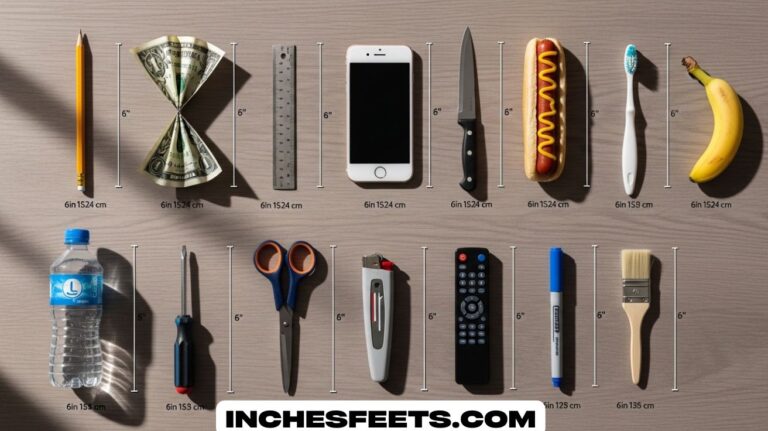
How Long Is 7 Inches? 12 Things That Are 7 Inches Long
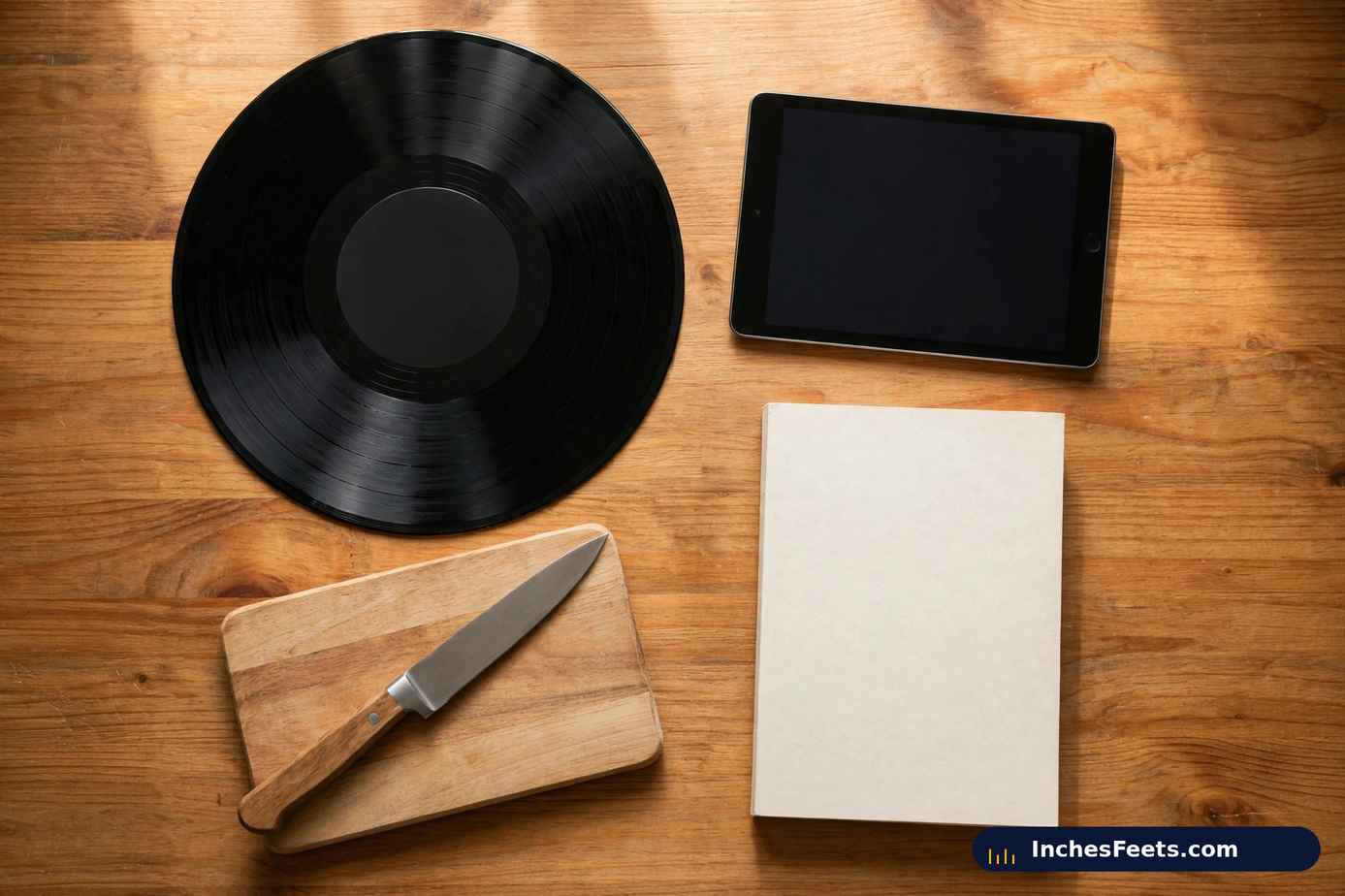
Looking for things that are 7 inches long? Start with the number itself: 7 inches is exactly 17.78 centimeters — 177.8 millimeters, or just over half a foot (0.5833 ft). It is the diameter of a vinyl single, the height of a mass-market paperback stood upright, and the span of two playing cards laid end to end.
Seven inches is a hand-scale measurement, which is exactly why the internet’s lists for it go wrong. The two most repeated examples — a standard pencil and a U.S. dollar bill — both fail a tape measure: the pencil is 7.5 inches long and the bill is 6.14. Both stay in this guide, with their real sizes printed beside them.
Below are 12 things that genuinely measure 7 inches, each checked against a maker’s specification, an official standard or a published size chart. Every example states its basis at the end of its section, so you can see exactly what was counted and what was not.
How Long Is 7 Inches?
Seven inches sits in an awkward gap: bigger than the things in your pocket, smaller than the things on your shelves. The fastest anchor is a standard 12-inch ruler — 7 inches is a little over half of one, ending an inch past the halfway mark. Against your own body it is closer still: measured hand length, wrist crease to middle fingertip, has a survey median of 7.1 inches for adult women, so 7 inches is, to within a tenth of an inch, the length of an average woman’s hand. In the kitchen it is about one and a half standard soda cans stacked (a 12 oz can stands 4.83 inches tall), and at a desk it is a paperback’s height or a small tablet’s long side.
| Unit | Equivalent of 7 Inches |
|---|---|
| Centimeters | 17.78 cm |
| Millimeters | 177.8 mm |
| Feet | 0.5833 ft |
| Yards | 0.1944 yd |
| Meters | 0.1778 m |
7 Inches at a Glance: The Verified List
- An Amazon Fire 7 tablet (7.11 inches on its long side — disclosed in its section)
- A 7-inch santoku knife blade (the kitchen knife blade, exact on maker specs)
- A mass-market paperback’s height (the standard 4.25 × 7 inch trim)
- A standard invitation card’s long side (the 5 × 7 inch standard)
- A 7-inch vinyl record (the 45 — exactly 7 inches across)
- A Kindle Paperwhite (6.96 inches tall — disclosed in its section)
- Two playing cards end to end (2 × 3.5 inches, exactly)
- A Churchill cigar (the 7 inch × 47 ring vitola standard)
- A 7-inch round cake pan (7-inch baking diameter on the maker’s spec)
- A 7-inch embroidery hoop (a standard stocked hoop size)
- A 7-inch cable tie (the trade size, 180 mm on the spec sheet — disclosed)
- Two U.S. business cards end to end (2 × 3.5 inches, exactly)
Every item on this list is checked in its own section below. The claims that did not survive checking stay in the article too, with their real measurements printed beside them — a standard pencil at 7.5 inches and a dollar bill at 6.14 inches are the two you will meet everywhere else.
Things That Are 7 Inches Long
Amazon Fire 7 Tablet
The competitor’s lead example survives, but only just, and only with its real figure printed. The “7” in Fire 7 names the screen class: a 7-inch, 1024 × 600 display. The tablet itself — the current 12th-generation model, released in 2022 — measures 7.11 × 4.63 × 0.38 inches (180.68 mm on its long side) in Amazon’s own specification, so the device in your hand is a tenth of an inch longer than the number in its name. Amazon’s spec also corrects the competitor’s battery line: he prints “up to seven hours,” which was the 2019 model’s figure; the current model’s rated battery life is up to 10 hours. Count the tablet on its long side, with the 0.11-inch difference stated, and it earns its place.
Counted: with disclosure — the current Fire 7’s body measures 7.11 inches long on Amazon’s spec sheet; the 7 in its name is the display class.
A Standard Pencil
This is the most repeated claim on the internet for this measurement, and it is wrong by half an inch. A standard unsharpened #2 hexagonal pencil measures 7.5 inches (19 cm) long, not 7 — a figure the competitor’s own FAQ prints (“a common pencil is usually around 7.5 inches long”) directly against his body text, which calls the same pencil 7 inches. The FAQ is the one that is right. Sharpen the pencil and it only gets shorter and less standard, so there is no reading of “standard pencil” that lands on 7 inches. Keep the example — it is the comparison everyone reaches for — but print its real size: half an inch over.
Not counted: a standard unsharpened pencil is 7.5 inches long — half an inch too long, as the competitor’s own FAQ admits.
U.S. Dollar Bill
The dollar bill fails in the other direction. United States currency is printed to a fixed Bureau of Engraving and Printing size: 6.14 inches long by 2.61 inches wide. That is 0.86 inches short of 7 — close enough to fool an eyeball estimate, nowhere near close enough to count. The competitor’s own text concedes the point mid-paragraph (“not exactly 7 inches”) while still listing the bill among his 7-inch things. A bill is a fine pocket reference for six inches and a bit; for seven it needs a partner it does not have — two bills laid by their widths make only 5.22 inches.
Not counted: a U.S. dollar bill measures 6.14 × 2.61 inches — 0.86 inches short of 7.
Kitchen Knife Blade
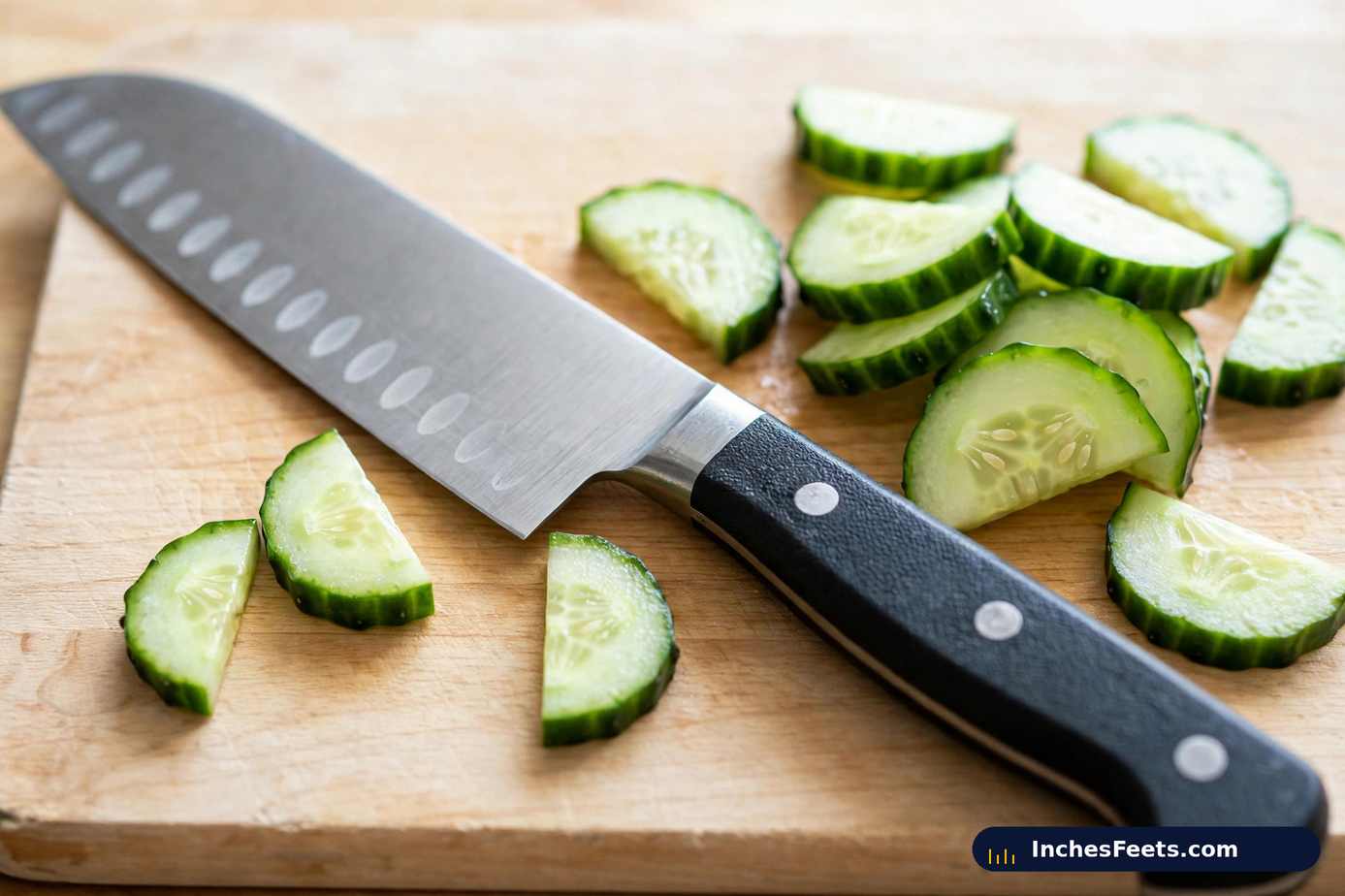
A “7-inch blade” sounds like a category too loose to verify, but one knife class is built and sold to exactly that figure: the santoku. Mercer Culinary’s Genesis 7-Inch Santoku (model M20707) lists its blade length as “7 Inches” in the maker’s own specification, and Victorinox’s Fibrox Pro 7-Inch Santoku states the same 7-inch blade. The santoku is the standard 7-inch blade of the home kitchen — shorter and lighter than an 8-inch chef’s knife, which is precisely why the size exists. The competitor’s instinct was right; it just needed a named knife and a spec sheet behind it.
Counted: exact — the standard 7-inch santoku blade class, verified on maker specifications (Mercer Culinary M20707; Victorinox Fibrox Pro 7-Inch Santoku).
Small Paperback Book Height
Paperback heights are not approximate — they are trim sizes set by the printer, and the classic mass-market trim is 4.25 × 7 inches. Barnes & Noble Press’s trim chart lists “4.25” x 7″ (Popular Mass Market paperback size),” and IngramSpark’s pocket-book trim is the same 4.25 × 7 inches (108 × 178 mm): the airport novel, the grocery-store romance, the classic Pocket Books format that settled at 7 inches tall in the 1950s. One honest caution: a 4.25 × 6.87 inch trim is also common in the same class, an eighth of an inch shorter, and the taller 5.5 × 8.5 inch books on the same shelf are trade paperbacks, a different format. On the named mass-market trim, the height is exactly 7 inches.
Counted: on the standard trim basis — the mass-market paperback trim size is 4.25 × 7 inches per publisher trim charts; the also-common 6.87-inch variant is disclosed.
Invitation Cards
The competitor’s figure for this one — invitations that “measure 7.0 × 6.0 inches” — is not a size the stationery trade sells. The standard invitation card is 5 × 7 inches (127 × 178 mm): the most common invitation size in the United States, sold by every major stationer (it is Minted’s “classic” size) and paired with the A7 envelope at 5.25 × 7.25 inches, as stationers’ size guides such as Paperlust’s set out. So the example is real, on the corrected figure: hold a standard invitation the tall way and its long side is exactly 7 inches. What does not exist is his 7 × 6 card.
Counted: on the corrected basis — the standard invitation card is 5 × 7 inches, so its long side is exactly 7 inches; the competitor’s 7.0 × 6.0 inch figure is not a standard size.
A 7-Inch Vinyl Record
The cleanest count on this page. The 45 rpm single — the format RCA Victor launched on 31 March 1949 — takes its size from a fixed standard: a diameter of 7 inches (17.8 cm). Every 45 ever pressed, from a 1950s jukebox single to a modern reissue, is built to that diameter, which is why the format is simply called “the 7-inch” in record shops. Stand one on edge and it is also a 7-inch height gauge; lay it flat and nothing about it is approximate.
Counted: exact — the 7-inch single is a fixed format standard of 7 inches (17.8 cm) in diameter.

A Kindle Paperwhite
Amazon’s current Kindle Paperwhite (12th generation, 2024) carries a 7-inch, 300 ppi display, and the device is built tight around it: 176.7 mm tall, which converts to 6.96 inches — four-hundredths of an inch under 7, a gap thinner than the bezel it sits in. Amazon’s own size line for the device rounds the figure to 5″ × 7″ × 0.3″. Counted the way this run counts disclosed near-exact devices (the Fire 7 above is its mirror image, a tenth over), the Paperwhite belongs on the list with its true figure printed: 6.96 inches tall.
Counted: with disclosure — the current Kindle Paperwhite measures 176.7 mm (6.96 inches) tall on Amazon’s specification, which Amazon itself rounds to 7 inches.

Two Playing Cards End to End
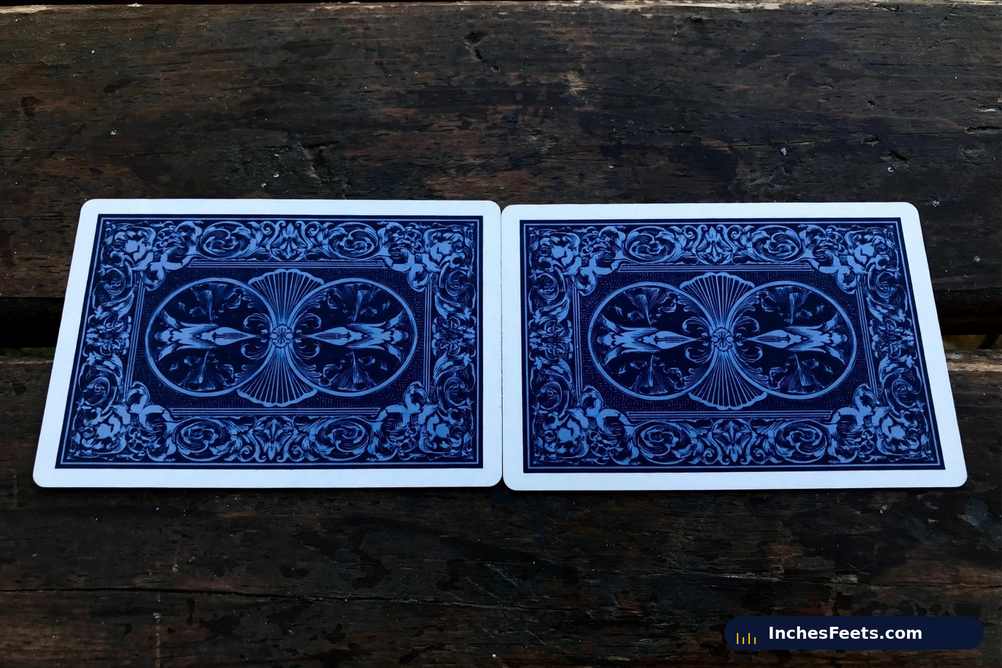
A poker-size playing card is a manufactured standard: 2.5 × 3.5 inches (63.5 × 88.9 mm), the size the United States Playing Card Company prints its Bicycle decks to. Lay two of them end to end along their long edges and the pair spans exactly 7.0 inches — no rounding, no tolerance, just 3.5 + 3.5. It is the most reliable 7-inch reference in a house with a card drawer, and it doubles as a measuring tool: one card is 3.5 inches, the pair is 7.
Counted: exact stack — two poker-size playing cards at the standard 3.5-inch length make exactly 7 inches end to end.
A Churchill Cigar
Cigar sizes are named, regulated vitolas, and the Churchill is defined by this exact length: 7 inches long by a 47 ring gauge (178 mm × 47), the standard figure in Habanos size charts. The name is earned — the format began as Romeo y Julieta’s Julieta No. 2 and took Winston Churchill’s name after his 1946 visit to the Havana factory, because it was the size he smoked. Any cigar sold as a Churchill, from any maker, is rolled to the same 7-inch standard.
Counted: exact — the Churchill vitola is a fixed standard size of 7 inches × 47 ring gauge (178 mm).
A 7-Inch Round Cake Pan
Bakeware is sold by its baking diameter, and the 7-inch round pan is a standard catalogue size. Fat Daddio’s 7-inch round cake pan (model PRD-73) states it in the maker’s own words: “Interior measures 7″ x 3″ (17.8 x 7.6 cm)” — the inside diameter, the dimension that decides the cake, is exactly 7 inches. The honest footnote is the rim: measured across the outside of the rolled edge, the same pan spans about 7.64 inches. The size name refers to the interior, as it does across the bakeware trade (this site’s 10-inch article counted Fat Daddio’s larger pan on the same basis), so the pan counts on the dimension it is sold by.
Counted: on the maker’s spec — the 7-inch round pan’s interior diameter is exactly 7 inches (17.8 cm); the wider rolled rim (≈7.64 inches overall) is disclosed.
A 7-Inch Embroidery Hoop
Embroidery hoops are made in a fixed ladder of sizes — 3, 4, 5, 6, 7, 8, 10, 12 inches — and 7 inches is a standard rung on it: hoop size charts list the 7-inch hoop at a 17.78 cm diameter, the medium size recommended for pillowcases, towels and wall art, and multi-size hoop sets are sold with the 7-inch ring as a standard member. Pick up the hoop from any standard set and its diameter is the size on the label: 7 inches.
Counted: on the standard size class — 7 inches is a standard embroidery hoop size, charted at 17.78 cm in diameter.
A 7-Inch Cable Tie
Cable ties are specified in millimetres and sold in inches, and the trade’s 7-inch size is a real catalogue line: manufacturer specification tables (for example the CHS nylon tie tables) list the 180 mm tie as the 7″ size — 4 × 180 mm, 7 inches, 40 lb loop tensile. The disclosure is in the arithmetic: 180 mm is 7.09 inches, so the tie in the bag is nine-hundredths over the number on the bag. That is the same class of rounding the Fire 7 carries in the other direction, and it is printed here for the same reason: the size class is genuinely “7-inch,” and the exact spec is 180 mm.
Counted: on the trade size, with disclosure — the standard 7-inch cable tie’s specification is 180 mm (7.09 inches), catalogued as the 7-inch size.
Two U.S. Business Cards End to End
The United States standard business card is 3.5 × 2 inches (88.9 × 50.8 mm) — the size in every printer’s size guide (VistaPrint’s guide states it outright) and the size of the card in your wallet right now. Two of them placed end to end along the long edge span exactly 7.0 inches. Between this and the playing cards above, the 3.5-inch card standard is the handiest exact route to 7 inches there is: one card, 3.5; two cards, 7.
Counted: exact stack — two U.S. standard business cards at 3.5 inches each make exactly 7 inches end to end.
How to Visualize 7 Inches
Start with your hand: the survey median for an adult woman’s hand, wrist crease to middle fingertip, is 7.1 inches, so for most women their own hand is the reference, and for most men it is their hand minus the last half-inch of middle finger. On a desk, picture a mass-market paperback stood on its spine edge, or a vinyl single — both are 7 inches without any estimating at all.
The neighbouring sizes on this site sharpen it further. If you have read how long is 8 inches, step one inch back from it: 7 inches is that page’s chef’s-knife world with an inch removed. And things that are 9 inches sits exactly two inches beyond — a 7-inch object is a 9-inch object with a playing card’s width (2.5 inches) almost, but not quite, taken away. Half of 7 inches is 3.5 inches — one playing card — and double it is 14 inches, a size with its own everyday anchors.
7 Inches Compared With Other Lengths
Against a foot, 7 inches is 58.3% of the way there — five inches short of a ruler’s full length. Against the sizes this run has already measured: it is a little over a third of 18 inches (2.57 × 7 inches makes 18), and how long is 10 inches exceeds it by exactly 3 inches — a 7-inch tablet beside a 10-inch tablet shows the gap at a glance. In metric it is 17.78 cm, close enough to 18 cm that metric packaging often rounds it there; the exact figure is the one in the table above. And against the corrected claims in this article: a dollar bill plus a playing card’s width comes to 8.64 inches — the bill alone, at 6.14, belongs to the six-inch conversation.
Conclusion
Seven inches turns out to be a size with two reputations. The famous examples mostly fail: the pencil is 7.5 inches, the dollar bill is 6.14, and the invitation card in the size usually quoted does not exist. The real list is better — a vinyl single and a Churchill cigar built to exact 7-inch standards, cards and business cards that stack to it exactly, a paperback trim and an invitation format set by the printing trade, and two Amazon devices that bracket the figure from a tenth of an inch on either side.
That is the habit worth keeping from this page: when a size is printed in a name — a 7-inch tablet, a 7-inch pan, a 7-inch santoku on a knife listing — check which dimension the number describes and what the spec sheet says beside it. The name is a starting point; the specification is the measurement.
FAQs
How Tall is 7 Inches?
7 inches is 17.78 centimeters (177.8 mm) tall — the height of a mass-market paperback or a vinyl single stood on edge, and within a tenth of an inch of the median adult woman’s hand length (7.1 inches, ANSUR II survey).
What Does 7 Inches Look Like?
Picture a 7-inch vinyl record, or two playing cards end to end. Two everyday comparisons mislead: a soda can is 4.83 inches tall, not the “about 4.5” often printed, and a standard ruler is 12 inches long, so 7 inches is a little over half a ruler — not “about a ruler.”
How Big is 7 Inches Compared to Hand?
Measured hand length (wrist crease to middle fingertip) has survey medians of 7.1 inches for women and 7.6 inches for men (ANSUR II), so 7 inches is roughly an average woman’s hand and about half an inch under an average man’s.