How Long Until 3:00 PM? Calculate the Exact Time Remaining Today
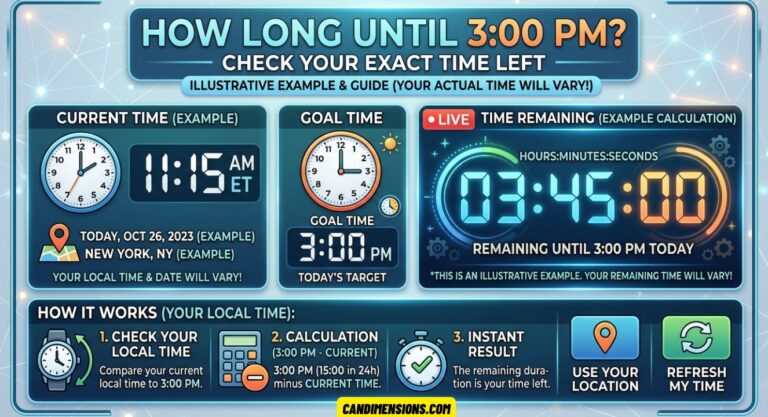
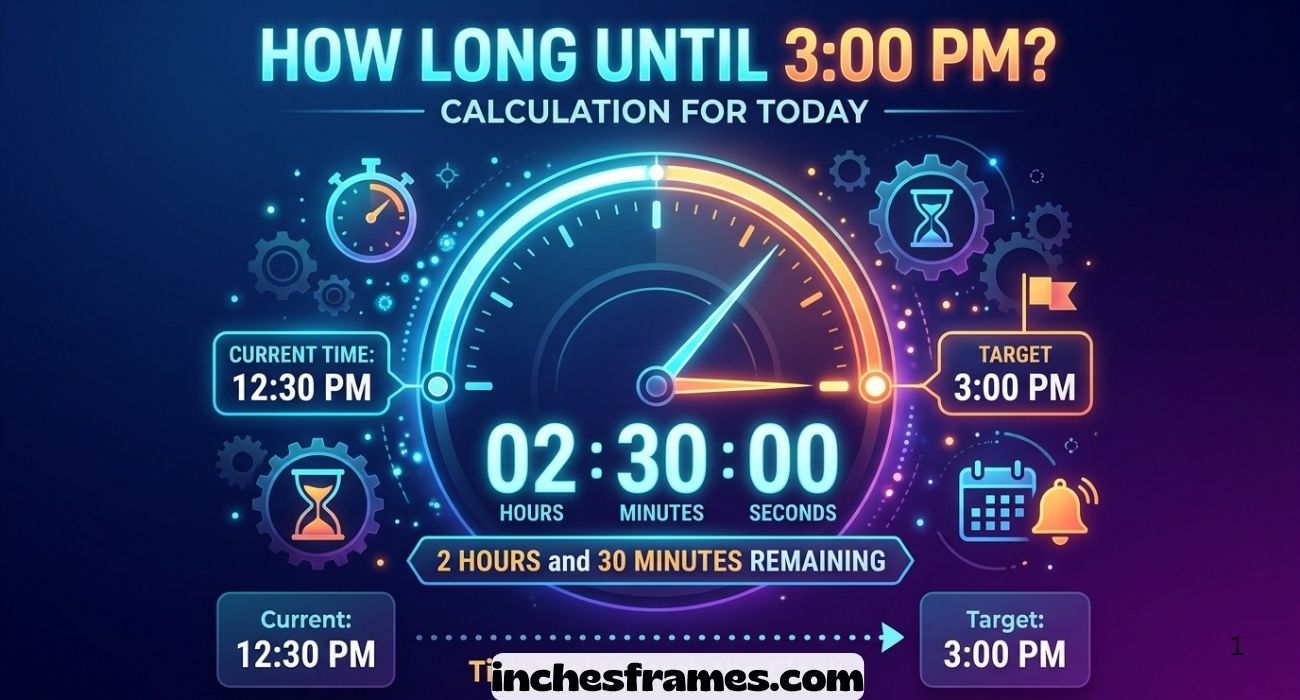
How long until 3:00 PM depends on your current local time. If it is 12:00 PM, you have 3 hours left. If it is 2:00 PM, you have 1 hour left. If it is 2:30 PM, only 30 minutes remain until 3:00 PM.
You can calculate the time remaining by subtracting the current time from 3:00 PM. A clock, online countdown timer, or time calculator can help you find the exact hours, minutes, and seconds. The countdown changes as time passes, so you should check your current local time for an accurate result.
This guide explains how to calculate the time until 3 PM, convert hours into minutes, understand different clock formats, and plan your afternoon around this common daily time.
How Long Until 3:00 PM Depends on the Current Time
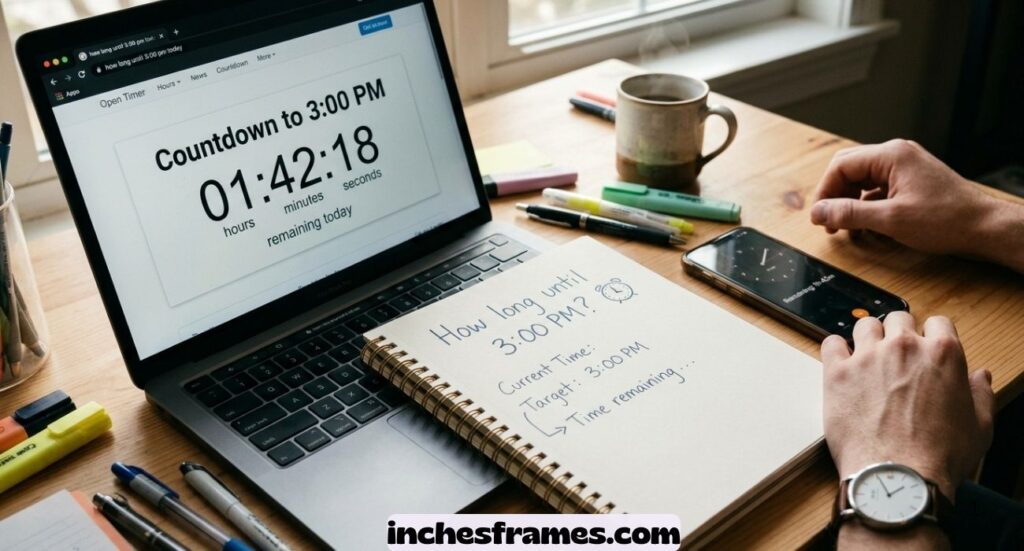
The time remaining until 3:00 PM changes throughout the day. At 9:00 AM, you have six hours left. At noon, you have three hours left. As the clock moves closer to 3 PM, the remaining time becomes shorter.
The easiest way to find the answer is to check your current time and count forward to 3:00 PM. You can also use a countdown timer to track the remaining time automatically.
For example, if your clock shows 1:20 PM, you have 40 minutes until 2:00 PM and another hour until 3:00 PM. The total remaining time is 1 hour and 40 minutes.
Examples of Time Remaining Until 3 PM
The following table shows how much time remains at different points during the day.
| Current Time | Time Until 3:00 PM |
|---|---|
| 7:00 AM | 8 hours |
| 8:00 AM | 7 hours |
| 9:00 AM | 6 hours |
| 10:00 AM | 5 hours |
| 11:00 AM | 4 hours |
| 12:00 PM | 3 hours |
| 1:00 PM | 2 hours |
| 1:30 PM | 1 hour 30 minutes |
| 2:00 PM | 1 hour |
| 2:15 PM | 45 minutes |
| 2:30 PM | 30 minutes |
| 2:45 PM | 15 minutes |
| 2:50 PM | 10 minutes |
| 2:55 PM | 5 minutes |
| 3:00 PM | 0 minutes |
These examples assume that the current time and the target time are on the same day. The exact answer will differ if the current time includes additional minutes or seconds.
What If It Is Already 3 PM?
If the current time is exactly 3:00 PM, no time remains until that day’s target. The countdown has reached zero.
If it is 3:15 PM, today’s 3 PM has already passed. If you want to know how long until the next 3:00 PM, you must calculate the time until 3 PM tomorrow. From 3:15 PM today, that duration is 23 hours and 45 minutes.
This distinction matters when you schedule reminders, appointments, work tasks, or other events. Always decide whether you mean today’s 3 PM or the next occurrence of 3 PM.
How Many Minutes Until 3 PM?
You can calculate the number of minutes remaining by converting each hour into 60 minutes.
For example, if it is 1:00 PM, two hours remain until 3 PM. Multiply 2 by 60 to get 120 minutes. If it is 2:30 PM, only 30 minutes remain.
| Current Time | Minutes Until 3 PM |
|---|---|
| 12:00 PM | 180 minutes |
| 12:30 PM | 150 minutes |
| 1:00 PM | 120 minutes |
| 1:30 PM | 90 minutes |
| 2:00 PM | 60 minutes |
| 2:15 PM | 45 minutes |
| 2:30 PM | 30 minutes |
| 2:45 PM | 15 minutes |
| 2:55 PM | 5 minutes |
This method is useful when you need to enter a duration into a timer, plan a short break, or determine how many minutes remain before a deadline.
Understanding the Time Calculation
Calculating the time until 3 PM is simple once you understand the relationship between the current time and the target time. You do not need advanced mathematics. You only need to compare the two times and calculate the difference.
The result may appear in hours and minutes, total minutes, or hours, minutes, and seconds. Each format describes the same duration in a different way.
The Simple Formula for Calculating Time Until 3 PM
The basic formula is:
Time remaining = Target time − Current time
For a target of 3:00 PM, use your current local time as the starting point and 3:00 PM as the ending point.
Suppose the current time is 12:40 PM. From 12:40 PM to 1:00 PM is 20 minutes. From 1:00 PM to 3:00 PM is another two hours. Therefore, the remaining time is 2 hours and 20 minutes.
You can apply this formula at any point before 3 PM. When the current time includes seconds, include them in the calculation if you need a precise countdown.
Step-by-Step Example of Calculating the Remaining Time
Imagine that you need to leave for an appointment at 3 PM, and your clock shows 1:35 PM.
First, calculate the time from 1:35 PM to 2:00 PM. This gives you 25 minutes. Next, calculate the time from 2:00 PM to 3:00 PM. This gives you 60 minutes.
Add the two durations together:
25 minutes + 60 minutes = 85 minutes.
Since 60 minutes equal one hour, 85 minutes equal 1 hour and 25 minutes.
This approach works well because it avoids complicated subtraction. Instead of subtracting the clock readings directly, you count forward from the current time to the target.
How to Calculate Time When the Minutes Are Different
Calculations become slightly more challenging when the current time includes minutes that do not match the target’s minutes. In these cases, counting forward to the next full hour often makes the answer easier to find.
Consider these examples:
| Current Time | Calculation | Time Remaining |
|---|---|---|
| 2:10 PM | 50 minutes to 3 PM | 50 minutes |
| 2:20 PM | 40 minutes to 3 PM | 40 minutes |
| 2:35 PM | 25 minutes to 3 PM | 25 minutes |
| 2:40 PM | 20 minutes to 3 PM | 20 minutes |
| 2:50 PM | 10 minutes to 3 PM | 10 minutes |
For a time such as 1:45 PM, first count 15 minutes to 2 PM. Then add another hour to reach 3 PM. The total is 1 hour and 15 minutes.
A common mistake is to subtract the minute values without considering the hour. Counting forward avoids this problem and makes the result easier to check.
Can You Calculate Time Without a Calculator?
Yes. You can calculate the remaining time mentally by counting forward in simple steps.
If it is 1:00 PM, count two hours to reach 3 PM. If it is 1:30 PM, add 30 minutes to reach 2 PM, then add one hour. The total is 1 hour and 30 minutes.
For times close to 3 PM, subtract the current minutes from 60. For example, 60 − 42 = 18, so 18 minutes remain when the clock shows 2:42 PM.
An online calculator becomes more useful when you are working with seconds, multiple time zones, overnight schedules, or several events.
How Long Until 3:00 PM Across Different Time Formats
The target time remains the same even when a clock displays it differently. Understanding these formats helps you read schedules, use digital devices, and avoid confusing morning and afternoon appointments.
In the United States, the 12-hour clock is common in everyday life. The 24-hour clock is also used in some professional settings, while military time is common in military operations.
12-hour Clock
The 12-hour clock divides a full day into two periods: AM and PM. Each period contains 12 hours.
AM covers the period from midnight until before noon. PM covers the period from noon until before midnight. Therefore, 3:00 PM means three hours after noon.
If the current time is 1:30 PM, the target is 90 minutes away. If the clock shows 2:45 PM, only 15 minutes remain.
Always check the AM or PM label when reading a schedule. The difference between 3:00 AM and 3:00 PM is 12 hours, so choosing the wrong period can create a major scheduling error.
24-hour Format
The 24-hour clock represents each hour of the day with a number from 00 through 23. It does not require AM or PM because each hour has its own number.
Under this system, 3:00 PM becomes 15:00. The conversion is straightforward for afternoon hours: add 12 to the hour shown on the 12-hour clock, except for 12 PM.
| 12-Hour Time | 24-Hour Time |
|---|---|
| 12:00 PM | 12:00 |
| 1:00 PM | 13:00 |
| 2:00 PM | 14:00 |
| 3:00 PM | 15:00 |
| 4:00 PM | 16:00 |
| 5:00 PM | 17:00 |
For example, if the current time is 14:20, the target time is 15:00. The difference is 40 minutes.
The 24-hour format is helpful for reading international schedules and comparing times without confusing morning and afternoon hours.
Military Time
Military time uses the 24-hour system and commonly expresses a time using four digits. In this notation, 3:00 PM is written as 1500 and is often spoken as “fifteen hundred” in military contexts.
Similarly, 1:00 PM is 1300, and 2:00 PM is 1400. Midnight is represented as 0000 in many contexts, although some organizations use 2400 to identify the end of a day.
If the current time is 1430, the remaining time until 1500 is 30 minutes. This makes military time convenient for operations that require clear and consistent schedules.
The key is to recognize that 1500 means 3 PM, not 15 hours after the current time.
See Also ; How Long Until 3:30 PM? Easy Time Calculation Guide
Why 3 PM Feels Like an Important Part of the Day
Three o’clock in the afternoon often falls between the main workday’s middle hours and the transition toward evening. For many people, it is a convenient point to check progress, complete an important task, or prepare for a scheduled activity.
Its importance depends on the person’s routine. A student may have a class ending at 3 PM, while an office worker may have a meeting or deadline at the same time. A parent may need to pick up a child, and a traveler may need to leave for an appointment.
Knowing the countdown gives you a clear time limit. If you have 45 minutes left, you can choose a task that fits that period. If you have three hours, you may have enough time for several activities.
The Middle of the Afternoon
The hours after lunch can include meetings, classes, errands, and unfinished work. Checking how long until 3 PM helps you decide what to complete before the next part of your day begins.
For example, someone with an important deadline at 3 PM can use the remaining time to finish a report, review details, and prepare the final version. A student can divide the time between studying and checking assignments.
The benefit comes from having a clear endpoint rather than treating the afternoon as an unlimited block of time.
3 PM as a Personal Deadline
A target time can turn a general intention into a specific plan. Instead of saying that you will finish a task sometime in the afternoon, you can aim to complete it by 3 PM.
This approach works best when the task has a realistic time limit. If you have 30 minutes left, choose a small, clearly defined goal. If you have two hours, you can plan a longer task with time for review.
Avoid assigning more work than the remaining time allows. A countdown should help you make better decisions, not create unnecessary pressure.
Using a Countdown Timer for Better Productivity
A countdown timer shows how much time remains before a target event. You can set it for a fixed duration based on the difference between the current time and 3 PM.
For example, if it is 1:45 PM, you can set a timer for 1 hour and 15 minutes. The timer will count down toward zero, helping you track the period without repeatedly checking the clock.
A productivity timer can also help you divide your remaining time into focused work periods and short breaks. This is useful when you have several tasks to finish before a meeting, class, or appointment.
How to Set a Countdown to 3 PM
Start by checking your current local time. Calculate the difference between that time and 3 PM, then enter the duration into a timer.
Suppose the current time is 12:50 PM. The remaining time is 2 hours and 10 minutes. Set the timer for that duration and begin your planned activities.
A duration-based timer and a clock-based alarm work differently. A countdown timer measures a period from the moment you start it. An alarm is set to ring at a particular clock time. For a deadline at exactly 3 PM, an alarm set for 3 PM may be more convenient because it follows the clock rather than relying on your manual calculation.
Break Your Remaining Time Into Smaller Tasks
You can divide the time before 3 PM into manageable blocks. If you have one hour, you might spend 40 minutes on your main task, 10 minutes reviewing your work, and 10 minutes preparing for the next activity.
This plan is only an example. Adjust the blocks according to the difficulty of your task and the time you need to prepare.
The purpose of dividing time is to make progress easier to measure. Instead of watching every minute pass, you can focus on completing one useful step at a time.
Avoid Common Countdown Mistakes
A timer is only useful when you set it correctly. Check whether you selected hours, minutes, or seconds in the appropriate fields. Confirm that you used the right target time and did not confuse AM with PM.
Also consider whether your device will keep the timer running when the screen locks or when you switch applications. If the event is important, use a separate alarm or calendar reminder as a backup.
Best Digital Tools for Counting Down to 3 PM
You do not need special equipment to calculate the time remaining until 3 PM. Most people can use a clock or timer already available on a phone or computer.
The best tool depends on whether you want a quick answer, a live countdown, or a reminder that sounds at a specific time. For an ordinary appointment, a clock alarm may be enough. For a task that requires focused work, a countdown timer may be more helpful.
Countdown Timers
An online countdown timer lets you enter a duration and watch the remaining time decrease. Some timers display hours, minutes, and seconds, while others provide an audible alert when the countdown ends.
For example, if you have 25 minutes left until 3 PM, set the timer for 25 minutes. You can then focus on your work without checking the clock repeatedly.
Remember that the countdown may no longer match the target time if you start it late, pause it, or leave it running incorrectly. For an exact clock-time deadline, compare it with the current time.
Time Calculators
A time calculator helps you find the difference between two clock readings. Enter the current time and the target time to calculate the duration.
This option is useful when the current time includes minutes and seconds, when you need to work across midnight, or when you want to convert a duration into total minutes.
For example, a calculator can show that the period from 1:25 PM to 3:00 PM is 1 hour and 35 minutes. It can also help with longer schedules that are harder to calculate mentally.
Smartphone Clocks
Most smartphones include a clock application with alarms and timers. An alarm set for 3:00 PM can remind you when the target time arrives, while a countdown timer can measure a duration you choose.
The main advantage is convenience. Your phone is often nearby, and you can check the time without opening a separate website.
For important events, confirm that the alarm has the correct time and sound settings. Silent mode, notification settings, or other device features may affect how alerts behave.
Smartwatches
A smartwatch can display the current time and provide alarms or timer alerts on your wrist. This can be convenient when you are exercising, commuting, working away from a desk, or unable to check your phone regularly.
If your watch supports alarms, set one for 3 PM. If you prefer a duration-based countdown, calculate the remaining time and enter that period into the timer.
Check that the watch displays the correct local time, especially after traveling or changing time zones. Device settings and synchronization can affect the time shown.
Local Time and Time Zones Matter More Than You Think
The answer to “How long until 3 PM?” depends on which location’s 3 PM you mean. Three o’clock in New York does not necessarily occur at the same moment as three o’clock in Los Angeles.
The United States spans multiple time zones, including Eastern, Central, Mountain, and Pacific. Alaska and Hawaii also have their own time-zone arrangements. As a result, people in different parts of the country may reach 3 PM at different moments.
For a personal appointment, use the local time where the event takes place. For a virtual meeting, confirm the time zone specified by the organizer.
How Daylight Saving Time Affects the Calculation
Many parts of the United States observe daylight saving time, when clocks move forward in spring and back in autumn. Other locations do not follow the same schedule.
If you calculate a countdown to an ordinary 3 PM event on the same day, daylight saving time usually does not change the basic subtraction. However, it can affect the relationship between local times in different regions and the duration of schedules that cross a clock change.
For example, a meeting scheduled for 3 PM Eastern Time should be interpreted according to the applicable Eastern local time on that date. Do not assume that a fixed time difference between two regions always applies throughout the year.
How to Calculate Time Until 3 PM in Another City
First, identify the city where the event will happen. Next, determine the local time in that city and calculate the remaining duration until 3 PM there.
For instance, if you live in California but need to join a meeting scheduled for 3 PM in New York, use the New York event time rather than your local clock’s 3 PM. During periods when Eastern Time is three hours ahead of Pacific Time, 3 PM in New York corresponds to noon in California.
The exact offset depends on the date and the time-zone rules in effect. A reliable world clock or calendar application can help you avoid mistakes.
Real-Life Situations Where Knowing the Countdown Helps
Knowing how much time remains until 3 PM can make everyday scheduling easier. The information is especially useful when an event has a fixed start time or when you need to finish a task before leaving.
The countdown gives you a practical way to divide the remaining time. You can decide what to do now, what can wait, and when you should stop working and prepare for the next event.
Work
Employees may need to submit a report, attend a meeting, speak with a client, or finish a shift-related task by 3 PM. Knowing the remaining time helps them estimate how much work they can complete.
If it is 1:30 PM, there are 90 minutes left. A worker might use the first hour to finish a report and the remaining 30 minutes to review it and send it before the deadline.
The plan should include time for unexpected delays. A deadline at 3 PM does not mean every minute before it should be filled with new work.
School
Students can use a countdown to prepare for an afternoon class, finish homework, review notes, or get ready for an activity.
If a study session must end at 3 PM and it is currently 2:15 PM, the student has 45 minutes available. That may be enough time to review a chapter, complete a short assignment, or organize materials for class.
A visible timer can help students remain aware of their study period without constantly checking the clock.
Appointments
Appointments often require preparation and travel. Knowing how long until 3 PM helps you decide when to stop your current activity and get ready.
Suppose a doctor’s appointment begins at 3 PM and the journey takes 25 minutes. If it is 2:00 PM, you have one hour until the appointment, but you should plan to leave early enough to allow for traffic, parking, and check-in.
The appointment time and departure time are different. Calculate both so that the countdown does not create a false sense of how much free time you have.
Travel
Travel plans may involve train departures, airport transfers, hotel check-ins, or scheduled pickups. A 3 PM departure requires more planning than simply waiting for the clock to reach 3 PM.
If you must arrive at a station by 3 PM, calculate your travel time and preparation time first. Then determine when you need to leave.
For travel across time zones, check the departure or arrival location shown on the ticket. Transportation schedules normally use local time at the relevant location, so the time printed on a ticket may differ from the time on your current clock.
Personal Plans
You can also use a 3 PM countdown for shopping, exercise, cooking, household chores, or meeting friends.
If you plan to go shopping at 3 PM and it is 1 PM, you have two hours available. You could use part of that period to prepare a list, finish a household task, and get ready to leave.
A specific target helps you avoid letting one activity take up the entire afternoon. It also gives you a clear point at which to move on to your next plan.
See Also ; How Long Until 2:30 PM? Calculate the Exact Time Remaining Today
Planning Your Afternoon Around 3 PM
Planning backward from a fixed time is a practical way to organize an afternoon. Instead of starting tasks without considering the deadline, decide what must happen before 3 PM and work backward from that point.
For example, if you have a meeting at 3 PM, you might reserve 15 minutes to prepare your notes, 10 minutes to review the agenda, and additional time to finish the task you are working on. The exact schedule depends on your responsibilities.
A simple plan should distinguish between essential tasks and optional tasks. Complete the most important work first, especially when a delay could affect another person or a scheduled event.
Build a Simple Afternoon Schedule
Imagine it is noon, and you have three hours until 3 PM. You can divide that period into separate blocks based on your priorities.
| Time | Example Activity |
|---|---|
| 12:00–12:30 PM | Eat lunch and prepare |
| 12:30–1:30 PM | Work on the main task |
| 1:30–1:40 PM | Take a short break |
| 1:40–2:30 PM | Finish remaining work |
| 2:30–2:45 PM | Review and check details |
| 2:45–3:00 PM | Prepare for the next event |
This is an example schedule rather than a fixed rule. You can change the blocks to match your energy, workload, and commitments.
Leave Time for Unexpected Delays
A plan that uses every available minute can become difficult to follow when something unexpected happens. A phone call, delayed journey, or task that takes longer than expected may affect the rest of your afternoon.
Try to leave a small buffer before an important event. If your meeting starts at 3 PM, aim to finish the preparation early enough to handle a last-minute problem.
This approach is especially helpful when the target time involves travel, other people, or work that needs careful review.
The Psychology of Waiting
Waiting for a specific time can make people more aware of each passing minute. This often happens when an event feels important, when a deadline is approaching, or when there is nothing else to occupy their attention.
A countdown can make the waiting period more concrete. Instead of wondering when 3 PM will arrive, you can see that 40 minutes remain and decide how to use them.
However, watching a timer continuously may distract you from the activity you want to complete. A timer works best when it provides a clear boundary without becoming the main focus of your attention.
Focus on What You Can Complete
When you have a limited amount of time, choose a task that fits the period. If 15 minutes remain, you might organize your notes, reply to a necessary message, or prepare materials for a meeting.
If two hours remain, you can work on a larger assignment and divide it into smaller steps.
The goal is to connect the remaining time with a realistic action. This can make waiting feel more useful because you have something specific to do before the target arrives.
Avoid Checking the Clock Too Often
Repeatedly checking the clock can interrupt your concentration. If you are working on a task, set an alarm or countdown and return to your work.
Check the time again when the alert sounds or when you reach a planned break. This gives you a way to monitor the deadline without interrupting every few minutes.
For events that require precise timing, use a reliable clock or reminder rather than relying only on your sense of how quickly time is passing.
Tips for Making Time Work for You
The best way to use a countdown to 3 PM is to connect it with a clear plan. Knowing the number of minutes remaining is helpful, but deciding what to do with those minutes makes the information more useful.
Start by checking the current time and confirming the target. Then choose an appropriate timer or alarm, estimate the time required for your task, and allow for preparation or unexpected delays.
A few simple habits can make this process easier. Use your calendar for scheduled events, your timer for short work periods, and your alarm for important clock-time reminders. Keep the time zone in mind when an event involves another city.
Avoid treating the countdown as a reason to rush every task. Some activities need more time than you have available. If you cannot finish everything before 3 PM, identify the most important work and schedule the remaining tasks for later.
Frequently Asked Questions
How long until 3:00 PM from right now?
The exact time depends on your current local time. If it is 1:00 PM, two hours remain. If it is 2:30 PM, 30 minutes remain. Check your current clock and subtract that time from 3:00 PM for the precise answer.
How many hours until 3 PM if it is noon?
If it is exactly 12:00 PM, there are 3 hours until 3:00 PM. This is equal to 180 minutes or 10,800 seconds.
How many minutes until 3 PM from 2:30 PM?
There are 30 minutes from 2:30 PM to 3:00 PM. If the current time includes seconds, account for those seconds when calculating the exact remaining duration.
What time is 3 PM in 24-hour format?
3:00 PM is written as 15:00 in the 24-hour format. In common four-digit military-time notation, it is written as 1500.
What if 3 PM has already passed today?
If today’s 3 PM has passed and you mean the next occurrence, calculate the duration until 3 PM tomorrow. For example, at 4:00 PM today, the next 3 PM is 23 hours away.
Is a countdown timer better than an alarm?
A countdown timer is useful for measuring a duration, such as 30 minutes of focused work. An alarm is useful when you need a reminder at a particular clock time, such as exactly 3 PM. For important events, using both can provide an extra reminder.
Does the time until 3 PM change by location?
Yes. The countdown depends on the local time at the location you mean. If it is 2 PM in one city and 1 PM in another, the time remaining until local 3 PM will be one hour and two hours, respectively.
How do I calculate the time until 3 PM in seconds?
First, calculate the remaining duration in hours, minutes, and seconds. Convert each hour into 3,600 seconds and each minute into 60 seconds, then add the results. For example, 30 minutes equals 1,800 seconds.
Can I set my phone to alert me at 3 PM?
Yes. Open your phone’s clock application, select the alarm feature, and set an alarm for 3:00 PM. Confirm the AM/PM setting and make sure the alarm is enabled.
Why does my countdown show a different time from another device?
The devices may use different time settings, time zones, or countdown start times. A duration-based timer may also differ from a clock-based reminder if it was started late or paused. Check that both devices use the intended local time and target.
Conclusion
Knowing how long until 3:00 PM helps you plan work, school activities, appointments, travel, and personal tasks. The exact answer depends on your current local time. At noon, three hours remain; at 2 PM, one hour remains; and at 2:45 PM, only 15 minutes remain.
To calculate the time, subtract your current time from the target time or count forward until the clock reaches 3 PM. Use a countdown timer for a set duration and an alarm for a specific clock time. If 3 PM has already passed, calculate the time until tomorrow’s occurrence when needed.