How Long Until 3:30 PM? Easy Time Calculation Guide
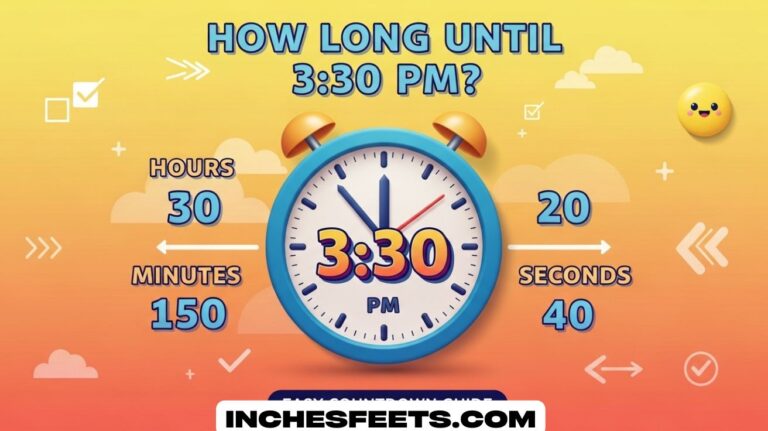
How long until 3:30 PM depends on your current local time. For example, if it is 1:00 PM, you have 2 hours and 30 minutes left. If it is 2:15 PM, you have 1 hour and 15 minutes remaining. At 3:00 PM, only 30 minutes remain until the target time.
You can calculate the time remaining by subtracting the current time from 3:30 PM. This simple method helps you plan appointments, work tasks, school activities, cooking, travel, and online meetings. This guide explains the calculation with clear examples, time conversions, common mistakes, and practical tips for getting an accurate answer.
Meaning / Definition
“How Long Until 3:30 PM?” asks how much time remains between the current moment and 3:30 in the afternoon. The answer is a time difference, which measures the duration between two points in time.
The target time, 3:30 PM, represents 30 minutes after 3:00 PM. It uses the 12-hour clock system, which divides the day into two 12-hour periods. The letters AM and PM help identify which part of the day a time belongs to.
The amount of time remaining changes throughout the day. At 12:00 PM, 3 hours and 30 minutes remain. At 2:00 PM, 1 hour and 30 minutes remain. At 3:25 PM, only 5 minutes remain.
The calculation also depends on the intended date. If the current time is already past 3:30 PM, today’s target has passed. You must decide whether you want to know how long ago it occurred or how long remains until 3:30 PM tomorrow.
Meaning in Simple Words
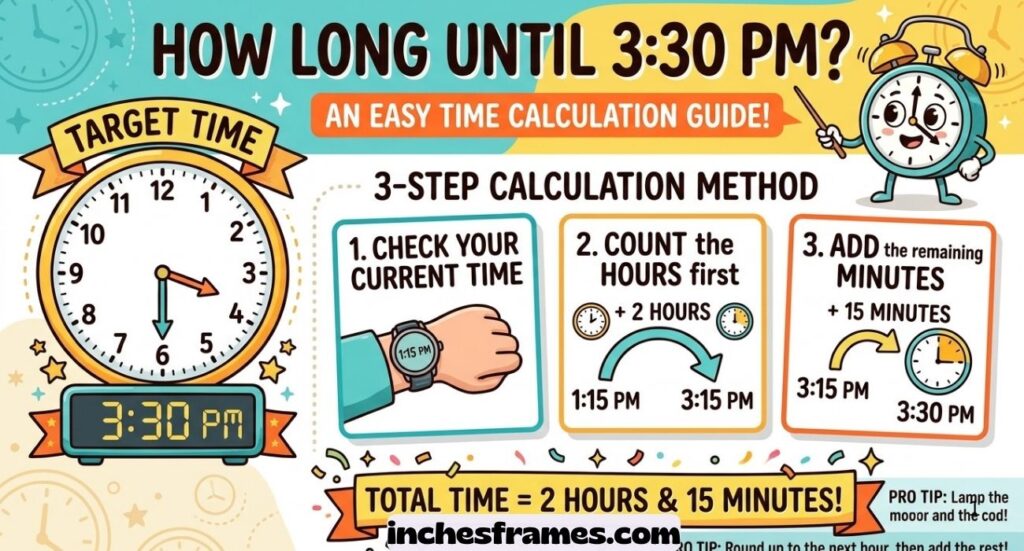
In simple words, the question means, “How much longer do I have to wait until the clock shows 3:30 PM?”
You only need two pieces of information: the current time and the target time. The current time tells you where you are in the day, while the target time tells you when your planned event should happen.
For example, imagine you have a meeting at 3:30 PM and your clock shows 2:30 PM. You have exactly one hour to prepare. If your clock shows 3:20 PM, you have only 10 minutes left.
Quick Answer
The exact answer to “How long until 3:30 PM?” depends on the current time where you are. Use the following table to find the remaining time for common afternoon clock readings.
| Current time | Time until 3:30 PM |
|---|---|
| 11:00 AM | 4 hours 30 minutes |
| 11:45 AM | 3 hours 45 minutes |
| 12:00 PM | 3 hours 30 minutes |
| 1:00 PM | 2 hours 30 minutes |
| 1:30 PM | 2 hours |
| 2:00 PM | 1 hour 30 minutes |
| 2:15 PM | 1 hour 15 minutes |
| 2:30 PM | 1 hour |
| 3:00 PM | 30 minutes |
| 3:15 PM | 15 minutes |
| 3:25 PM | 5 minutes |
| 3:30 PM | 0 minutes |
These examples assume the current time and target time refer to the same day and time zone.
Simple Formula
You can calculate the time remaining until 3:30 PM with this basic formula:
Time remaining = Target time − Current time
For example, if the current time is 1:00 PM, subtract 1:00 PM from 3:30 PM. The result is 2 hours and 30 minutes.
For calculations that involve different minute values, it helps to convert both clock times into minutes after midnight.
The formula is:
Minutes after midnight = (Hours × 60) + Minutes
For 3:30 PM, the calculation is:
3:30 PM = (15 × 60) + 30 = 930 minutes after midnight.
For 2:15 PM, the calculation is:
2:15 PM = (14 × 60) + 15 = 855 minutes after midnight.
Subtract the current time from the target time:
930 − 855 = 75 minutes.
Since 75 minutes equals 1 hour and 15 minutes, the answer is 1 hour and 15 minutes.
This method works well when the hour and minute values differ. If the target has already passed, account for the next day when that is the intended target.
How Long Until 3:30 PM?
To find how long until 3:30 PM, check your current local time and calculate the difference. You can do this with a regular clock, a time calculator, or a digital countdown timer.
Suppose the current time is 12:45 PM. From 12:45 PM to 1:00 PM is 15 minutes. From 1:00 PM to 3:00 PM is 2 hours. From 3:00 PM to 3:30 PM is another 30 minutes. Together, these intervals equal 2 hours and 45 minutes.
If the current time is 3:10 PM, the remaining time is much shorter. Subtract 10 minutes from the 30-minute interval between 3:00 PM and 3:30 PM. The result is 20 minutes.
A countdown timer can make this process easier when you need a running display of the time remaining. However, a manual calculation is often enough for appointments, daily schedules, and simple planning.
Real-Life Examples
Real-life examples make it easier to understand how a countdown to 3:30 PM works. Each example below uses a specific starting time and calculates the interval until the target.
Example 1: It Is 1:00 PM
Suppose you check the clock at 1:00 PM and have an appointment scheduled for 3:30 PM. Count from 1:00 PM to 3:00 PM to get 2 hours. Then add the remaining 30 minutes.
The total time remaining is 2 hours and 30 minutes, or 150 minutes. You can use this interval to finish work, prepare documents, travel, or complete other tasks before your appointment.
Example 2: It Is 2:15 PM
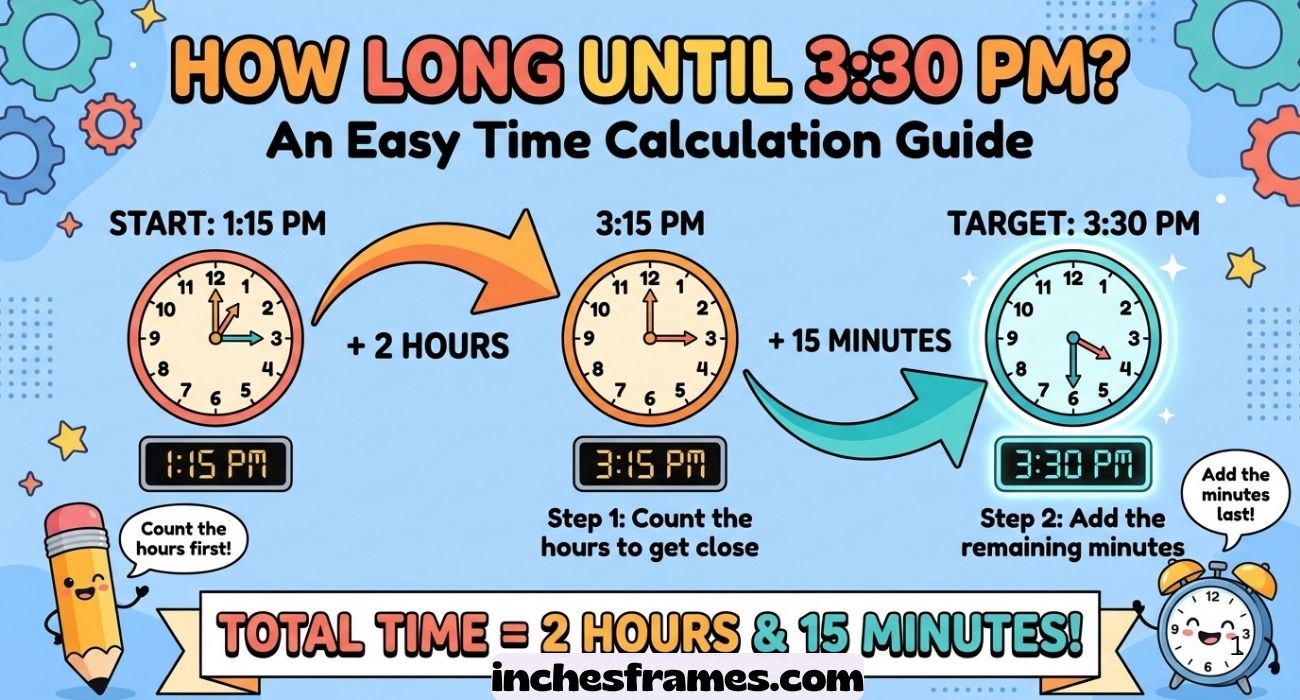
Imagine that it is 2:15 PM and you need to join an online meeting at 3:30 PM. From 2:15 PM to 3:15 PM is one hour. From 3:15 PM to 3:30 PM is another 15 minutes.
Therefore, 1 hour and 15 minutes remain. This equals 75 minutes or 4,500 seconds.
You can use this time to review your notes, check your equipment, and prepare anything you need for the meeting.
Example 3: It Is 3:00 PM
When the clock shows 3:00 PM, 30 minutes remain until 3:30 PM. The calculation is straightforward because both times occur within the same hour.
For example, a student with an assignment due at 3:30 PM has half an hour to review the work and submit it. A worker with a scheduled break at 3:30 PM can use the same calculation to finish a task before stepping away.
The remaining interval equals 30 minutes or 1,800 seconds.
Example 4: It Is 3:15 PM
If it is 3:15 PM, the target time is only 15 minutes away. The minute hand needs to move from 15 to 30 while the hour remains within the 3 PM hour.
The answer is 15 minutes, or 900 seconds.
This short interval may be enough to prepare for a phone call, gather your belongings, or review the details of an upcoming appointment. For an event that requires travel, remember to allow enough time to reach the destination.
Example 5: It Is 3:30 PM
If the current time is exactly 3:30 PM, the target has arrived. There are zero minutes remaining until 3:30 PM.
A countdown set to this target should reach zero. If you are waiting for a meeting, appointment, or scheduled task, this is the planned start time.
If you check the clock just after 3:30 PM, the target has passed for that day. The calculation then depends on whether you want to measure elapsed time since 3:30 PM or count down to the next day’s occurrence.
Example 6: It Is 4:00 PM
Suppose the current time is 4:00 PM. Today’s 3:30 PM occurred 30 minutes ago, so there is no positive waiting time left until that day’s target.
If you mean the next 3:30 PM tomorrow, the calculation is different. From 4:00 PM today to midnight is 8 hours. From midnight to 3:30 PM tomorrow is 15 hours and 30 minutes.
The total is 23 hours and 30 minutes on a normal day without a daylight saving time change affecting the elapsed duration.
This distinction is useful when scheduling recurring meetings, reminders, or activities that happen every afternoon.
Example 7: It Is 11:45 AM
If it is 11:45 AM, the target time is still in the afternoon. First, count 15 minutes to reach noon. Then count 3 hours from noon to 3:00 PM. Finally, add 30 minutes to reach 3:30 PM.
The total is 3 hours and 45 minutes, or 225 minutes.
This example shows why it helps to divide a longer interval into smaller sections. You can calculate the time across noon without confusing AM and PM.
See Also ; How Long Until 2:30 PM? Calculate the Exact Time Remaining Today
Synonyms and Related Terms
People use several phrases when asking how much time remains before a specific clock time. These phrases often have the same general meaning, but some refer to different types of calculations.
Time until 3:30 PM describes the waiting period between the current moment and the target. “How many hours until 3:30 PM?” asks for the duration in hours, often with additional minutes. “How many minutes until 3:30 PM?” expresses the same duration entirely in minutes.
A time difference is the interval between two clock readings or moments. A countdown timer displays the time remaining and may update automatically. A time interval describes a length of time, such as 30 minutes or 2 hours and 15 minutes.
Other related phrases include “time remaining before 3:30 PM,” “3:30 PM countdown,” “calculate the time until 3:30,” and “how much longer until 3:30 PM?” Each phrase points to the same practical goal: finding the time left before the intended event.
When to Use
Calculating the time until 3:30 PM can help with everyday planning. A clear countdown allows you to organize tasks, prepare for scheduled events, and decide how to use the time available.
1. Planning an Appointment
An appointment scheduled for 3:30 PM gives you a fixed target. By checking the current time, you can determine when to begin preparing and how much time you have before leaving.
For example, if it is 2:00 PM, you have 90 minutes before the appointment. You might use part of that time to gather documents, confirm the address, and prepare for travel. If the appointment is in person, calculate travel time separately so you do not mistake the entire countdown for available preparation time.
2. Preparing for Work
Workers can use the time remaining until 3:30 PM to organize deadlines, finish tasks, or prepare for a shift change. A known target helps break a larger workload into manageable periods.
If it is 1:30 PM, two hours remain until 3:30 PM. You could plan to finish one task by 2:30 PM and use the final hour for review or follow-up work. This approach is especially useful when several responsibilities compete for attention.
3. School or Classes
Students and teachers may need to calculate the time before a class, tutoring session, school activity, or assignment deadline. Knowing the remaining duration can help them organize their work and prepare materials.
For example, if an activity begins at 3:30 PM and the current time is 3:00 PM, students have 30 minutes left. They can use that interval to complete a short assignment, gather supplies, or move to the correct room.
Actual school schedules vary, so always check the published schedule for the correct start time.
4. Travel Planning
A 3:30 PM departure, pickup, or transportation booking creates a clear planning deadline. Calculating the time remaining can help you decide when to pack, leave home, or head toward a pickup point.
Suppose it is 1:45 PM and your ride is scheduled for 3:30 PM. You have 1 hour and 45 minutes before the scheduled time. However, that does not mean you should wait until the last moment to prepare.
Allow additional time for traffic, parking, walking, check-in, or other travel needs. The countdown tells you how much time remains until departure, not how long the journey will take.
5. Cooking or Baking
Cooking often involves a target time for putting food in the oven, checking a recipe, or serving a meal. If you plan to serve dinner at 3:30 PM, calculating the remaining time can help you arrange preparation steps.
For example, if it is 2:00 PM, you have 90 minutes until your planned serving time. You can work backward from 3:30 PM to decide when to prepare ingredients or begin cooking.
Always follow the recipe’s cooking instructions and food-safety guidance. A countdown to the serving time does not replace the recommended cooking duration or checks for doneness.
6. Taking a Break
A scheduled break can provide a useful point for organizing work or study sessions. If you plan to take a break at 3:30 PM, knowing the time remaining can help you decide whether to start a new task or finish an existing one.
At 3:00 PM, for example, you have 30 minutes before the planned break. You might use that time to finish a short task and save a longer activity for afterward.
A timer can also remind you when it is time to pause, especially if you tend to lose track of time while working.
7. Online Meetings
Online meetings often require participants to prepare a few minutes before the scheduled start. A countdown to 3:30 PM helps you organize documents, test your microphone, and open the meeting link.
If the current time is 3:10 PM, you have 20 minutes before the meeting begins. You can use part of that time to review the agenda and confirm that you have the correct invitation.
For meetings involving people in different locations, verify the time zone shown on the calendar invitation. A meeting listed as 3:30 PM Eastern Time may not occur at 3:30 PM on a clock set to Pacific Time.
When NOT to Use
A simple same-day subtraction works for many everyday questions, but it does not cover every situation. You may need another method when the date changes, the target refers to a different time of day, or you require a live countdown.
When You Need a Different Date
If you mean 3:30 PM tomorrow, next Monday, or another specific date, you must include that date in your calculation. The next occurrence of 3:30 PM is not always the intended target.
For example, if it is 4:00 PM on Tuesday, the next daily occurrence of 3:30 PM is on Wednesday. Under normal conditions, 23 hours and 30 minutes remain.
Daylight saving time can affect elapsed time when the interval crosses a clock change. This matters in parts of the United States that observe daylight saving time, particularly when planning across the spring or fall transition. Use the relevant local date, time zone, and clock rules for an exact result.
When You Mean 3:30 AM
The target time must be clear before you calculate the duration. 3:30 AM occurs in the early morning, while 3:30 PM occurs in the afternoon.
For example, if the current time is 2:00 PM, 3:30 PM is 1 hour and 30 minutes away. The following day’s 3:30 AM is 13 hours and 30 minutes away under normal clock conditions.
Confusing AM and PM can change the answer substantially. Check the target carefully before subtracting the times.
When the Target Time Has Passed
If the current time is later than 3:30 PM, today’s target has already occurred. A negative result from direct subtraction may indicate that you need to clarify the question rather than treat the result as a countdown.
For example, at 4:00 PM, 30 minutes have passed since 3:30 PM. If you want the next 3:30 PM, tomorrow’s target is 23 hours and 30 minutes away under normal conditions.
The correct answer depends on whether you mean time elapsed since the target or time remaining until its next occurrence.
When You Need an Exact Countdown
Manual subtraction provides a duration, but it does not automatically update as seconds pass. If you need an active countdown showing hours, minutes, and seconds, use a reliable timer or clock application.
An exact countdown also depends on the accuracy of the device clock and the selected time zone. If your computer’s clock is incorrect, the displayed countdown may not match the actual time remaining.
For appointments and meetings, a calendar reminder can be useful alongside a countdown. A reminder alerts you at a chosen time, while a countdown continuously shows the remaining duration.
Common Mistakes
Small errors can lead to incorrect time calculations. Checking the current time, target date, AM/PM designation, and minute values helps prevent most of these problems.
Mistake 1: Forgetting AM and PM
One common mistake is treating 3:30 AM and 3:30 PM as the same target. They are 12 hours apart on the same local clock schedule.
For example, if it is 1:00 PM, the time until 3:30 PM is 2 hours and 30 minutes. The time until the next 3:30 AM is 14 hours and 30 minutes under normal clock conditions.
Always confirm whether the event occurs in the morning or afternoon.
Mistake 2: Ignoring the Current Time
The answer changes as time passes. A calculation made at 1:00 PM will not remain correct at 2:00 PM.
At 1:00 PM, 2 hours and 30 minutes remain. One hour later, only 1 hour and 30 minutes remain. Use the current clock reading rather than an earlier estimate when accuracy matters.
Mistake 3: Assuming 3:30 PM Is Always Today
The target may refer to tomorrow or another date, especially if today’s 3:30 PM has passed. Assuming the target is always today can produce a confusing or misleading answer.
If it is 5:00 PM, today’s target is already 1 hour and 30 minutes in the past. Tomorrow’s 3:30 PM is 22 hours and 30 minutes away under normal conditions.
Identify the intended date before calculating.
Mistake 4: Confusing 12:00 PM and 12:00 AM
The 12-hour clock can be confusing around noon and midnight. 12:00 PM means noon, while 12:00 AM means midnight, at the beginning of a new calendar day.
For example, noon to 3:30 PM is 3 hours and 30 minutes. Midnight to 3:30 AM is also 3 hours and 30 minutes, but the target is in the early morning rather than the afternoon.
Remembering this difference helps avoid mistakes when calculating across midnight.
Mistake 5: Forgetting Minutes
Calculating only the hour difference can leave out part of the interval. If the current time is 2:15 PM, the target is not simply one hour away.
From 2:15 PM to 3:15 PM is one hour, followed by another 15 minutes until 3:30 PM. The correct answer is 1 hour and 15 minutes.
Include both hours and minutes whenever the times do not fall on the same minute mark.
Mistake 6: Subtracting the Numbers Incorrectly
Clock arithmetic differs from ordinary decimal subtraction because each hour contains 60 minutes, not 100.
For example, subtracting 2:45 PM from 3:30 PM requires careful handling of the minute values. Since 30 minutes is less than 45 minutes, borrow one hour from 3:30 PM. This gives 2 hours and 90 minutes for the subtraction.
Now subtract:
2 hours and 90 minutes − 2 hours and 45 minutes = 45 minutes.
Therefore, from 2:45 PM until 3:30 PM, 45 minutes remain.
Converting both times into minutes after midnight is another reliable way to avoid borrowing errors.
Mistake 7: Forgetting Time Zones
The phrase “3:30 PM” does not identify one universal moment unless the relevant time zone is known. The United States spans several time zones, including Eastern, Central, Mountain, and Pacific.
If it is 3:00 PM Eastern Time, only 30 minutes remain until 3:30 PM Eastern Time. However, the corresponding time on a Pacific Time clock may be 12:00 PM, with 3 hours and 30 minutes remaining until 3:30 PM Pacific Time.
When scheduling across locations, confirm the time zone and date. This is particularly important for remote meetings, flights, and events that involve people in different parts of the country.
How to Calculate the Time Until 3:30 PM
You can calculate the time remaining until 3:30 PM in a few simple steps. This method works with a wall clock, a phone, a computer, or a basic time difference calculator.
Step 1: Check the Current Time
Read the current time from a reliable clock. Make sure you know whether it is AM or PM and whether the clock displays your intended local time.
For example, suppose the current time is 1:40 PM. Write down both the hour and the minutes so you do not lose part of the interval.
Step 2: Identify the Target
Confirm that your target is 3:30 PM on the intended date. If the target has already passed, decide whether you mean a past event or the next occurrence.
For this example, assume that 3:30 PM is later on the same day.
Step 3: Count Full Hours
Starting from 1:40 PM, count forward to 2:40 PM. That gives you one full hour.
You can continue counting in full hours until you approach the target. Counting forward is often easier than subtracting clock readings directly, especially when the minutes are different.
Step 4: Add the Remaining Minutes
From 2:40 PM to 3:30 PM is 50 minutes. Add those minutes to the full hour calculated in the previous step.
The total is 1 hour and 50 minutes.
This forward-counting method is useful because it avoids confusion when the target minute value is smaller than the current minute value.
Example Calculation
Suppose it is 2:42 PM and you want to know how long until 3:30 PM.
Convert both times into minutes after midnight:
| Time | Calculation | Minutes after midnight |
|---|---|---|
| 2:42 PM | (14 × 60) + 42 | 882 |
| 3:30 PM | (15 × 60) + 30 | 930 |
Subtract the current time from the target time:
930 − 882 = 48 minutes.
Therefore, 48 minutes remain until 3:30 PM.
You can also count forward from 2:42 PM to 3:00 PM, which takes 18 minutes. Then add another 30 minutes to reach 3:30 PM. The result is the same: 48 minutes.
See Also ; How Long Until 4:30 PM? Simple Time Guide, Examples
Comparison With Similar Terms
Understanding the difference between time formats, countdowns, and scheduling terms can help you select the right calculation for your needs.
A clock time tells you when something happens. A duration tells you how long something lasts or how long you must wait. A countdown displays the remaining duration and may update continuously.
For example, 3:30 PM is a clock time, 45 minutes is a duration, and a countdown showing 00:45:00 represents 45 minutes remaining.
3:30 PM in Different Time Formats
The same moment can be written in different clock formats. In the United States, the 12-hour format is common in everyday conversation, while the 24-hour format is often used in some technical, travel, and scheduling settings.
| Format | Representation |
|---|---|
| 12-hour clock | 3:30 PM |
| 24-hour clock | 15:30 |
| Hours and minutes | 3 hours and 30 minutes after noon |
| Minutes after midnight | 930 minutes |
| Minutes after noon | 210 minutes |
| Seconds after midnight | 55,800 seconds |
These values describe the same clock time using different units or formats. The 24-hour representation, 15:30, avoids the need for AM or PM.
When calculating the time until 3:30 PM, the format does not change the actual duration. It simply changes how the clock reading is written.
Why 3:30 PM Is Useful for Scheduling
A specific target such as 3:30 PM provides a clear reference point for organizing daily activities. It can represent an appointment, a work deadline, a class, a delivery window, or a planned break.
Knowing the time remaining helps you decide which tasks fit into the available period. If you have 90 minutes before 3:30 PM, you can plan around that interval instead of guessing how much time is left.
However, the countdown should not be confused with the amount of time you can safely spend on a task. Travel, preparation, unexpected delays, and other responsibilities may require you to finish earlier than the target time.
For recurring activities, calendar reminders and digital clocks can make scheduling easier. A countdown provides a live view of the remaining time, while a calendar records the event’s date and time.
Quick Reference: Time Remaining Before 3:30 PM
The following table provides a quick reference for several common times before the target.
| Current time | Hours remaining | Minutes remaining |
|---|---|---|
| 12:00 PM | 3 hours 30 minutes | 210 minutes |
| 12:30 PM | 3 hours | 180 minutes |
| 1:00 PM | 2 hours 30 minutes | 150 minutes |
| 1:30 PM | 2 hours | 120 minutes |
| 2:00 PM | 1 hour 30 minutes | 90 minutes |
| 2:15 PM | 1 hour 15 minutes | 75 minutes |
| 2:30 PM | 1 hour | 60 minutes |
| 2:45 PM | 45 minutes | 45 minutes |
| 3:00 PM | 30 minutes | 30 minutes |
| 3:15 PM | 15 minutes | 15 minutes |
| 3:25 PM | 5 minutes | 5 minutes |
| 3:29 PM | 1 minute | 1 minute |
| 3:30 PM | 0 minutes | 0 minutes |
The table assumes the target is 3:30 PM on the same day. It does not show a live countdown, so check your current clock before using a value for an upcoming event.
Frequently Asked Questions
How many hours until 3:30 PM?
The number of hours depends on the current time. At 12:00 PM, 3 hours and 30 minutes remain. At 1:00 PM, 2 hours and 30 minutes remain. At 2:30 PM, one hour remains.
How many minutes until 3:30 PM?
The answer depends on the current time. At 3:00 PM, 30 minutes remain. At 3:15 PM, 15 minutes remain. At 2:00 PM, 90 minutes remain.
How long until 3:30 PM if it is 2:45 PM?
If it is 2:45 PM, 45 minutes remain until 3:30 PM. You can count 15 minutes to reach 3:00 PM and then another 30 minutes to reach 3:30 PM.
What if it is already past 3:30 PM?
If the current time is later than 3:30 PM, today’s target has passed. You can calculate how long ago it occurred or count forward to 3:30 PM the following day. For example, at 4:00 PM, tomorrow’s 3:30 PM is 23 hours and 30 minutes away under normal clock conditions.
Is 3:30 PM the same as 15:30?
Yes. Both represent the same afternoon clock time. The 12-hour clock writes it as 3:30 PM, while the 24-hour clock writes it as 15:30.
Can I use a calculator to find the time until 3:30 PM?
Yes. A time calculator can help determine the interval between the current time and the target. For a simple calculation, you can also count forward in hours and minutes or convert both times into minutes after midnight and subtract them.
Does the time zone affect how long until 3:30 PM?
Yes. If you are asking about 3:30 PM in your own location, use your local clock. If you are asking about 3:30 PM in another location, the difference between the time zones matters. This is especially important for meetings, travel, and scheduled online events.
How do I calculate the time until 3:30 PM in seconds?
First, calculate the remaining duration in minutes, then multiply by 60. For example, 15 minutes equals 900 seconds, while 30 minutes equals 1,800 seconds. For an exact second-by-second countdown, use a clock or timer that updates automatically.
What is the easiest way to remember the calculation?
Check the current time, confirm that the target is 3:30 PM on the intended date, and count forward until you reach it. If you need greater accuracy, convert both clock readings into minutes and subtract the smaller value from the larger one when the target occurs later on the same day.
Conclusion
Knowing how long until 3:30 PM helps you manage appointments, work tasks, school activities, travel plans, and other daily responsibilities. The answer depends on the current time: at 1:00 PM, 2 hours and 30 minutes remain; at 2:15 PM, 1 hour and 15 minutes remain; and at 3:00 PM, only 30 minutes remain.
To calculate the time accurately, check your current local clock, confirm the correct AM or PM designation, and subtract the current time from the target. If 3:30 PM has already passed, determine whether you mean the previous occurrence or the next day’s target. For a changing, second-by-second result, use a reliable countdown timer.