How Long Until 4:30 PM? Simple Time Guide, Examples
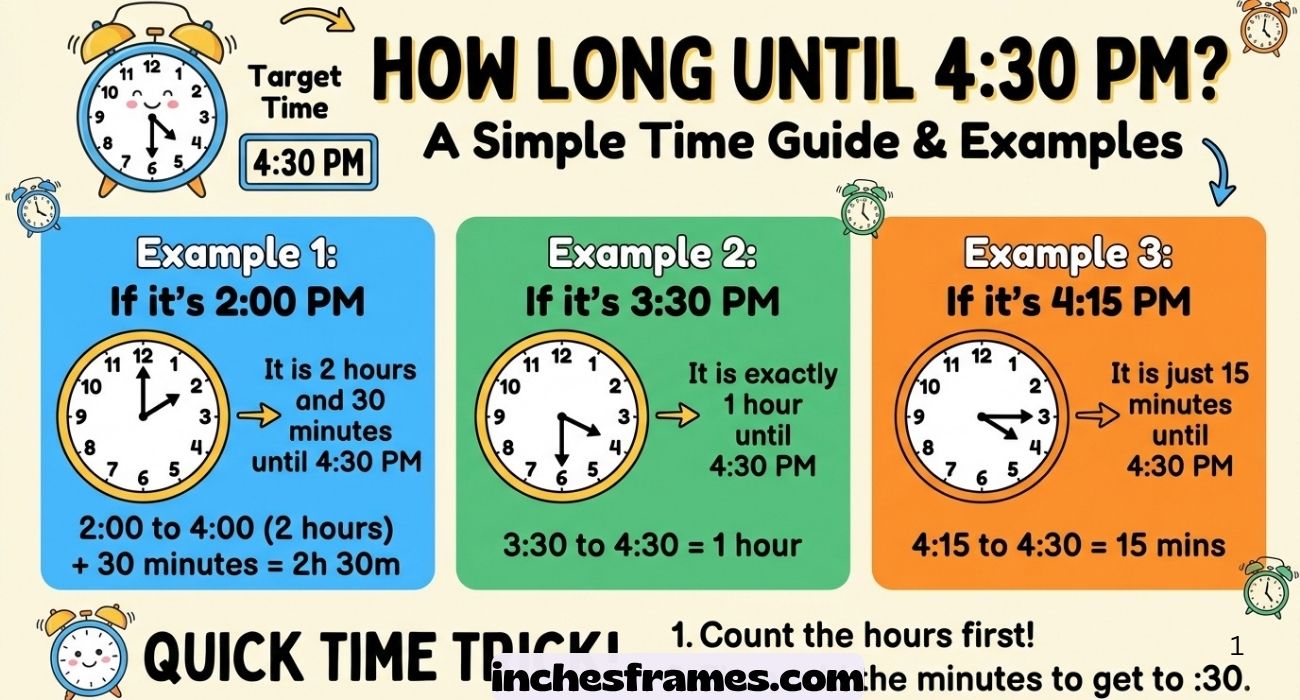
How long until 4:30 PM depends on your current local time. If it is 2:00 PM, you have 2 hours and 30 minutes left. If it is 3:30 PM, only 1 hour remains. If it is already 4:30 PM, the countdown for that day has ended.
Knowing the time remaining until 4:30 PM can help you plan appointments, finish work, prepare dinner, catch a bus, or join an online meeting on time. You can calculate the difference by subtracting the current time from the target time. This guide explains the calculation with simple examples, time tables, and practical tips for avoiding common mistakes.
1. Meaning / Definition
“How long until 4:30 PM?” is a question that asks how much time remains before the clock reaches 4:30 in the afternoon. The answer is a duration, usually expressed in hours and minutes, rather than a specific clock reading.
For example, if your current time is 1:00 PM, you have 3 hours and 30 minutes until 4:30 PM. If your clock shows 4:00 PM, you have only 30 minutes left. The closer the current time gets to the target, the shorter the remaining duration becomes.
This calculation is useful when you need to know how much time you have before a scheduled event. You can use a digital clock, a time calculator, or a countdown timer to work out the difference. The result depends on the current time, the date, and the time zone associated with your target event.
If 4:30 PM has already passed, you must decide whether you want to know how long ago it was or how long remains until the next 4:30 PM tomorrow. These are two different calculations.
2. Meaning in Simple Words
In simple words, asking how long until 4:30 PM means asking, “How much longer do I have to wait before it becomes 4:30 in the afternoon?”
Imagine that you are working on a task and your shift ends at 4:30 PM. If the current time is 3:00 PM, you have 90 minutes left. You can use those minutes to finish your work, organize your desk, or prepare for the next day.
The answer can be written in different ways. For example, 90 minutes is the same as 1 hour and 30 minutes. Both describe the same amount of time, but hours and minutes may be easier to understand when planning everyday activities.
Quick Answer
The exact time remaining until 4:30 PM depends on your current local time. Here are some common examples.
| Current time | Time remaining until 4:30 PM |
|---|---|
| 12:00 PM | 4 hours 30 minutes |
| 1:00 PM | 3 hours 30 minutes |
| 2:00 PM | 2 hours 30 minutes |
| 2:30 PM | 2 hours |
| 3:00 PM | 1 hour 30 minutes |
| 3:30 PM | 1 hour |
| 4:00 PM | 30 minutes |
| 4:15 PM | 15 minutes |
| 4:25 PM | 5 minutes |
| 4:29 PM | 1 minute |
| 4:30 PM | 0 minutes |
These calculations assume that the current time and 4:30 PM refer to the same day and the same local time zone.
If the current time is 5:00 PM, today’s 4:30 PM has already passed. The next 4:30 PM will occur tomorrow, which is 23 hours and 30 minutes away, assuming the clock follows an ordinary 24-hour day without a daylight saving time change.
3. Real-Life Examples
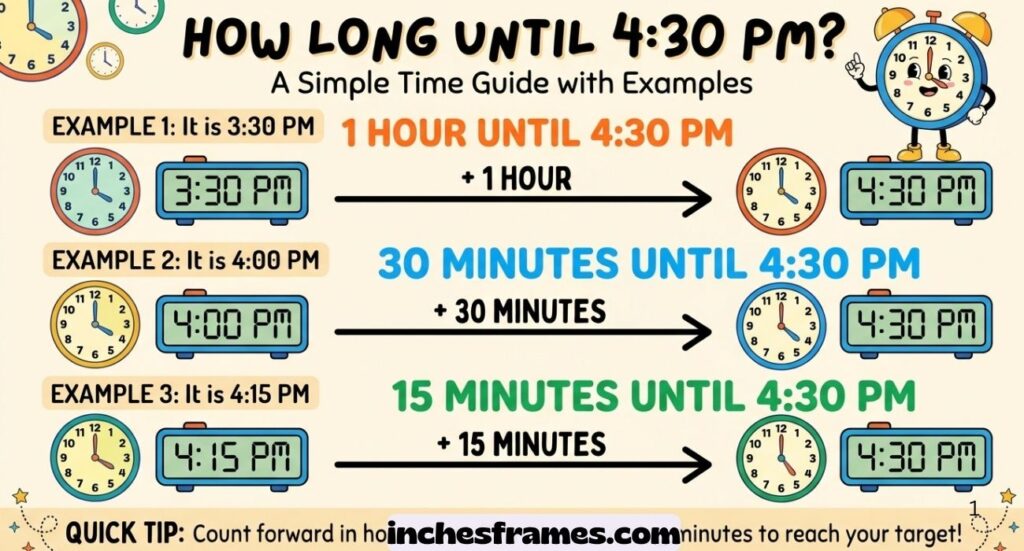
Knowing how long until 4:30 PM can make daily planning easier. Many people use this calculation to manage appointments, school activities, work schedules, transportation, and household tasks.
The following examples show how to calculate the remaining time and apply the answer to real situations.
Example 1: Planning an Appointment
Suppose you have a dentist appointment at 4:30 PM, and your clock shows 2:45 PM. You need to determine how much time you have before leaving.
From 2:45 PM to 3:45 PM is 1 hour. From 3:45 PM to 4:30 PM is another 45 minutes. Therefore, 1 hour and 45 minutes remain.
You can use this time to finish your current task, gather any documents, and prepare for the trip. However, the countdown only measures the time until the appointment. It does not account for travel time, traffic, parking, or check-in procedures.
For a smoother schedule, calculate your departure time separately and leave enough room for unexpected delays.
Example 2: Waiting for School to End
Imagine that a student expects an after-school program to finish at 4:30 PM. The current time is 3:15 PM.
There are 45 minutes between 3:15 PM and 4:00 PM, followed by another 30 minutes until 4:30 PM. The total remaining time is 1 hour and 15 minutes.
A student can use this information to organize homework or prepare for an upcoming activity. A parent can use it to estimate when to leave for pickup.
Actual school dismissal times vary, so always check the school’s schedule rather than assuming every school finishes at 4:30 PM.
Example 3: Preparing for Work
An employee plans to finish a shift at 4:30 PM. At 1:30 PM, the employee checks the clock to see how much time remains.
From 1:30 PM to 4:30 PM is exactly 3 hours. This gives the employee a clear period for completing assignments, responding to messages, and preparing a handover if needed.
The same calculation can help someone working toward a 4:30 PM deadline. Breaking the remaining time into smaller work periods can make it easier to decide which tasks need attention first.
Remember that the time until the deadline does not always equal the time available for focused work. Meetings, breaks, and other responsibilities may reduce that time.
Example 4: Cooking Dinner
Suppose you want to serve dinner at 4:30 PM, and it is now 4:00 PM. You have 30 minutes before your planned serving time.
You can use this period to finish preparing ingredients, cook a quick meal, or arrange the table. If your recipe requires 45 minutes of cooking, however, the remaining 30 minutes will not be enough to complete it from start to finish.
This example shows the difference between the time remaining until a target clock time and the duration required to complete a task. Both calculations are useful, but they answer different questions.
Example 5: Catching a Bus
Imagine that your bus is scheduled to depart at 4:30 PM. The current time is 4:05 PM, so you have 25 minutes remaining.
You should consider how long it takes to reach the stop, whether you need to buy a ticket, and how early the transit provider recommends arriving. If the journey to the stop takes 15 minutes, you have only 10 minutes of additional time before departure.
A countdown timer can help you monitor the remaining time, but it cannot guarantee that you will reach the bus on time. Always check the current transportation schedule and allow a suitable travel buffer.
Example 6: Online Meeting
Suppose you have an online meeting scheduled for 4:30 PM, and the current time is 3:50 PM. The difference is 40 minutes.
You can use those 40 minutes to review your notes, prepare your presentation, check your internet connection, and open the meeting link. Starting these tasks early can help prevent last-minute problems.
If other participants live in different parts of the United States or another country, confirm the meeting’s time zone. A meeting listed at 4:30 PM Eastern Time does not begin at 4:30 PM Pacific Time.
Example 7: When 4:30 PM Has Passed
Suppose your clock shows 5:00 PM, but you want to know how long until 4:30 PM.
Today’s target time has already passed. If you mean the next occurrence of 4:30 PM, which will be tomorrow, the calculation works as follows.
From 5:00 PM to midnight is 7 hours. From midnight to 4:30 PM tomorrow is 16 hours and 30 minutes. Adding these durations gives 23 hours and 30 minutes.
However, if you want to know how long ago today’s 4:30 PM occurred, the answer is just 30 minutes. Always identify whether you need the time remaining until a future event or the time elapsed since a past event.
4. Synonyms and Related Terms
People use several phrases when asking about the time remaining before 4:30 PM. These include time until 4:30 PM, countdown to 4:30 PM, how many minutes until 4:30 PM, and how many hours until 4:30 PM.
These phrases generally describe the same goal: finding the duration between the current time and the target time. A time difference can also describe the interval between two clock readings, while elapsed time usually refers to the amount of time that has passed since an event began or occurred.
A time calculator performs the calculation for you, while a countdown timer can display the remaining duration and update as time passes. A manually calculated answer is useful for a quick estimate, but it does not automatically change when another minute passes.
AM vs. PM
AM and PM divide the 12-hour clock into two periods. AM covers the time from midnight until before noon, while PM covers the time from noon until before midnight.
The difference matters because 4:30 AM and 4:30 PM occur 12 hours apart. If you accidentally select the wrong period in an alarm or calendar, you may calculate the wrong waiting time.
| Time format | Meaning |
|---|---|
| 12:00 AM | Midnight |
| 4:30 AM | Early morning |
| 12:00 PM | Noon |
| 4:30 PM | Afternoon |
| 11:59 PM | One minute before midnight |
For example, if the current time is 3:30 PM, you have 1 hour until 4:30 PM. If the current time is 3:30 AM, you have 13 hours until 4:30 PM on the same day.
Always check the AM or PM label when reading a digital clock or setting a reminder.
5. When to Use
Calculating the time until 4:30 PM is useful whenever an activity has a fixed start time, end time, or deadline. The result helps you decide how much time remains and whether you can complete another task before the target arrives.
It can also help you organize your daily schedule more realistically. Instead of guessing how much time you have, you can calculate the actual interval and plan around it.
Use it for appointments
If you have an appointment at 4:30 PM, calculate the remaining time before you begin preparing. This helps you decide when to gather your documents, get ready, and leave home.
For example, if it is 3:00 PM, you have 90 minutes until the appointment. If the journey takes 40 minutes, you should account for that travel time rather than treating all 90 minutes as free time.
Use it for work
A 4:30 PM deadline or shift ending can provide a useful point for organizing your workload. Calculate the remaining time and decide which tasks you can realistically complete.
For example, if it is 2:30 PM, you have 2 hours before 4:30 PM. You can divide that time between urgent assignments, communication, and end-of-day preparation.
Use it for school
Students can use the calculation to manage study periods, after-school activities, and assignment deadlines. Parents can also use it when planning school pickups or transportation.
If a tutoring session starts at 4:30 PM and it is currently 3:45 PM, there are 45 minutes remaining. This information can help a student finish a short task or prepare the materials needed for the session.
Use it for travel
Travel planning often involves more than checking a departure time. You may need to reach a station, airport, bus stop, or meeting point before a scheduled event.
If your train departs at 4:30 PM, calculate how much time remains and compare it with the time needed to reach the station. Check the provider’s official schedule for any changes.
Use it for reminders
A reminder can help you prepare for a planned event before the target time arrives. You might set an alarm to remind you to leave home, submit a form, or begin preparing for a meeting.
Choose the reminder time based on the task. A reminder 10 minutes before 4:30 PM may be suitable for a simple activity, while a trip or important appointment may require much more preparation time.
Use it for countdowns
A live countdown can show the remaining hours, minutes, and seconds until 4:30 PM. It is helpful when you need to monitor a deadline or prepare for an event that begins at a specific time.
A live countdown should use an accurate clock and the correct target date and time zone. A manually calculated duration becomes less accurate as a representation of the current remaining time because it does not update automatically.
Use it for daily planning
You can use 4:30 PM as a reference point when organizing errands, household tasks, exercise, or meal preparation.
If it is 1:00 PM, you have 3 hours and 30 minutes until the target. Before starting a task, consider whether it can fit into that period alongside your other responsibilities.
This approach helps you make realistic plans without assuming that every available minute can be used for work.
How to Calculate the Time Until 4:30 PM
You can calculate the remaining time by subtracting the current time from the target time. When both times fall on the same day, the process is straightforward.
Time remaining = Target time − Current time
For example, suppose the current time is 2:20 PM and the target is 4:30 PM. From 2:20 PM to 4:20 PM is 2 hours. Another 10 minutes brings the clock to 4:30 PM. Therefore, the answer is 2 hours and 10 minutes.
You can also convert the times into minutes after midnight. Since 4:30 PM is 16:30 in the 24-hour clock, it equals 990 minutes after midnight. If the current time is 2:20 PM, it is 860 minutes after midnight. Subtracting 860 from 990 gives 130 minutes, which equals 2 hours and 10 minutes.
This method works well when the minutes do not match neatly or when you want to check your answer.
If the current time is before 4:30 PM
When the current time is earlier than 4:30 PM on the same day, subtract the current time from the target.
For example, if it is 1:45 PM, the interval until 2:45 PM is 1 hour. From 2:45 PM to 4:30 PM is another 1 hour and 45 minutes. The total is 2 hours and 45 minutes.
If the current time is 3:20 PM, 40 minutes remain until 4:00 PM, followed by 30 minutes until 4:30 PM. The result is 1 hour and 10 minutes.
If the current time is after 4:30 PM
When it is later than 4:30 PM, today’s target has passed. If you want the time until the next 4:30 PM, calculate the interval across midnight.
For example, if it is 6:00 PM, midnight is 6 hours away. From midnight until 4:30 PM tomorrow is another 16 hours and 30 minutes. The total is 22 hours and 30 minutes.
For everyday calculations, this works when the local day follows its usual 24-hour length. On daylight saving time transition days, the actual elapsed duration can differ from the clock-time calculation.
If the current time is exactly 4:30 PM
If the current time is exactly 4:30 PM, the time remaining until that day’s target is zero. The target time has arrived.
If you are counting down to tomorrow’s 4:30 PM instead, the next target is approximately 24 hours away on an ordinary day. A daylight saving time change can make the actual elapsed duration 23 or 25 hours instead.
6. When NOT to Use
A simple time subtraction is useful for everyday planning, but it can produce a misleading answer when you use the wrong date, clock format, or time zone. You should also avoid treating an old calculation as a live countdown.
Understanding these limitations helps you use time calculations correctly, especially for travel, remote meetings, and events scheduled in different locations.
Do not ignore the date
The time 4:30 PM occurs every day, so you must identify the correct date when calculating a future event.
If today’s 4:30 PM has passed, the next occurrence is tomorrow unless you are referring to another specific date. For an appointment next week, calculate the duration to the actual appointment date rather than assuming the event takes place today.
Do not confuse AM and PM
Always confirm whether the target is 4:30 AM or 4:30 PM. These times are separated by 12 hours.
For example, if it is 3:30 PM, the next 4:30 PM is 1 hour away. However, the next 4:30 AM is 13 hours away.
A quick check of the AM/PM label can prevent mistakes when setting alarms, booking travel, or scheduling meetings.
Do not ignore time zones
The same clock time can refer to different moments in different places. For example, 4:30 PM in New York does not generally occur at the same moment as 4:30 PM in Los Angeles.
The United States uses several time zones, including Eastern, Central, Mountain, and Pacific Time. Some areas also have different daylight saving time practices.
If someone schedules a meeting for 4:30 PM Eastern Time, a participant in Los Angeles must convert that time to the appropriate Pacific Time. Always confirm the location or time zone attached to the event before calculating the countdown.
Do not assume the answer stays the same
The remaining time changes as the clock moves forward. If you calculate that 1 hour remains until 4:30 PM, another 30 minutes passing means that only 30 minutes remain.
A calculation is accurate for the moment it represents. If you need the current countdown later, check the clock again or use an updating timer.
Do not use a fixed answer for a live countdown
A fixed answer such as “30 minutes remaining” becomes outdated after time passes. A live countdown updates the duration based on the current clock and the target event.
For a deadline or meeting, use a reliable device clock or timer when you need frequent updates. Make sure the device has the correct time and time zone, and confirm the event’s date before relying on the countdown.
See Also ; How Long Until 3:15 PM? Calculate the Exact Time Remaining Today
7. Common Mistakes
Time calculations may seem simple, but small errors can change the result. Most mistakes involve subtracting the wrong hour, overlooking minutes, confusing AM and PM, or forgetting that the target time may occur on another day.
Mistake 1: Subtracting the wrong hour
One common error is subtracting the hour numbers without considering whether the minutes require borrowing an hour.
For example, from 3:50 PM to 4:30 PM, the difference is not 1 hour and 20 minutes. Since 3:50 PM is only 10 minutes before 4:00 PM, and 4:30 PM is 30 minutes after 4:00 PM, the correct answer is 40 minutes.
Breaking the calculation into smaller intervals can help prevent this mistake.
Mistake 2: Forgetting the minutes
Another error is calculating only the difference between the hour numbers. This can leave out part of the duration.
If the current time is 2:15 PM, the interval until 4:30 PM is 2 hours and 15 minutes, not simply 2 hours. You must account for the extra 15 minutes between 2:15 PM and 2:30 PM, as well as the remaining interval to 4:30 PM.
Always compare both the hour and minute values.
Mistake 3: Treating 4:30 PM as 4:30 AM
Confusing AM and PM can shift your calculation by half a day. The two times occur 12 hours apart.
If your target is 4:30 PM, use the afternoon time. Do not accidentally calculate the interval to early morning unless that is what your schedule requires.
Check the clock format before subtracting the times.
Mistake 4: Forgetting tomorrow
If the current time is 5:00 PM, today’s 4:30 PM is already in the past. Saying that 30 minutes remain would be incorrect if you mean the next upcoming 4:30 PM.
The correct duration until tomorrow’s 4:30 PM is 23 hours and 30 minutes on an ordinary day. The 30-minute figure describes how long ago today’s target passed.
Mistake 5: Using the wrong time zone
A scheduled event may use a different time zone from the one shown on your clock. This often matters for remote meetings, travel arrangements, and calls with people in other states.
Before calculating the time remaining, identify the event’s local time zone. Convert the scheduled time to your own location if necessary.
Mistake 6: Rounding the answer
Rounding a duration can be useful for rough planning, but it can cause problems when accuracy matters.
For example, 27 minutes until 4:30 PM is not the same as 30 minutes. The difference may matter when catching transportation or joining a meeting.
Use the exact hours and minutes whenever the schedule requires a precise answer.
Mistake 7: Confusing elapsed time with remaining time
Elapsed time measures how long something has already lasted. Remaining time measures how much longer you must wait before a target occurs.
If it is 5:00 PM, today’s 4:30 PM occurred 30 minutes ago. The next 4:30 PM is 23 hours and 30 minutes away on an ordinary day.
Identifying which duration you need will help you choose the correct calculation.
8. Comparison with Similar Terms
The phrase “How Long Until 4:30 PM?” is related to several other time questions, but each may require a slightly different calculation. Some ask for the time remaining, while others ask for a clock conversion or the time elapsed since a past event.
Understanding these differences can help you use the right formula and avoid confusing the target time with the duration.
4:30 PM in Different Formats
The same target time can appear in 12-hour or 24-hour notation. The format changes how the time is written, not the moment it represents.
| Format | Representation of 4:30 PM |
|---|---|
| 12-hour clock | 4:30 PM |
| 24-hour clock | 16:30 |
| Hours and minutes after midnight | 16 hours, 30 minutes |
| Total minutes after midnight | 990 minutes |
The 24-hour clock is common in transportation schedules, digital systems, and many international settings. It removes the need for AM and PM labels because the hour numbers run from 00 through 23.
For example, 4:30 PM becomes 16:30, while 4:30 AM remains 04:30. Knowing this conversion can make it easier to compare times and calculate intervals.
Understanding the Calculation With More Examples
The following examples show how the time remaining changes at different points in the afternoon.
| Current time | Calculation | Remaining time |
|---|---|---|
| 12:45 PM | 12:45 PM to 4:30 PM | 3 hours 45 minutes |
| 1:20 PM | 1:20 PM to 4:30 PM | 3 hours 10 minutes |
| 2:10 PM | 2:10 PM to 4:30 PM | 2 hours 20 minutes |
| 2:50 PM | 2:50 PM to 4:30 PM | 1 hour 40 minutes |
| 3:10 PM | 3:10 PM to 4:30 PM | 1 hour 20 minutes |
| 3:45 PM | 3:45 PM to 4:30 PM | 45 minutes |
| 4:10 PM | 4:10 PM to 4:30 PM | 20 minutes |
| 4:25 PM | 4:25 PM to 4:30 PM | 5 minutes |
Each answer represents the duration until 4:30 PM on the same day. These examples can help you check your own calculations or estimate how much time remains before a planned activity.
What If It Is 4:31 PM?
If the current time is 4:31 PM, today’s 4:30 PM has passed by one minute.
If you want to know the time until the next 4:30 PM, tomorrow’s target is 23 hours and 59 minutes away on an ordinary day. If you instead want to know how long ago 4:30 PM occurred, the answer is one minute.
This is a useful example because even a difference of one minute changes whether the target is in the future or the past.
See Also ; How Long Until 2:20? Calculate the Exact Time Remaining
What If It Is Midnight?
Midnight is 12:00 AM, the beginning of a new calendar day. From midnight to 4:30 PM on the same day, 16 hours and 30 minutes remain.
In 24-hour notation, midnight is 00:00 and 4:30 PM is 16:30. Subtracting 00:00 from 16:30 gives 16 hours and 30 minutes.
If you are using an actual elapsed-time countdown across a daylight saving time transition, the result may differ from a simple clock-time subtraction. For ordinary daily planning, however, the same-day calculation is straightforward.
What If It Is Noon?
Noon is 12:00 PM. From noon to 4:30 PM, there are 4 hours and 30 minutes.
You can calculate this by counting four full hours from noon to 4:00 PM, followed by another 30 minutes. This is also a helpful reference point for checking the afternoon portion of your schedule.
Remember that noon is 12:00 PM, while midnight is 12:00 AM. Confusing the two can lead to a major scheduling error.
Frequently Asked Questions
How many minutes are there until 4:30 PM?
The number of minutes depends on the current time. If it is 4:00 PM, 30 minutes remain. If it is 3:30 PM, 60 minutes remain. Multiply the remaining hours by 60 and add any extra minutes to find the total.
How many hours are left until 4:30 PM from 2:00 PM?
There are 2 hours and 30 minutes between 2:00 PM and 4:30 PM. In decimal form, this equals 2.5 hours, or 150 minutes.
How do I calculate the time until 4:30 PM without a calculator?
Subtract the current time from 4:30 PM. For example, from 3:15 PM to 4:15 PM is 1 hour, followed by 15 minutes to reach 4:30 PM. The total is 1 hour and 15 minutes.
What if it is already 4:30 PM?
If the clock shows exactly 4:30 PM, zero minutes remain until that day’s target. If you mean the next occurrence tomorrow, it is approximately 24 hours away on an ordinary day.
How long until 4:30 PM if it is 3:45 PM?
There are 45 minutes remaining. You can calculate this by counting from 3:45 PM to 4:00 PM, which is 15 minutes, and then from 4:00 PM to 4:30 PM, which is another 30 minutes.
Is 4:30 PM the same as 16:30?
Yes. In the 24-hour clock, 4:30 PM is written as 16:30. The conversion adds 12 to the hour for afternoon times after 12:00 PM, while noon itself remains 12:00.
Does a countdown timer automatically update the answer?
A live countdown timer updates the remaining duration as time passes, provided it uses an accurate clock and the correct target settings. A manual calculation does not update automatically, so you must check the current time again to obtain a new result.
Does the time zone affect how long until 4:30 PM?
Yes. The answer depends on which location’s 4:30 PM you mean. If an event uses Eastern Time and you are in Pacific Time, convert the event to your local time before calculating the remaining duration.
Conclusion
How long until 4:30 PM depends on the current time, the target date, and the relevant time zone. If it is 2:00 PM, you have 2 hours and 30 minutes left. If it is 3:30 PM, you have 1 hour remaining. At exactly 4:30 PM, the countdown for that day reaches zero.
To calculate the answer, subtract the current time from the target time and account for the minutes. If 4:30 PM has already passed, decide whether you need the elapsed time since today’s target or the remaining time until tomorrow’s occurrence. Checking AM and PM, the date, and the time zone will help you get the right answer and plan your day with confidence.