How Long Until 2:20? Calculate the Exact Time Remaining
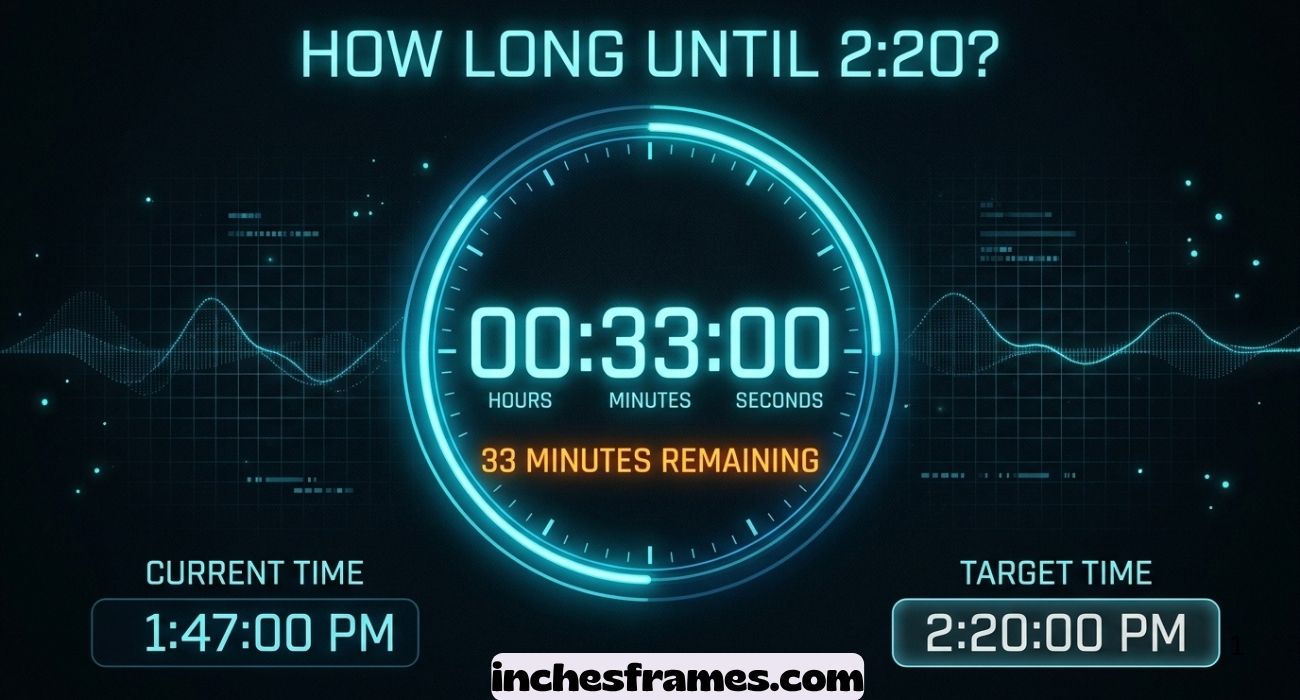
How long until 2:20? The exact time remaining depends on your current local time and whether you mean 2:20 AM or 2:20 PM. For example, if it is 1:20 PM and you want to know how long until 2:20 PM, you have exactly 1 hour remaining. If it is 2:10 PM, you have only 10 minutes left.
You can calculate the time remaining by subtracting the current time from your target time. If 2:20 has already passed, you must decide whether you mean the next 2:20 later that day or the same time on the following day. This guide explains how to calculate the exact time difference, convert hours into minutes, and avoid common mistakes involving AM, PM, midnight, and time zones.
1. Meaning / Definition
The phrase “How Long Until 2:20?” asks how much time remains before the clock reaches 2:20. The answer is a time duration measured in hours, minutes, and sometimes seconds. People often use this calculation to prepare for appointments, attend meetings, manage work tasks, or check how much time remains before an event starts.
The target time can refer to either 2:20 AM or 2:20 PM. In the United States, most everyday clocks use the 12-hour format, so AM and PM help distinguish morning from afternoon and evening. Without this detail, a time calculation may produce a result that does not match your plans.
For example, if the current time is 1:20 PM, the time remaining until 2:20 PM is one hour. However, if it is 3:00 PM, the next 2:20 AM is 11 hours and 20 minutes away. The correct answer depends on the current time and the intended occurrence of 2:20.
A time difference calculator can help find this duration, but you can also work it out manually by counting the hours and minutes between the two times.
2. Meaning in Simple Words
In simple words, “How Long Until 2:20?” means asking how much longer you need to wait before it becomes 2:20.
Look at your clock, identify the current time, and count forward until you reach the target. If it is 2:00 PM, you need to wait 20 minutes. If it is 1:30 PM, you need to wait 50 minutes. If it is 12:00 PM, you need to wait 2 hours and 20 minutes.
The calculation becomes slightly different when the target time has already passed. For example, if it is 3:00 PM and you want to know when 2:20 AM arrives, you must count through midnight. If you mean 2:20 PM on the following day, you must count an entire overnight period and the next afternoon.
The key is to identify the correct target first. Once you know whether you mean morning or afternoon, you can calculate the remaining time without confusion.
Quick Answer
How long until 2:20? The answer changes according to your current time. Here are some common examples when the target is 2:20 PM.
| Current time | Time remaining until 2:20 PM |
|---|---|
| 12:00 PM | 2 hours 20 minutes |
| 1:00 PM | 1 hour 20 minutes |
| 1:20 PM | 1 hour |
| 1:30 PM | 50 minutes |
| 1:45 PM | 35 minutes |
| 2:00 PM | 20 minutes |
| 2:10 PM | 10 minutes |
| 2:15 PM | 5 minutes |
| 2:19 PM | 1 minute |
| 2:20 PM | 0 minutes |
These examples assume that the target is 2:20 PM on the same day and that the current time is before that target.
If you need an exact, live answer, use your local clock and subtract the current time from 2:20. A countdown timer can also display the remaining hours, minutes, and seconds.
3. Real-Life Examples
Real-life examples make it easier to understand how a countdown timer works. The following calculations show how much time remains until 2:20 in different situations. Each example identifies the target time so that AM and PM do not cause confusion.
Example 1: It Is 1:20 PM
Suppose your current local time is 1:20 PM and you want to know how long until 2:20 PM.
The minutes are the same in both times, so you only need to count the difference between the hours. Moving from 1:20 PM to 2:20 PM takes exactly one hour.
Calculation: 2:20 PM − 1:20 PM = 1 hour.
You can use this calculation when you have a meeting scheduled for 2:20 PM, a class starting at that time, or an appointment you need to prepare for.
Example 2: It Is 1:30 PM
If it is 1:30 PM, you have 50 minutes until 2:20 PM.
First, count from 1:30 PM to 2:00 PM. That takes 30 minutes. Then count from 2:00 PM to 2:20 PM, which takes another 20 minutes.
Calculation: 30 minutes + 20 minutes = 50 minutes.
This method is useful when you need to estimate the time available to finish a task before a deadline.
Example 3: It Is 1:45 PM
When the current time is 1:45 PM, the target of 2:20 PM is 35 minutes away.
You can count 15 minutes from 1:45 PM to 2:00 PM. Then add the remaining 20 minutes from 2:00 PM to 2:20 PM.
Calculation: 15 minutes + 20 minutes = 35 minutes.
This calculation can help you decide whether you have enough time to prepare for an appointment, finish a short assignment, or get ready for a scheduled call.
Example 4: It Is 2:00 PM
If your clock shows 2:00 PM, the time remaining until 2:20 PM is 20 minutes.
The hour does not change during this calculation. You simply subtract the current minute value, 0, from the target minute value, 20.
Calculation: 20 − 0 = 20 minutes.
This is a simple example of calculating a short duration. You can use the same method for a reminder, a scheduled break, or an activity beginning at 2:20 PM.
Example 5: It Is 2:10 PM
If it is 2:10 PM, you have 10 minutes left until 2:20 PM.
Both times fall within the same hour, so you only need to subtract the minutes.
Calculation: 20 − 10 = 10 minutes.
This result can help when you need to leave for an appointment, join an online meeting, or finish preparing for an upcoming activity. If the task requires travel, remember to allow enough time to reach your destination.
Example 6: It Is 12:00 PM
In the United States, 12:00 PM means noon. If it is noon and your target is 2:20 PM on the same day, you have 2 hours and 20 minutes remaining.
Count two full hours from noon to 2:00 PM. Then add another 20 minutes to reach 2:20 PM.
Calculation: 2 hours + 20 minutes = 2 hours 20 minutes.
In total minutes, this duration equals 140 minutes because two hours contain 120 minutes, and the additional 20 minutes bring the total to 140.
Example 7: It Is 11:00 PM
Suppose it is 11:00 PM and you want to know how long until 2:20 AM. Since 2:20 AM occurs after midnight, you must include the change to the next day.
From 11:00 PM to midnight is one hour. From midnight to 2:00 AM is another two hours. Finally, add 20 minutes.
Calculation: 1 hour + 2 hours + 20 minutes = 3 hours 20 minutes.
Therefore, 2:20 AM is 3 hours and 20 minutes away. This calculation is helpful when planning an overnight trip, an early shift, or an activity scheduled for the early morning.
Example 8: It Is 3:00 PM
If it is 3:00 PM, the time 2:20 PM has already passed. You must decide which occurrence of 2:20 you want to calculate.
If you mean 2:20 AM the following morning, the calculation crosses midnight. From 3:00 PM to midnight is 9 hours, and from midnight to 2:20 AM is another 2 hours and 20 minutes.
Calculation: 9 hours + 2 hours 20 minutes = 11 hours 20 minutes.
If you mean 2:20 PM on the following day, the remaining duration is 23 hours and 20 minutes. The difference occurs because the second calculation continues all the way to the following afternoon.
4. Synonyms and Related Terms

People use several phrases when looking for the time remaining until a specific clock time. These phrases often describe the same basic calculation, but some focus on the number of hours, while others focus on minutes or a running timer.
Understanding these related terms helps you choose the right calculation for your needs.
Time Until 2:20
“Time until 2:20” refers to the duration between the current time and the next intended occurrence of 2:20. The answer depends on whether you mean 2:20 AM or 2:20 PM.
For example, if it is 1:50 PM, the time until 2:20 PM is 30 minutes. If it is 2:30 PM, the next 2:20 AM is 11 hours and 50 minutes away.
Time Remaining Until 2:20
“Time remaining until 2:20” describes the amount of time left before the target arrives. It is especially useful for planning deadlines, appointments, and scheduled activities.
For instance, if a meeting begins at 2:20 PM and the current time is 1:55 PM, you have 25 minutes remaining. This tells you how much preparation time is available before the meeting starts.
Countdown to 2:20
A countdown timer shows the time left before a selected target. Depending on the tool, it may display hours, minutes, and seconds.
A countdown to 2:20 can be useful when you want to watch the time decrease rather than calculate it manually. However, you must select the correct target and time zone if the event takes place in another location.
How Many Hours Until 2:20?
This question focuses on the number of hours between the current time and the target. The result may include additional minutes rather than a whole number of hours.
For example, from 12:20 PM to 2:20 PM is exactly two hours. From 1:20 PM to 2:20 PM is one hour. From 1:30 PM to 2:20 PM is 50 minutes, which is less than one full hour.
How Many Minutes Until 2:20?
This phrase asks for the remaining duration expressed entirely in minutes. To convert hours into minutes, multiply the number of hours by 60 and then add any extra minutes.
For example, 1 hour and 20 minutes equals 80 minutes. Therefore, from 1:00 PM to 2:20 PM, the remaining time is 80 minutes.
2:20 Countdown
A 2:20 countdown is a timer set to reach the target time of 2:20. It may be used on a phone, computer, digital clock, or online timer.
Unlike a timer that runs for a fixed duration of 20 minutes, a clock-based countdown depends on the current time. If it is 1:30 PM, the countdown to 2:20 PM lasts 50 minutes, not 20 minutes.
Related Time Terms
Other related searches include time duration calculator, time difference, hours and minutes calculator, minutes until 2:20 AM, and minutes until 2:20 PM. Each term relates to finding or expressing the time between two points.
The 24-hour clock can also help remove AM/PM confusion. In this format, 2:20 AM is written as 02:20, while 2:20 PM is written as 14:20. The 24-hour format is common in transport schedules, work shifts, and other settings where clarity matters.
5. When to Use
Calculating the time until 2:20 can help you organize everyday activities and make better use of the time available. It is particularly useful when you have a fixed start time and need to decide what you can complete beforehand.
Planning an Appointment
Suppose you have a doctor’s appointment at 2:20 PM. If it is currently 1:40 PM, you have 40 minutes before the appointment begins.
Knowing this duration helps you plan when to leave, gather any necessary documents, and prepare for the visit. If you need to travel, calculate the journey time separately and allow extra time for possible delays.
Managing Study Time
Students can use a countdown to plan study sessions, prepare for classes, or finish assignments before a deadline.
For example, if your study session ends at 2:20 PM and the current time is 1:20 PM, you have one hour available. You can use that time to review notes, practice questions, or complete a specific section of an assignment.
A clock-based countdown can also remind you when to stop studying and move to the next activity.
Planning Work Tasks
Workers can calculate the time remaining before meetings, shift changes, scheduled breaks, and project deadlines.
If a meeting starts at 2:20 PM and it is 1:50 PM, you have 30 minutes to prepare. You can use that time to review documents, finish an urgent task, or organize questions for the meeting.
Accurate calculations also help prevent scheduling conflicts when several activities occur close together.
Waiting for an Event
You may want to know how long remains before an online class, livestream, appointment, or planned activity begins.
If the event starts at 2:20 PM and the current time is 2:05 PM, the wait is 15 minutes. A countdown timer can make that interval easier to track without repeatedly checking the clock.
For events scheduled in another city, confirm the event’s local time before calculating the countdown.
Setting an Alarm
An alarm helps you remember a future task, but setting the correct time requires knowing whether you mean morning or afternoon.
If you need to wake up at 2:20 AM, choose the AM setting on a 12-hour clock. If you want a reminder for an afternoon appointment, select 2:20 PM.
Check the alarm’s date and repeat settings when the event occurs overnight or on a different day.
Planning Travel
Travel plans often depend on departure times, arrival times, and connections. Knowing how long until 2:20 can help you decide when to leave for a station, airport, or meeting point.
For example, if a train departs at 2:20 PM and it is 1:20 PM, you have one hour until departure. However, this does not mean you have a full hour to reach the station. You must subtract the time needed to travel and arrive before departure.
For flights and other scheduled transport, always verify the local time shown by the service provider.
See Also ; What Time Was It 6 Hours Ago? Calculate the Exact Time Easily
6. When NOT to Use
A basic countdown works well when the current time and target time are clear. However, you should not rely on a simple calculation without checking important details that could change the result.
Do Not Forget AM and PM
Do not assume that 2:20 always means the same part of the day. The difference between 2:20 AM and 2:20 PM is 12 hours.
For example, if it is 1:30 AM, the time until 2:20 AM is 50 minutes. If you mean 2:20 PM instead, the remaining time is 12 hours and 50 minutes.
Always identify the intended target before calculating.
Do Not Assume 2:20 Is Always Today
If the current time is later than your target, the next occurrence may be tomorrow.
For example, at 3:00 PM, 2:20 PM has already passed. The next 2:20 AM is 11 hours and 20 minutes away, while 2:20 PM the following day is 23 hours and 20 minutes away.
Check the date as well as the clock time whenever the calculation crosses midnight.
Do Not Ignore Minutes
Looking only at the hour can lead to an incorrect answer. A current time of 1:55 PM is much closer to 2:20 PM than 1:05 PM.
At 1:55 PM, only 25 minutes remain. At 1:05 PM, 1 hour and 15 minutes remain.
Always compare both the hour and minute values rather than estimating from the hour alone.
Do Not Ignore Time Zones
A scheduled event may use a different time zone from your current location. In that case, calculating from your local clock without converting the target time can produce the wrong countdown.
For example, an online meeting listed at 2:20 PM Eastern Time may not begin at 2:20 PM for someone in another US time zone. Check the event’s stated time zone and convert it to your local time before calculating the duration.
Daylight saving time can also affect the difference between locations. Use a reliable time-zone converter for events scheduled across regions, particularly when the date matters.
Do Not Confuse Midnight and Noon
Midnight and noon are different points in the day. On a 12-hour clock, 12:00 AM means midnight, while 12:00 PM means noon.
This distinction matters when calculating how long until 2:20. From 12:00 AM to 2:20 AM is 2 hours and 20 minutes. From 12:00 PM to 2:20 PM, the duration is also 2 hours and 20 minutes, but the events occur 12 hours apart.
If you are unsure, use the 24-hour clock: midnight is 00:00, and noon is 12:00.
7. Common Mistakes
Small errors can change a time calculation significantly. Understanding the most common mistakes helps you calculate the time remaining accurately, especially when the target is near midnight or falls in a different AM/PM period.
Mistake 1: Confusing 2:20 AM With 2:20 PM
The most common source of confusion is failing to identify whether the target is in the morning or afternoon.
If the current time is 1:20 AM, the wait until 2:20 AM is one hour. If the target is 2:20 PM, the wait is 13 hours.
How to avoid it: Confirm AM or PM before subtracting the times.
Mistake 2: Forgetting the Next Day
A target time that has passed cannot be reached again on the same day. You must move to the next occurrence if that is what your schedule requires.
For example, if it is 10:00 PM and the target is 2:20 AM, you need to count through midnight. The correct duration is 4 hours and 20 minutes.
How to avoid it: Check whether the target occurs later today or on the following day.
Mistake 3: Ignoring Minutes
Some people compare only the hour numbers and overlook the minutes. This can produce a result that is too long or too short.
For example, from 1:50 PM to 2:20 PM, the answer is 30 minutes, not one hour. You can count 10 minutes to 2:00 PM and another 20 minutes to 2:20 PM.
How to avoid it: Break the calculation into smaller intervals when the minute values differ.
Mistake 4: Counting Backward
If the goal is to find how long until a future time, you should measure the duration from the current time forward to the target. Subtracting in the wrong direction can make the result negative or confusing.
For example, from 1:40 PM to 2:20 PM, count 20 minutes to 2:00 PM and another 20 minutes to 2:20 PM. The result is 40 minutes.
How to avoid it: Start at the current time and count forward to the intended target.
Mistake 5: Confusing 12 AM and 12 PM
Mixing up midnight and noon can shift a calculation by 12 hours.
If it is 11:00 AM, the time until 12:00 PM is one hour. If it is 11:00 PM, the time until 12:00 AM is also one hour, but midnight begins the next calendar day.
How to avoid it: Remember that 12 AM is midnight and 12 PM is noon.
Mistake 6: Forgetting Overnight Calculations
When a countdown crosses midnight, you must include the time remaining before midnight and the time after midnight.
For example, from 11:30 PM to 2:20 AM, there are 30 minutes until midnight and 2 hours and 20 minutes after midnight. The total is 2 hours and 50 minutes.
How to avoid it: Divide overnight calculations into two parts: the time until midnight and the time from midnight to the target.
Mistake 7: Assuming the Answer Stays the Same
The remaining time decreases as the clock moves forward. A calculation that is correct at 1:30 PM will no longer be correct at 1:45 PM.
At 1:30 PM, 50 minutes remain until 2:20 PM. Fifteen minutes later, only 35 minutes remain.
How to avoid it: Check the current time again if you need an up-to-date answer. Use a live countdown when seconds matter.
8. Comparison with Similar Terms
Several time-related terms sound similar but serve slightly different purposes. Understanding the differences helps you choose the right method for finding the time until 2:20.
| Term | Meaning | Example |
|---|---|---|
| Time until 2:20 | Duration before the target time | 50 minutes from 1:30 PM |
| Time difference | Duration between two clock times | Difference between 1:30 PM and 2:20 PM |
| Countdown timer | A display that tracks remaining time | A timer showing 00:50:00 |
| Time duration calculator | A tool that calculates the length of an interval | 1 hour 20 minutes between two times |
| Alarm clock | A device or app that alerts you at a chosen time | An alarm set for 2:20 PM |
| 24-hour clock | A time format that uses values from 00:00 to 23:59 | 14:20 for 2:20 PM |
| Elapsed time | Time that has already passed | 30 minutes since 1:50 PM |
The main difference is that a countdown looks forward to a target, while elapsed time looks backward at a period that has already passed. A time calculator can handle either type of calculation, depending on the times you enter.
For a straightforward question such as “How Long Until 2:20?”, you usually need only the current time, the target time, and the correct AM/PM or 24-hour setting.
See Also ; 25 Daily-Use Items Measuring 9 Inches Long (Real-Life Examples
How to Calculate the Time Until 2:20 Manually
You do not need a special tool to calculate the remaining time. A simple method works for most everyday situations.
First, identify the current time and decide whether the target is 2:20 AM or 2:20 PM. Next, count forward from the current time to the target. If the calculation crosses a full hour, count the minutes up to that hour and then add the remaining minutes.
For example, if it is 1:35 PM, count 25 minutes to 2:00 PM and another 20 minutes to 2:20 PM. The total is 45 minutes.
You can also calculate the duration by converting both times to minutes after midnight, provided both times belong to the same day. For 1:35 PM, the current time is 815 minutes after midnight. For 2:20 PM, the target is 860 minutes after midnight.
Subtract the values:
860 − 815 = 45 minutes.
If the target falls on the following day, add 24 hours to the target’s time value before subtracting. This adjustment accounts for the change of date.
Converting the Remaining Time Into Minutes
Sometimes, the total number of minutes is more useful than hours and minutes. For example, you may need to know how many minutes remain before a class begins or a timer ends.
Use the following conversion rules:
| Duration | Total minutes |
|---|---|
| 10 minutes | 10 minutes |
| 30 minutes | 30 minutes |
| 1 hour | 60 minutes |
| 1 hour 20 minutes | 80 minutes |
| 1 hour 30 minutes | 90 minutes |
| 2 hours | 120 minutes |
| 2 hours 20 minutes | 140 minutes |
| 3 hours 20 minutes | 200 minutes |
To convert a duration into minutes, multiply the hours by 60 and add the remaining minutes. For example, 2 hours and 20 minutes equals \(2 \times 60 + 20 = 140\) minutes.
Frequently Asked Questions
How long until 2:20 PM if it is 2:00 PM?
There are exactly 20 minutes until 2:20 PM. Both times fall within the same hour, so subtract 0 minutes from 20 minutes.
How many minutes are there until 2:20 if it is 1:50 PM?
There are 30 minutes until 2:20 PM. You can count 10 minutes to 2:00 PM and another 20 minutes to reach the target.
How long until 2:20 AM from 11:00 PM?
There are 3 hours and 20 minutes until 2:20 AM the following day. The calculation includes one hour until midnight and another 2 hours and 20 minutes after midnight.
How long until 2:20 PM from noon?
From 12:00 PM to 2:20 PM, the duration is 2 hours and 20 minutes, or 140 minutes.
What if 2:20 PM has already passed?
If 2:20 PM has passed, you must decide whether you mean 2:20 AM later that night or 2:20 PM the next day. The answer depends on your intended target.
For example, at 3:00 PM, 2:20 AM the following day is 11 hours and 20 minutes away.
Is 2:20 AM the same as 14:20?
No. In the 24-hour clock, 2:20 AM is written as 02:20, while 2:20 PM is written as 14:20. The 24-hour format helps avoid AM/PM confusion.
Can a countdown timer calculate the exact time until 2:20?
Yes. A countdown timer can calculate the remaining duration when you provide the correct target time and date. A live timer can also update the display as time passes. Its accuracy depends on the device clock, timer software, and correct time settings.
Does the time until 2:20 change by location?
Yes. The answer can differ if people are in different time zones. If an event is scheduled for 2:20 PM in New York, someone in California must convert that target to local time before calculating the countdown.
How do I calculate the time until 2:20 without a calculator?
Start at your current time and count forward to 2:20. Break the duration into smaller parts, such as counting to the next full hour and then adding the remaining minutes. For an overnight calculation, include the time until midnight and continue from midnight to the target.
Why does the countdown to 2:20 keep changing?
The remaining time decreases as the clock advances. If 50 minutes remain at 1:30 PM, only 35 minutes remain at 1:45 PM. A live countdown updates continuously, while a manually calculated result becomes outdated as time passes.
Conclusion
Knowing how long until 2:20 is a simple way to manage appointments, work tasks, study sessions, and daily plans. The exact answer depends on your current local time, whether you mean 2:20 AM or 2:20 PM, and whether the target occurs today or the following day.
To calculate the remaining time, identify the correct target, count forward from the current time, and account for any change in the hour or date. Remember that one hour equals 60 minutes and that overnight calculations must include midnight. With these simple steps, you can calculate the time until 2:20 accurately and plan your next activity with confidence.