
Dollar Bill Dimensions: Size, Height, and Length
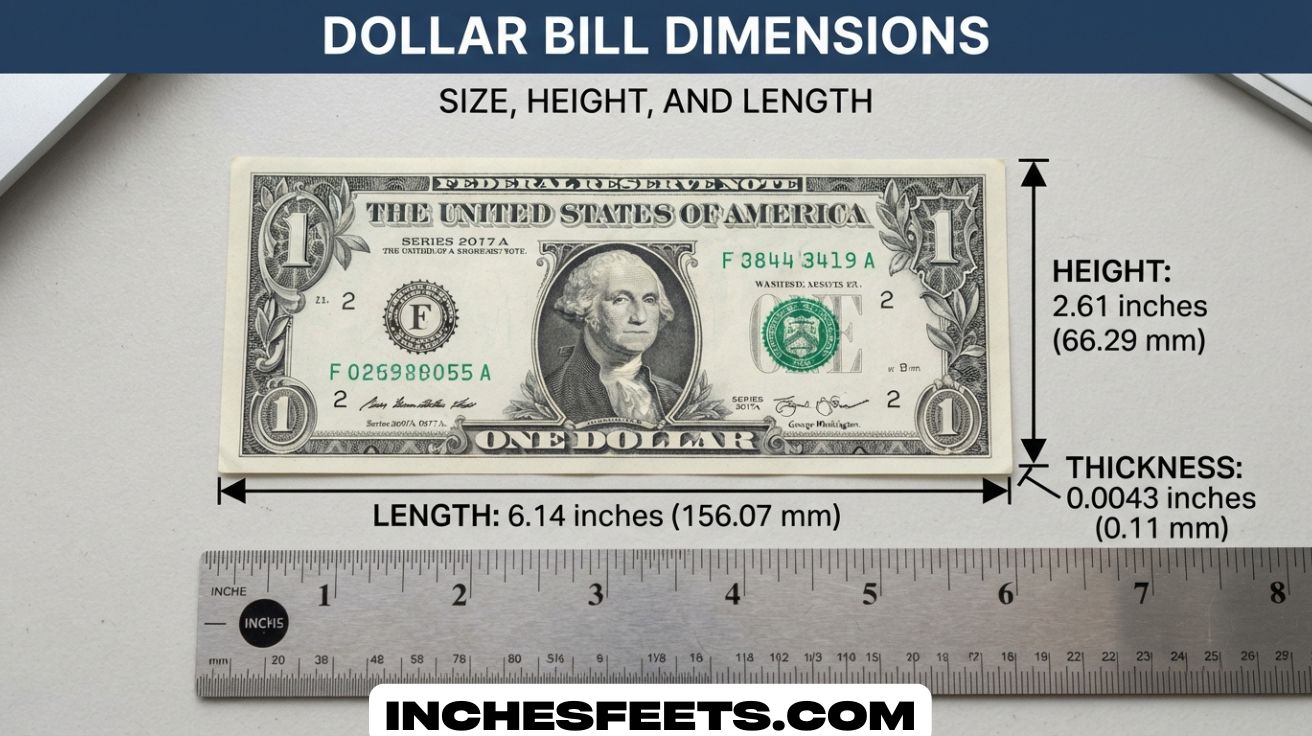
Dollar Bill Dimensions are the size, length, width, and thickness of U.S. paper money. Every bill, from $1 to $100, has the same measurements. These dimensions help bills fit in wallets, ATMs, and vending machines easily.
Do you know all U.S. bills are exactly the same size? This makes handling money simple. It also helps machines count bills quickly. Understanding Dollar Bill Dimensions can be fun and useful.
A dollar bill is 6.14 inches long and 2.61 inches wide. Its thickness is 0.0043 inches, and it weighs about 1 gram. These Dollar Bill Dimensions have stayed the same since 1929.
Dollar Bill Dimensions in Different Units
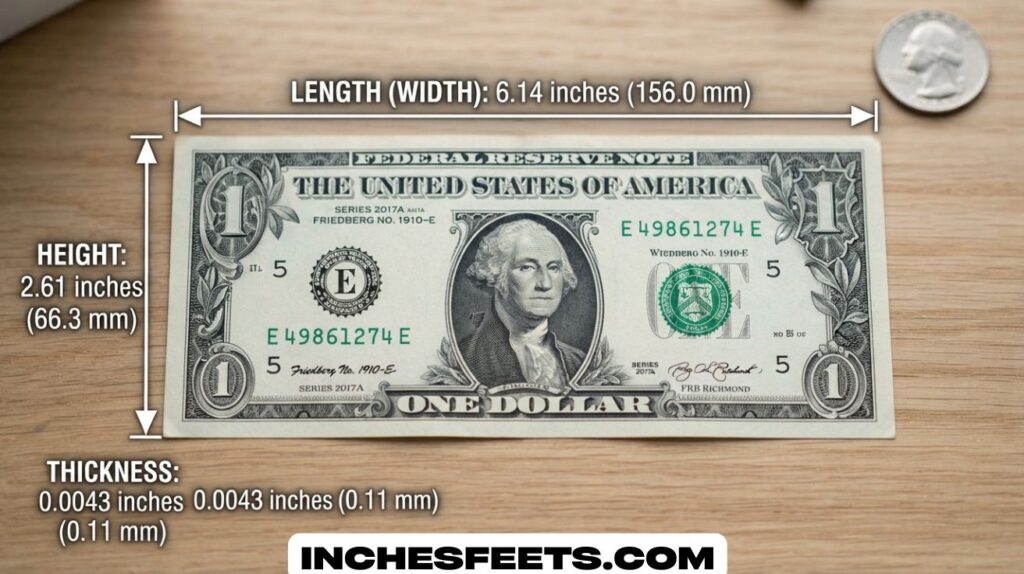
A U.S. dollar bill measures exactly 6.14 inches long and 2.61 inches wide, which translates to 156 mm by 66.3 mm in metric units. Its Bill thickness is approximately 0.0043 inches or 0.109 mm, making it thinner than two sheets of regular printer paper. Despite being thin, the Cotton-linen currency composition gives it durability and a unique texture that feels stronger than ordinary paper. Each bill weighs about 1 gram, which means a stack of 100 bills weighs roughly 100 grams, and a thousand bills weigh just over 2 pounds.
In practical terms, a dollar bill is slightly longer than a standard credit card but narrower. It fits comfortably in wallets, cash registers, ATMs, and vending machines thanks to its standardized dimensions. These measurements are consistent across all Standardized U.S. bills, which simplifies the design of ATM bill compatibility and Vending machine bill size.
Quick Reference Table
Here’s a simple table to quickly understand Dollar bill dimensions and weight across different units:
| Feature | Imperial | Metric |
| Length | 6.14 inches | 156 mm |
| Width | 2.61 inches | 66.3 mm |
| Thickness | 0.0043 inches | 0.109 mm |
| Weight | 0.035 ounces | 1 gram |
These measurements apply to all denominations, making Dollar bill thickness stack height easy to calculate for collectors or anyone handling cash.
Are All Dollar Bill Dimensions the Same?
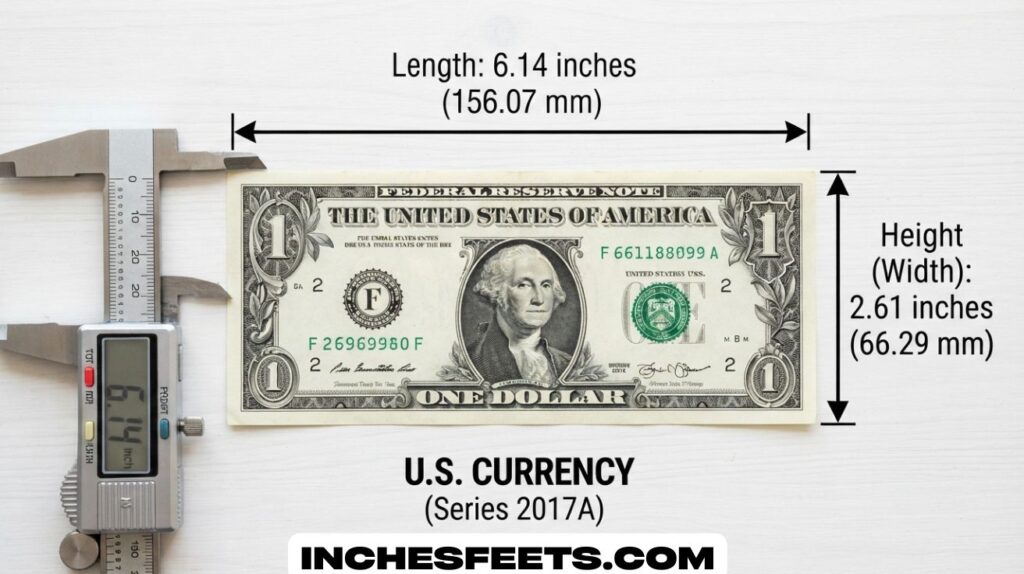
Yes, all U.S. bills share the same Dollar bill dimensions, from the $1 bill to the $100 bill. This uniformity is one of the features that makes Standardized U.S. bills practical for both machines and humans. Unlike many other countries, which use different sizes for different denominations, the United States chose consistency. This standardization ensures that Federal Reserve bills fit easily in ATMs, wallets, and vending machines without special adjustments.
Keeping all bills the same size also reduces production costs and simplifies printing and storage. By maintaining consistent American money dimensions, the Treasury has made money handling more efficient and reliable across the country.
One Size Fits All U.S. Currency
The decision to maintain identical Dollar bill dimensions across all denominations has historical and practical reasons. Machines like ATMs or vending machines can accept bills without recalibrating for different sizes. Wallets and cash registers do not need extra compartments for different bill types. From a production standpoint, printing Standardized U.S. bills reduces errors and waste. While some countries vary bill sizes to help visually impaired users, the United States prioritized U.S. currency size uniformity for efficiency and cost-effectiveness.
Historical Dollar Bill Sizes
Before 1929, Historical U.S. banknotes were much larger than today’s bills. Known as “horse blanket currency,” these bills sometimes measured up to 7.4 inches by 3.1 inches, nearly 30% larger than modern notes. This variety made handling money cumbersome and complicated storage in banks and wallets.
In 1929, the Treasury decided to standardize Dollar bill length and width. The new smaller size not only saved on production costs but also improved durability. The switch modernized U.S. dollar history and helped streamline banking operations. Today, the uniform American money dimensions trace their roots to this important historical change.
Dollar Bill Dimensions by Denomination
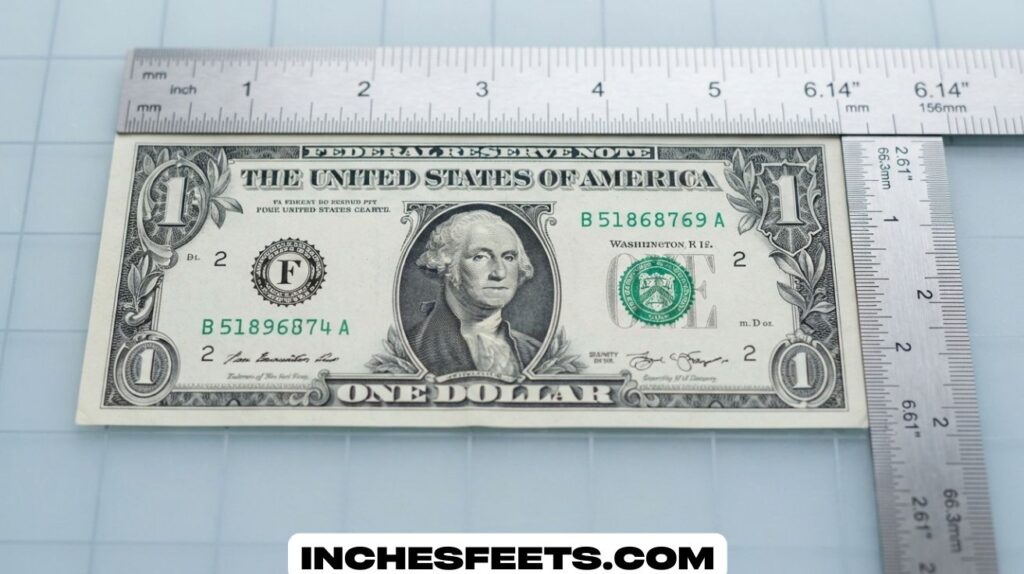
All modern U.S. bills share identical Dollar bill dimensions, but each denomination features unique designs and security features.
Common Denominations
The $1 bill features George Washington on the front and the Great Seal of the United States on the back. Its Bill thickness and size match every other denomination. The $5 bill depicts Abraham Lincoln and includes the Lincoln Memorial on the back, with subtle design updates to prevent counterfeiting. The $10 bill features Alexander Hamilton and the U.S. Treasury building on the reverse. Notably, this is the only bill without a president’s portrait.
The $20 bill has Andrew Jackson’s portrait, widely circulated, and the White House on the back. The $50 bill features Ulysses S. Grant and the U.S. Capitol building, with green and peach colors to prevent forgery. Finally, the $100 bill, featuring Benjamin Franklin, is recognized worldwide for its blue security threads and Bill security threads and color-shifting ink. Every $1, $5, $10, $20, $50, $100 bill sizes share identical Dollar bill dimensions, simplifying circulation.
Rare and Discontinued Bills
Some bills are rare or no longer in circulation but still maintain standard Dollar bill length and width. The $2 bill, featuring Thomas Jefferson, is uncommon but not rare. Large denominations like $500, $1,000, $5,000, and $10,000 bills were discontinued in 1969 due to the risk of misuse by criminals. The $100,000 Gold Certificate never entered public circulation and was used only for transactions between Federal Reserve banks.
Collectors prize these Historical U.S. banknotes for their rarity and design features. Many bills now reside in museums or private collections, offering fascinating insights into U.S. dollar history and Money collector facts.
See Also : Jerry Can Size Dimensions: Height, and Length – Complete Guide
Dollar Bill Thickness and Stack Height
How Thick Is a Dollar Bill?
A single U.S. dollar bill measures just 0.0043 inches thick, or 0.109 mm. Despite its thinness, the Cotton-linen currency composition gives it durability far beyond ordinary paper. Bills can withstand around 4,000 folds without tearing. This makes handling Standardized U.S. bills practical for daily use, vending machines, and ATMs.
Stack Calculations
Understanding Dollar bill thickness stack height is both fascinating and practical. Ten bills stacked together reach about 0.43 millimeters, barely noticeable. A stack of 100 bills is roughly 0.43 inches, less than half an inch tall. A thousand one-dollar bills reach 4.3 inches, about the height of a coffee mug. Ten thousand bills stack to 43 inches, or around 3.5 feet.
For a million dollars in $1 bills, the stack would tower approximately 358 feet, taller than the Statue of Liberty. In contrast, a million dollars in $100 bills is just 3.58 feet, compact enough to fit in a briefcase. These calculations demonstrate the impact of Currency weight, Dollar bill thickness, and American money dimensions in everyday and large-scale cash handling.
The Exact Measurements of a U.S. Dollar Bill
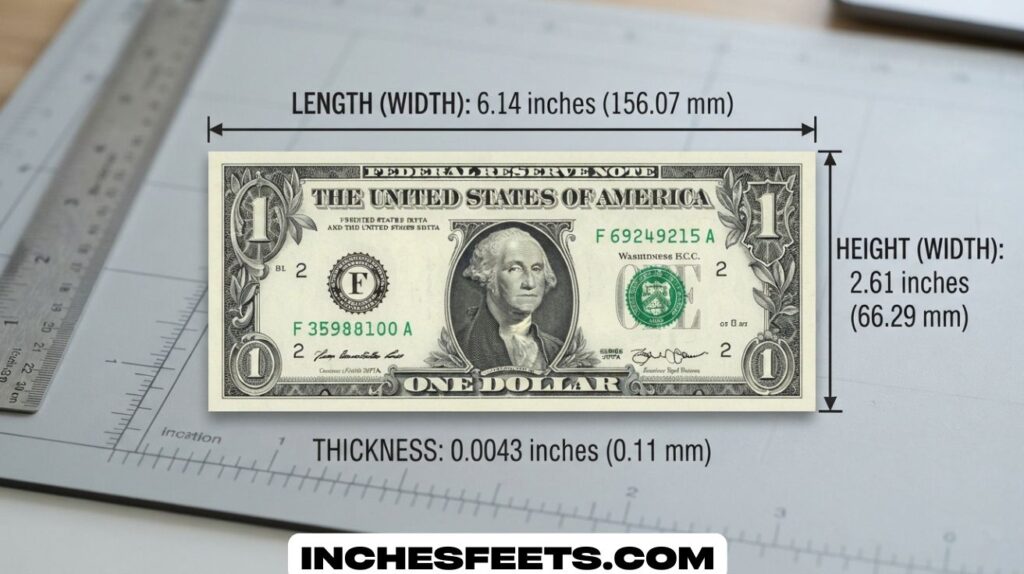
A U.S. dollar bill measures 6.14 inches in length and 2.61 inches in width. Its Bill thickness is only 0.0043 inches, or 0.109 mm, making it thinner than ordinary paper. The standardized size ensures that all denominations fit easily in wallets, cash registers, and machines. These Dollar bill dimensions are consistent across $1, $5, $10, $20, $50, and $100 bills.
The consistent size of Standardized U.S. bills makes currency handling simple and practical. Despite their thinness, the Cotton-linen currency composition gives bills strength and durability. They can withstand thousands of folds without tearing. Knowing these exact measurements is essential for collectors, educators, and anyone who wants a clear understanding of American money dimensions and their practical uses.
Dollar Bill Dimensions in Metric Units
In metric terms, a U.S. dollar bill measures 156 mm in length and 66.3 mm in width. Its thickness converts to 0.109 mm, and each bill weighs roughly 1 gram. Understanding these Paper money measurements in metric units is useful for international comparisons or educational projects, providing a clear perspective on how U.S. currency size stacks up globally.
These metric measurements also help visualize cash storage. For example, stacking 100 bills equals about 4.3 centimeters in height, while 1,000 bills reach roughly 43 centimeters. This makes Dollar bill thickness stack height calculations easier to grasp. The combination of length, width, and weight ensures that all Federal Reserve bills work seamlessly in ATMs, vending machines, and wallets.
Why All U.S. Bills Share the Same Size
All U.S. currency, from $1 to $100, shares identical Dollar bill dimensions. This uniformity makes handling and counting money easier for banks, businesses, and consumers. Machines like ATMs and vending machines can process bills without adjusting for different sizes, enhancing efficiency in everyday financial transactions and supporting ATM bill compatibility nationwide.
The uniform size also reduces production costs and waste. By creating Standardized U.S. bills, the Treasury ensures consistency and durability. Collectors benefit as well, since knowing exact Dollar bill length and width helps identify authentic bills. Uniform dimensions simplify storage and distribution, making the U.S. currency system practical and highly organized.
The History Behind Modern Dollar Bill Dimensions
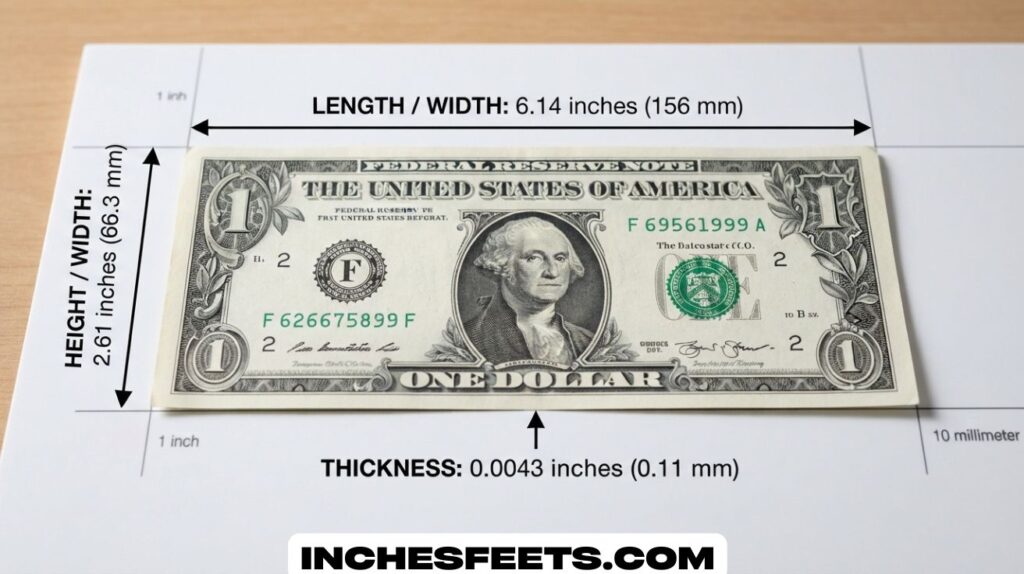
Before 1929, Historical U.S. banknotes were larger and varied in size. These “horse blanket” bills sometimes reached 7.4 inches by 3.1 inches. Handling, storing, and transporting them was difficult. The Treasury standardized the smaller Dollar bill dimensions to save on production costs and improve efficiency across banks and businesses.
This change marked a major step in U.S. dollar history. Smaller bills fit better in wallets and registers and lasted longer in circulation. By adopting uniform American money dimensions, the Treasury also enabled better machine processing, including Vending machine bill size compatibility. The decision created the modern size we know today.
See Also : Red Bull Can Size Dimensions: Height and Length
Dollar Bill Dimensions for Collectors
Collectors pay close attention to Dollar bill length and width and design features. Knowing Bill thickness and subtle security details like color-shifting ink helps identify authentic bills. Collecting rare denominations, including $2 bills or discontinued Large denomination bills ($500, $1,000, $10,000), is easier when the standard dimensions are understood.
Understanding Paper money measurements also allows collectors to display bills accurately in albums or frames. Stacking, storing, and protecting them requires awareness of Dollar bill thickness stack height. The uniform size across all Federal Reserve bills ensures that collectors can easily compare bills from different years and series.
Comparing Dollar Bills with Everyday Objects
A U.S. dollar bill is slightly longer than a standard credit card but narrower, measuring 6.14 inches by 2.61 inches. This practical U.S. currency size allows it to fit perfectly in wallets, cash registers, and money clips. Even vending machines are designed to accommodate these Dollar bill dimensions.
The thickness is less than two sheets of printer paper, but the Cotton-linen currency composition provides durability. Visualizing stacks can be interesting: 100 bills equal roughly half an inch, while a million $1 bills reach 358 feet. This comparison illustrates Dollar bill thickness stack height and emphasizes the practicality of American money dimensions.
Design Features and Security Measures
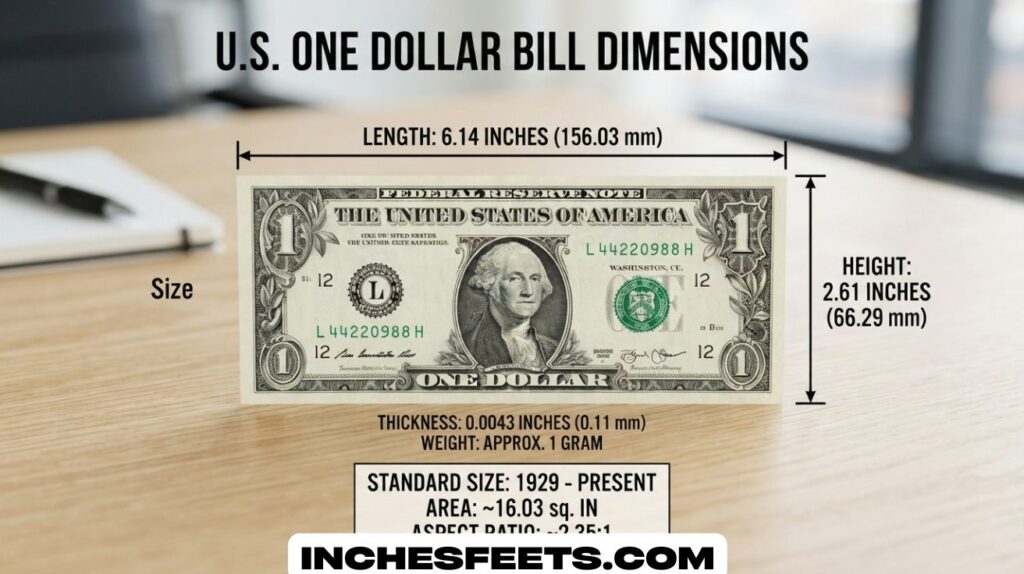
Each denomination includes unique Currency design features. From portraits of presidents to the Bill security threads and color-shifting ink, these elements prevent counterfeiting. Even though the $1, $5, $10, $20, $50, $100 bill sizes are identical, the design changes make each denomination instantly recognizable.
Security features also enhance durability and authenticity. Watermarks, microprinting, and colored threads in the cotton-linen blend help banks, machines, and individuals verify bills. Understanding these Dollar bill dimensions alongside security elements is essential for collectors, educators, and anyone handling Standardized U.S. bills.
Dollar Bill Thickness and Stack Heights
A single dollar bill is only 0.0043 inches thick. While extremely thin, the Cotton-linen currency composition ensures resilience. Folding, stacking, or handling bills in everyday life does not easily damage them, making Dollar bill thickness stack height calculations reliable and practical for businesses and collectors.
Stacks grow quickly with multiple bills. Ten bills measure less than half a millimeter, 100 bills are 0.43 inches, and 1,000 bills reach 4.3 inches. Calculating height for Currency weight and volume becomes easier with these standard Dollar bill dimensions, helping banks, businesses, and enthusiasts visualize cash storage.
Rare and Discontinued U.S. Bills
Some bills, like the $2 bill, are uncommon, while Large denomination bills ($500, $1,000, $10,000) were discontinued in 1969. Despite their rarity or high value, all these notes share the same Dollar bill dimensions as modern bills. Knowing their Paper money measurements helps collectors authenticate and preserve these historical notes.
The $100,000 Gold Certificate, used only for interbank transactions, also follows the standard size. Many discontinued bills are now museum pieces, prized for their design and historical value. Understanding Dollar bill length and width helps collectors and historians maintain accurate records and proper storage conditions.
See Also : Celsius Can Dimensions: Size, Height & Length
Practical Applications of Dollar Bill Dimensions
The uniform Dollar bill dimensions allow ATMs, vending machines, and cash registers to process bills efficiently. Businesses rely on consistent U.S. currency size to avoid machine jams, miscounts, or operational errors. Knowing Dollar bill thickness ensures smooth handling in daily transactions.
For educators and students, Paper money measurements illustrate practical math concepts, including Dollar bill thickness stack height, weight, and volume calculations. Collectors use these dimensions to design display cases and albums. Overall, the uniformity of Standardized U.S. bil
FAQs
Is a dollar bill 6 inches long?
A U.S. dollar bill is 6.14 inches long, slightly longer than 6 inches. All denominations share this standard Dollar bill length.
How long is a $20 bill in inches?
The $20 bill measures 6.14 inches in length, identical to all other Standardized U.S. bills.
Is a dollar bill 7 inches?
No, a modern dollar bill is 6.14 inches long, not 7 inches. Older pre-1929 bills were larger.
How long is a $100 bill?
The $100 bill is also 6.14 inches long, the same as every other U.S. currency denomination.
Conclusion
Dollar Bill Dimensions show that every U.S. bill, from $1 to $100, has the same size. Each bill measures 6.14 inches long and 2.61 inches wide with a thickness of 0.0043 inches. This uniform size makes it easy to carry bills in wallets, store them in banks, and use them in ATMs or vending machines. The Dollar bill dimensions also help collectors and teachers understand money better. Knowing these measurements is useful for counting, stacking, and organizing cash safely.
The standard Dollar Bill Dimensions have stayed the same since 1929. The cotton-linen mix makes the bills strong and long-lasting. All designs, colors, and security features fit perfectly on the same size. Learning these dimensions helps children, students, and adults handle money correctly and appreciate how well U.S. currency works every day.