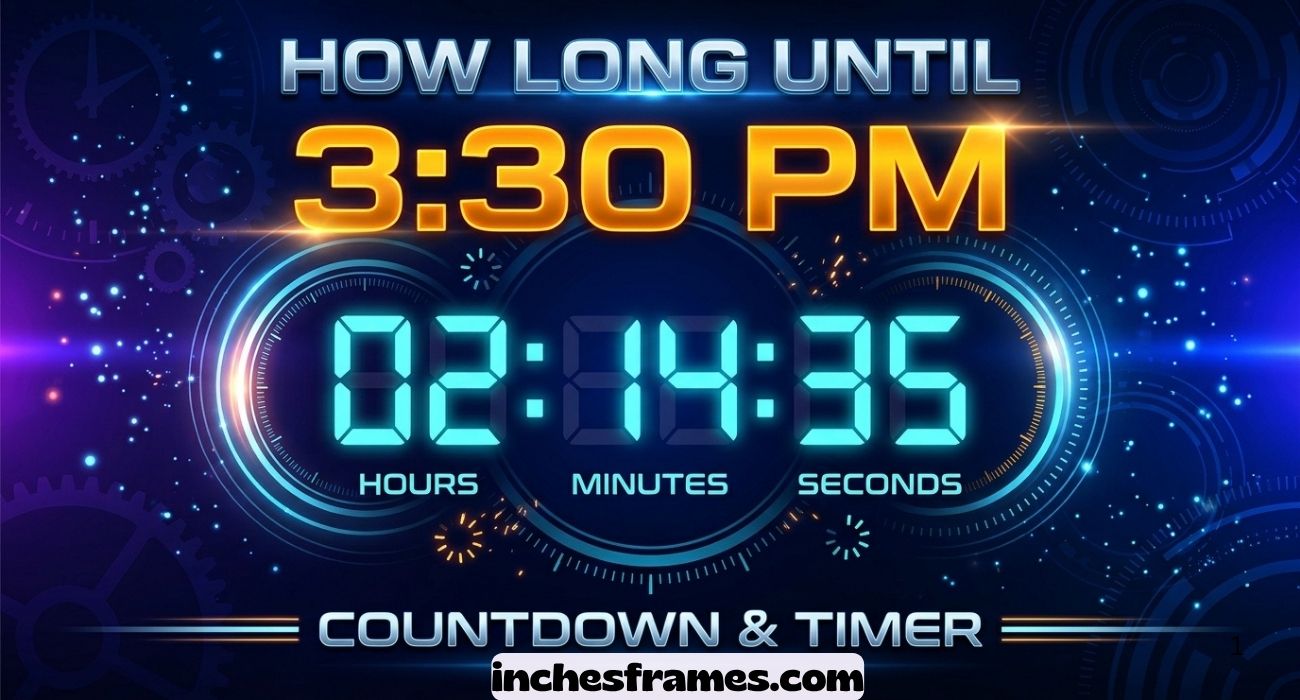
How Long Until 3:30 PM? Time Countdown & Timer
How long until 3:30 PM? The exact answer depends on your current local time. For example, if it is 1:30 PM, you have 2 hours left until 3:30 PM. If it is 3:00 PM, only 30 minutes remain. You can use a countdown timer or a simple time calculation to find the remaining hours, minutes, and seconds.
Knowing how long until 3:30 PM can help you plan your workday, prepare for an appointment, manage school activities, or finish a task before a deadline. This guide explains how to calculate the time remaining, convert 3:30 PM into different time formats, and handle situations where the target time has already passed.
What Does “How Long Until 3:30 PM?” Mean?
The question “How Long Until 3:30 PM?” asks how much time remains between the current time and 3:30 in the afternoon. The answer changes throughout the day because every passing minute reduces the remaining time.
For example, if the current time is 12:30 PM, exactly 3 hours remain until 3:30 PM. At 2:00 PM, the remaining time is 1 hour and 30 minutes. At 3:15 PM, only 15 minutes remain.
Understanding the Meaning of 3:30 PM
The time 3:30 PM means thirty minutes past three o’clock in the afternoon. It belongs to the second half of the day in the 12-hour clock system, which uses AM and PM to distinguish morning and afternoon or evening hours.
AM generally covers the period from midnight until just before noon. PM covers the period from noon until just before midnight. Therefore, 3:30 AM occurs early in the morning, while 3:30 PM occurs in the afternoon.
This distinction matters when setting alarms, planning meetings, booking transportation, or checking deadlines. Confusing AM with PM can shift a scheduled event by 12 hours.
What Does Time Until 3:30 PM Mean?
Time until 3:30 PM is the duration between the current time and the next occurrence of 3:30 PM. People commonly express this duration in hours and minutes, although a digital clock or timer may also display seconds.
Suppose you check your clock at 1:45 PM. From 1:45 PM to 2:45 PM is one hour. From 2:45 PM to 3:30 PM is another 45 minutes. Therefore, 1 hour and 45 minutes remain.
If it is already 4:00 PM, today’s 3:30 PM has passed. In that case, a countdown to the next 3:30 PM would normally refer to tomorrow.
Why Does the Answer Depend on Your Current Time?
The remaining time depends on three main factors: your current clock time, the intended date, and your time zone.
A person checking the clock at 2:00 PM has 90 minutes remaining. Someone checking at 3:00 PM has only 30 minutes remaining. The same target time produces different answers because the starting times differ.
Your location also matters when the target refers to a scheduled event in another place. For example, 3:30 PM in New York may not occur at the same moment as 3:30 PM in California. Always confirm which location’s time you need to follow.
How Long Until 3:30 PM?
The answer is the difference between your current local time and 3:30 PM. If your clock shows 2:30 PM, you have 1 hour remaining. If it shows 3:10 PM, you have 20 minutes remaining.
For the most accurate result, check your current clock and subtract that time from the target. A live countdown timer can make this easier by updating the remaining time automatically.
Check the Countdown to 3:30 PM
A countdown to 3:30 PM shows how much time remains before the target time arrives. Depending on the timer, the display may show hours, minutes, and seconds.
A useful timer should use the correct local time and clearly identify the target as 3:30 PM rather than 3:30 AM. If you are counting down to a meeting, appointment, or online event, also confirm the date and time zone.
A countdown is especially helpful when you need to monitor the time while working on another task. Instead of calculating the difference repeatedly, you can check the displayed time remaining.
Examples of Time Remaining Until 3:30 PM
The following table shows how much time remains at several common times before 3:30 PM.
| Current Time | Time Until 3:30 PM |
|---|---|
| 12:00 PM | 3 hours 30 minutes |
| 12:30 PM | 3 hours |
| 1:00 PM | 2 hours 30 minutes |
| 1:30 PM | 2 hours |
| 2:00 PM | 1 hour 30 minutes |
| 2:30 PM | 1 hour |
| 3:00 PM | 30 minutes |
| 3:15 PM | 15 minutes |
| 3:25 PM | 5 minutes |
| 3:29 PM | 1 minute |
| 3:30 PM | 0 minutes |
These examples assume that the current time and target time are on the same day and use the same time zone. They provide a quick reference for planning an afternoon schedule.
How the Countdown Changes Every Second
A countdown decreases as time passes. If 10 minutes remain, the timer starts at 10:00 when displaying minutes and seconds. After one minute, it shows 9:00. When only one minute remains, it shows 1:00.
At exactly 3:30 PM, the remaining time reaches zero. After that point, a timer designed to count down to the next occurrence may begin counting toward tomorrow’s 3:30 PM.
The displayed result depends on the timer’s design and clock synchronization. A timer that updates every second may look smoother than one that refreshes less frequently, but both should use an accurate clock to produce a reliable result.
See Also ; What Time Was It 5 Hours Ago? Calculate the Exact Time
How Do You Calculate the Time Until 3:30 PM?
You can calculate the time until 3:30 PM with basic subtraction. First, check the current time. Next, compare it with 3:30 PM. Finally, express the difference in hours and minutes.
The general formula is:
Time remaining = Target time − Current time
This formula works directly when the current time is earlier than the target on the same day. If 3:30 PM has already passed, you must decide whether you mean the elapsed time since 3:30 PM or the countdown to tomorrow’s occurrence.
Step 1: Check the Current Time
Look at your phone, computer, watch, or another reliable clock. Confirm the hour and minutes, and check whether the time is AM or PM.
For example, 1:20 PM and 1:20 AM represent different parts of the day. Using the wrong period will produce an incorrect result.
If you are planning an event in another location, use the time zone associated with that event rather than automatically relying on your own local clock.
Step 2: Subtract the Current Time From 3:30 PM
Suppose the current time is 1:45 PM. You want to find the difference between 1:45 PM and 3:30 PM.
From 1:45 PM to 2:45 PM is one hour. From 2:45 PM to 3:30 PM is 45 minutes. Adding these periods gives a total of 1 hour and 45 minutes.
The same method works for other times. If it is 2:10 PM, then 2:10 PM to 3:10 PM is one hour, followed by another 20 minutes to reach 3:30 PM. The total is 1 hour and 20 minutes.
Step 3: Convert the Difference Into Hours and Minutes
Once you find the time difference, express it in a format that is easy to understand.
For example, 90 minutes equals 1 hour and 30 minutes. Similarly, 75 minutes equals 1 hour and 15 minutes.
You can use this conversion when a calculator gives you the result in total minutes rather than hours and minutes. Divide the total minutes by 60 to find the number of full hours. The remainder represents the additional minutes.
Example Calculation: From 2:15 PM to 3:30 PM
If the current time is 2:15 PM, follow these steps:
- From 2:15 PM to 3:15 PM is 1 hour.
- From 3:15 PM to 3:30 PM is 15 minutes.
- Add the two periods together.
The result is 1 hour and 15 minutes, or 75 minutes.
This calculation is useful when you need to determine how much time remains before a class starts, a meeting begins, or a task deadline arrives.
A Simple Formula for Calculating Time Until 3:30 PM
For calculations in minutes, convert the current time and target time into minutes after midnight.
The target time, 3:30 PM, equals 930 minutes after midnight because 15 hours multiplied by 60 equals 900, and adding 30 minutes gives 930.
If the current time is 2:00 PM, it equals 840 minutes after midnight. Subtracting 840 from 930 gives 90 minutes.
Therefore:
930 − 840 = 90 minutes
The result is 1 hour and 30 minutes. This method is useful for manual calculations and time calculator tools.
How Many Minutes Until 3:30 PM?
The number of minutes until 3:30 PM depends on the current time. For example, 90 minutes remain at 2:00 PM, while 30 minutes remain at 3:00 PM.
To convert hours and minutes into total minutes, multiply the number of hours by 60 and add the remaining minutes.
Total minutes = (Hours × 60) + Remaining minutes
This method gives you a single number that can be useful for scheduling, planning short tasks, and setting timers.
Minutes Until 3:30 PM at Common Times
| Current Time | Minutes Until 3:30 PM |
|---|---|
| 12:00 PM | 210 minutes |
| 12:30 PM | 180 minutes |
| 1:00 PM | 150 minutes |
| 1:30 PM | 120 minutes |
| 2:00 PM | 90 minutes |
| 2:15 PM | 75 minutes |
| 2:30 PM | 60 minutes |
| 2:45 PM | 45 minutes |
| 3:00 PM | 30 minutes |
| 3:15 PM | 15 minutes |
| 3:25 PM | 5 minutes |
For example, if you have 1 hour and 15 minutes remaining, multiply one hour by 60 and add 15. The result is 75 minutes.
When Is Counting Minutes More Useful?
Counting minutes can be more convenient than using hours when a deadline is approaching. If you have 25 minutes before a meeting, knowing the exact number of minutes makes it easier to decide whether you have time for a short task.
Minutes are also useful for planning breaks, preparing to leave home, organizing study sessions, and estimating how long a routine activity can continue before a scheduled event.
For longer periods, hours and minutes usually provide a clearer picture. For short periods, total minutes make the remaining time easier to compare.
How Many Seconds Until 3:30 PM?
The number of seconds remaining until 3:30 PM changes continuously. If 5 minutes remain, there are 300 seconds left. If only 1 minute remains, there are 60 seconds left.
To convert minutes into seconds, multiply by 60. To convert hours into seconds, multiply by 3,600 because each hour contains 60 minutes and each minute contains 60 seconds.
How to Convert Minutes Into Seconds
Use this simple formula:
Total seconds = Minutes × 60
For example, 15 minutes multiplied by 60 equals 900 seconds. Similarly, 10 minutes equals 600 seconds, and 30 minutes equals 1,800 seconds.
If you have 1 hour and 15 minutes remaining, first convert the hour into 3,600 seconds. Then convert the additional 15 minutes into 900 seconds. Add them together to get 4,500 seconds.
Seconds Until 3:30 PM at Different Times
| Current Time | Time Remaining | Total Seconds |
|---|---|---|
| 3:00 PM | 30 minutes | 1,800 |
| 3:15 PM | 15 minutes | 900 |
| 3:20 PM | 10 minutes | 600 |
| 3:25 PM | 5 minutes | 300 |
| 3:29 PM | 1 minute | 60 |
| 3:29:30 PM | 30 seconds | 30 |
These values are exact for the stated starting times, assuming the clock moves normally and the target is 3:30 PM on the same day.
Why a Seconds Countdown Is Helpful
A seconds countdown provides more detail when an event is close. It can help you prepare for the start of a video meeting, the opening of an online event, a timed activity, or the beginning of a scheduled presentation.
Seconds are less useful for planning several hours ahead because the exact value changes constantly. In that situation, hours and minutes provide a clearer overview until the event gets closer.
3:30 PM in 24-Hour Time
In the 24-hour clock system, 3:30 PM is written as 15:30. This format counts the hours from 00:00 at midnight through 23:59 just before the next midnight.
The 24-hour format does not need AM or PM because each hour has its own number. It is used in many transport schedules, work systems, travel itineraries, and international settings where clear time communication matters.
How the 24-Hour Clock Works
The 24-hour clock starts at 00:00, which represents midnight. Noon is 12:00, and afternoon hours continue from 13:00 onward.
For afternoon times from 1:00 PM through 11:59 PM, add 12 to the hour while keeping the minutes unchanged. For example, 2:15 PM becomes 14:15, and 6:45 PM becomes 18:45.
Midnight and noon need special attention. Midnight is 00:00 at the start of a calendar day, while noon is 12:00.
Convert 3:30 PM Into 24-Hour Time
To convert 3:30 PM into the 24-hour format, add 12 to the hour because the time falls in the afternoon.
3 + 12 = 15
Keep the minutes unchanged at 30. The final result is 15:30.
This format is useful for reading schedules and entering times into systems that require the 24-hour clock. If you see 15:30 on a timetable, it means 3:30 PM, not 3:30 AM.
12-Hour Time vs. 24-Hour Time
| 12-Hour Format | 24-Hour Format |
|---|---|
| 12:00 PM | 12:00 |
| 1:30 PM | 13:30 |
| 2:30 PM | 14:30 |
| 3:30 PM | 15:30 |
| 4:30 PM | 16:30 |
| 5:30 PM | 17:30 |
| 6:30 PM | 18:30 |
Both formats describe the same moments. The main difference is how they label the hours.
What Is 3:30 PM in Military Time?
Military time expresses afternoon hours using numbers from 13 through 23 instead of returning to 1 after noon. Under the common four-digit military notation, 3:30 PM is written as 1530, often spoken as “fifteen thirty” in everyday explanations of the format.
Military time helps reduce confusion between morning and afternoon schedules. It is particularly useful when a schedule needs to communicate exact times clearly.
Understanding Military Time
Military time follows the same 24-hour sequence as the standard 24-hour clock. The main difference is the way people commonly write and say the time.
For example, 8:00 AM is written as 0800, noon is 1200, and 5:00 PM is 1700. A leading zero is commonly used for morning hours in four-digit notation.
Write 3:30 PM in Military Time
To convert 3:30 PM into military time, add 12 to the hour and retain the minutes.
3 + 12 = 15
The result is 15:30 in standard 24-hour notation or 1530 in common military notation.
Remember that 3:30 AM is different. It is written as 0330, while 3:30 PM is 1530. Checking the AM or PM designation before converting prevents a 12-hour error.
See Also ; How Long Until 3:00 PM? Calculate the Exact Time Remaining Today
How Long Is 3:30 PM From Other Common Times?
The time remaining until 3:30 PM becomes easier to understand when you compare it with familiar points during the day. These comparisons can help you plan lunch breaks, work sessions, classes, appointments, or afternoon errands.
The following examples assume that each starting time occurs before 3:30 PM on the same day.
| Starting Time | Time Until 3:30 PM |
|---|---|
| 11:30 AM | 4 hours |
| 12:00 PM | 3 hours 30 minutes |
| 12:45 PM | 2 hours 45 minutes |
| 1:00 PM | 2 hours 30 minutes |
| 1:15 PM | 2 hours 15 minutes |
| 1:30 PM | 2 hours |
| 1:45 PM | 1 hour 45 minutes |
| 2:00 PM | 1 hour 30 minutes |
| 2:15 PM | 1 hour 15 minutes |
| 2:30 PM | 1 hour |
| 2:45 PM | 45 minutes |
| 3:00 PM | 30 minutes |
| 3:15 PM | 15 minutes |
Comparing Morning and Afternoon Times
If the current time is 11:30 AM, four hours remain until 3:30 PM. This gives you a larger block of time for work, study, or other activities.
At 1:30 PM, the remaining time drops to two hours. By 3:00 PM, only 30 minutes remain.
Comparing the current time with the target helps you decide how much work you can reasonably complete before the deadline. It also helps you avoid starting a task that may take longer than the time available.
Planning Tasks Around 3:30 PM
Suppose you need to leave for an appointment at 3:30 PM. If it is 2:30 PM, you have one hour available. You can use that hour to finish a task, prepare your belongings, and allow time for travel.
If it is already 3:15 PM, you have only 15 minutes. At that point, it may be better to focus on the most urgent preparations rather than begin a long task.
The goal is not just to know the time difference. It is to use that information to make realistic decisions.
What If 3:30 PM Has Already Passed?
If the current time is later than 3:30 PM, today’s target has already passed. You need to decide whether you want to calculate how long ago 3:30 PM occurred or how long remains until 3:30 PM tomorrow.
For example, if it is 4:00 PM, 30 minutes have passed since 3:30 PM. The next 3:30 PM is tomorrow, which is 23 hours and 30 minutes away.
Calculate How Long Ago 3:30 PM Was
Subtract 3:30 PM from the current time if both times occur on the same day.
If the current time is 4:15 PM, then 45 minutes have passed since 3:30 PM. If the current time is 6:00 PM, then 2 hours and 30 minutes have passed.
These calculations measure elapsed time rather than time remaining. The difference matters when reviewing a missed appointment, checking a past deadline, or recording when an event took place.
Calculate the Time Until Tomorrow’s 3:30 PM
To find the time until tomorrow’s 3:30 PM, calculate the time remaining until midnight and then add the time from midnight to 3:30 PM.
For example, if it is 5:00 PM today, seven hours remain until midnight. Tomorrow’s 3:30 PM is another 15 hours and 30 minutes after midnight.
Adding these periods gives 22 hours and 30 minutes.
This calculation assumes that both days follow the usual clock schedule without a daylight saving time change affecting the elapsed duration.
Why the Date Matters
A countdown must identify the correct target date as well as the target time. Without a date, 3:30 PM could mean later today or tomorrow.
This matters for online meetings, travel plans, work deadlines, and events scheduled near midnight. Always check the date displayed in your calendar or timer when the intended time has already passed.
3:30 PM Today vs. 3:30 PM Tomorrow
The difference between today’s 3:30 PM and tomorrow’s 3:30 PM depends on whether today’s target is still in the future.
If the current time is 1:00 PM, today’s 3:30 PM is 2 hours and 30 minutes away. Tomorrow’s 3:30 PM is 26 hours and 30 minutes away under a normal 24-hour day.
If the current time is 4:00 PM, today’s 3:30 PM has passed. Tomorrow’s 3:30 PM is now 23 hours and 30 minutes away.
When to Choose Today’s Countdown
Choose today’s 3:30 PM when you are planning something that will happen later the same afternoon. Examples include a class, work meeting, delivery window, or appointment.
A countdown to today’s target should reach zero at 3:30 PM on the current calendar date. Once that moment passes, a timer should not silently treat tomorrow’s target as the same event unless it is designed to repeat daily.
When to Choose Tomorrow’s Countdown
Choose tomorrow’s 3:30 PM when today’s target has passed or when you are planning a future event for the next day.
A calendar reminder is often useful when the event is important because it can store the date, time, and alert settings together. A simple countdown may show the duration, but it may not provide the same scheduling features.
Daylight Saving Time and Time Zones
The time between two matching clock times on consecutive days is usually 24 hours. However, a daylight saving time change can make the actual elapsed duration between local times different from 24 hours.
Time zones also matter when the event occurs in a different location. For example, a meeting scheduled for 3:30 PM in one US time zone may appear at a different local clock time for someone elsewhere.
For events involving different locations, confirm the event’s time zone and date. This is more reliable than assuming that every local clock follows the same schedule.
Why Use a Countdown Timer for 3:30 PM?
A countdown timer shows the time remaining until a chosen moment. It can help you keep track of deadlines without repeatedly checking the clock or performing manual calculations.
For a target such as 3:30 PM, a timer is useful because the remaining time changes continuously. You can quickly see whether you have two hours, 30 minutes, or only a few seconds left.
Improve Daily Time Management
A countdown can help divide an afternoon into manageable periods. For example, if you have until 3:30 PM to complete a task, you can decide how much time to spend on each part.
It can also help you recognize when you should stop working on one activity and prepare for the next. A visible timer makes the deadline easier to track.
Prepare for Meetings and Appointments
If you have a meeting at 3:30 PM, a timer can help you remember when to finish your current task and get ready. You can also use a calendar alert as a backup reminder.
For appointments that require travel, calculate the time needed to get ready and reach the destination. A countdown to the appointment itself does not account for traffic, preparation, or travel time unless you plan for those separately.
Support Study Sessions and Work Breaks
A countdown can help students and workers set a clear endpoint for a task. For example, you may work on an assignment until 3:30 PM and then review your progress.
It is also useful for managing short breaks. If you have 15 minutes before returning to work, a timer can help you keep the break within that period.
Choose a Timer That Matches Your Needs
A simple online timer is suitable for watching the time remaining until a target. A calendar reminder is better when you need an alert for a specific date. A stopwatch measures elapsed time, so it is more appropriate when you want to track how long an activity takes rather than count down to a fixed clock time.
Choose the tool based on the task. For a recurring appointment, use a calendar with a repeat setting. For a one-time deadline, use a date-aware countdown or reminder that identifies the correct target.
Common Mistakes When Calculating Until 3:30 PM
Small errors can produce incorrect time calculations. Checking the AM or PM designation, using the correct date, and confirming the time zone can prevent most common mistakes.
Confusing AM and PM
The difference between 3:30 AM and 3:30 PM is 12 hours. If you accidentally select the morning time, your calculation will not match an afternoon deadline.
Always verify the intended time period before calculating the difference or setting a reminder.
Forgetting to Convert Hours Into Minutes
One hour contains 60 minutes, not 100. When converting 2 hours and 30 minutes into total minutes, calculate 2 × 60 + 30. The answer is 150 minutes.
Using 100 minutes per hour will produce an incorrect result.
Ignoring the Target Date
If it is already 4:00 PM, today’s 3:30 PM has passed. A countdown to the next occurrence must refer to tomorrow.
A timer that does not display the target date can cause confusion, especially when planning events several days ahead.
Using the Wrong Time Zone
The local time on your device may differ from the time used for an event in another city. Before calculating the remaining time, identify whether the target uses your local time or the event location’s time.
This is particularly important for remote meetings, flights, webinars, and international deadlines.
Forgetting Daylight Saving Time Changes
Some US locations change their clocks seasonally, while others do not follow the same schedule. A local time difference across a daylight saving transition may not equal the simple elapsed duration you expect.
For a countdown to a specific future event, use a date-aware clock or calendar that accounts for the relevant location’s time rules.
Treating a Countdown as a Reminder
A countdown displays the time remaining, but it may not notify you when the target arrives. If you need an alert, choose a timer or calendar application that supports notifications and confirm that notifications are enabled.
Quick Reference for 3:30 PM
The following table summarizes common conversions and calculations for 3:30 PM.
| Item | Answer |
|---|---|
| Standard 12-hour time | 3:30 PM |
| 24-hour time | 15:30 |
| Common military notation | 1530 |
| Minutes after noon | 210 minutes |
| Minutes after midnight | 930 minutes |
| Seconds after midnight | 55,800 seconds |
| Time from 2:30 PM to 3:30 PM | 1 hour |
| Time from 3:00 PM to 3:30 PM | 30 minutes |
| Time from 3:15 PM to 3:30 PM | 15 minutes |
| Time from 3:29 PM to 3:30 PM | 1 minute |
These conversions refer to the same moment in the day. The number of hours, minutes, or seconds remaining depends on the current time.
Fast Time Calculation Examples
If it is 12:30 PM, three hours remain until 3:30 PM. If it is 1:30 PM, two hours remain. If it is 2:30 PM, one hour remains.
For shorter intervals, the calculation is just as simple. From 3:10 PM to 3:30 PM is 20 minutes, while from 3:20 PM to 3:30 PM is 10 minutes.
Use these examples as a reference, but check your current clock for the exact remaining time.
Frequently Asked Questions
How long until 3:30 PM today?
The time until 3:30 PM today depends on your current local time. If it is 2:00 PM, 90 minutes remain. If it is 3:00 PM, 30 minutes remain. Check your clock and subtract the current time from 3:30 PM for the exact result.
How many hours are left until 3:30 PM?
The remaining hours depend on when you check. At 12:30 PM, three hours remain. At 1:30 PM, two hours remain. At 2:30 PM, one hour remains. If the target has already passed, calculate the time until tomorrow’s 3:30 PM instead.
How many minutes are there until 3:30 PM from 2:15 PM?
There are 75 minutes between 2:15 PM and 3:30 PM. This equals 1 hour and 15 minutes. You can calculate it by adding 60 minutes to reach 3:15 PM and then adding another 15 minutes.
How many seconds are left until 3:30 PM?
The exact number depends on the current time, including the seconds. If it is exactly 3:25 PM, 300 seconds remain. If it is exactly 3:29 PM, 60 seconds remain.
What is 3:30 PM in military time?
3:30 PM is written as 1530 in common military time notation. In standard 24-hour clock notation, it is written as 15:30. Both formats represent the same afternoon time.
Is 3:30 PM afternoon or evening?
3:30 PM is generally considered afternoon. It occurs after noon and before the evening hours. The exact point at which people describe the time as evening varies by context and personal usage.
What if it is already past 3:30 PM?
If it is past 3:30 PM, today’s target has passed. You can calculate how long ago it occurred or count down to tomorrow’s 3:30 PM. For example, at 4:00 PM, 30 minutes have passed since today’s target, and 23 hours and 30 minutes remain until tomorrow’s target.
Can I use a countdown timer for a daily 3:30 PM event?
Yes. You can use a recurring calendar reminder or a timer that supports daily repetition. Check that it uses the correct time zone and follows local clock changes when necessary.
Why does my countdown show a different time from someone else’s?
The difference may result from different current clock times, time zones, target dates, or device clock settings. Confirm that both countdowns refer to the same moment and use synchronized clocks before comparing the results.
Conclusion
Knowing how long until 3:30 PM helps you plan your afternoon, manage deadlines, and prepare for scheduled activities. The exact answer depends on your current local time. For example, 1:30 PM leaves two hours, 2:30 PM leaves one hour, and 3:00 PM leaves 30 minutes.
You can calculate the difference manually, convert it into minutes or seconds, or use a countdown timer for a continuously updated display. Remember to check AM or PM, the target date, and the correct time zone. If today’s 3:30 PM has already passed, use tomorrow’s target when you need to count down to the next occurrence.