
How Long Is 20 Feet? 14 Common Things That Are Twenty Feet Long
Twenty feet is exactly 6.096 meters (609.6 centimeters, or 240 inches), and if you are wondering how far is 20 feet visually, picture the length of a standard shipping container or the height of a two-story house. That one span — longer than any car, taller than any giraffe — is the size behind moving trucks, garages, flagpoles and parking lots everywhere.
Twenty feet shows up in daily life more than almost any other mid-size measurement: it is the depth of a standard two-car garage, the most common height for a front-yard flagpole, and the class name of the moving truck most families rent. The trouble is that many size lists online get their examples wrong, calling things “20 feet” that actually measure 15, 17 or 30 feet.
Below, you will see what 20 feet looks like against the things around you, meet fourteen examples whose sizes were checked against real standards and manufacturer specs, get honest corrections to the comparisons people repeat most, and learn quick ways to pace the distance off with no tape measure at all.

How Long Is 20 Feet Visually?
Start with the car in your driveway. A typical sedan is roughly 15 to 16 feet long, so 20 feet is a full car length plus about a quarter of another one. If two sedans parked nose to tail in front of you, 20 feet would end somewhere around the second car’s windshield — not, as some lists claim, at the second car’s bumper.
Sports give another fix on the size. An NBA court is 94 feet long and 50 feet wide, so 20 feet is 40% of the court’s width — a serious chunk of the floor. And for height, use the door you walk through every day: a standard US door is 80 inches tall (6 feet 8 inches), so three standard doors stacked edge to edge make exactly 240 inches — exactly 20 feet.
Everyday Things That Are Exactly 20 Feet
Plenty of lists round loosely. These anchors do not: each one was checked against a standard, a rulebook or a manufacturer’s specification, and each lands on or within a few inches of 20 feet.
- Shipping container (20-foot class): the ISO 668 standard sets its outside length at 6,058 mm — 19 feet 10½ inches, the nominal “20-foot” box the whole shipping world is built around.
- 20-foot moving truck (cargo box): U-Haul’s 20′ truck class carries a cargo box 19 feet 6 inches long inside — the rental world’s working version of 20 feet.
- Extension ladder (20-foot size): a 20-foot extension ladder’s two sections total exactly 20 feet of rail (Louisville Ladder spec) — though it opens to 17 feet, as explained below.
- Residential flagpole: 20 feet is the most common flagpole height for homes, sized for a 3×5 or 4×6 foot flag.
- Pontoon boat (20-foot class): Bennington’s 20 SVL, a typical 20-foot pontoon, has a deck 20 feet 6 inches long.
- Parking space (full-size stall): standard stalls run 18 to 20 feet long, and many local codes specify a full 9 × 20 foot space.
- Two-story house: a typical two-story home stands about 20 to 25 feet tall, with low-profile designs right at 20 feet.
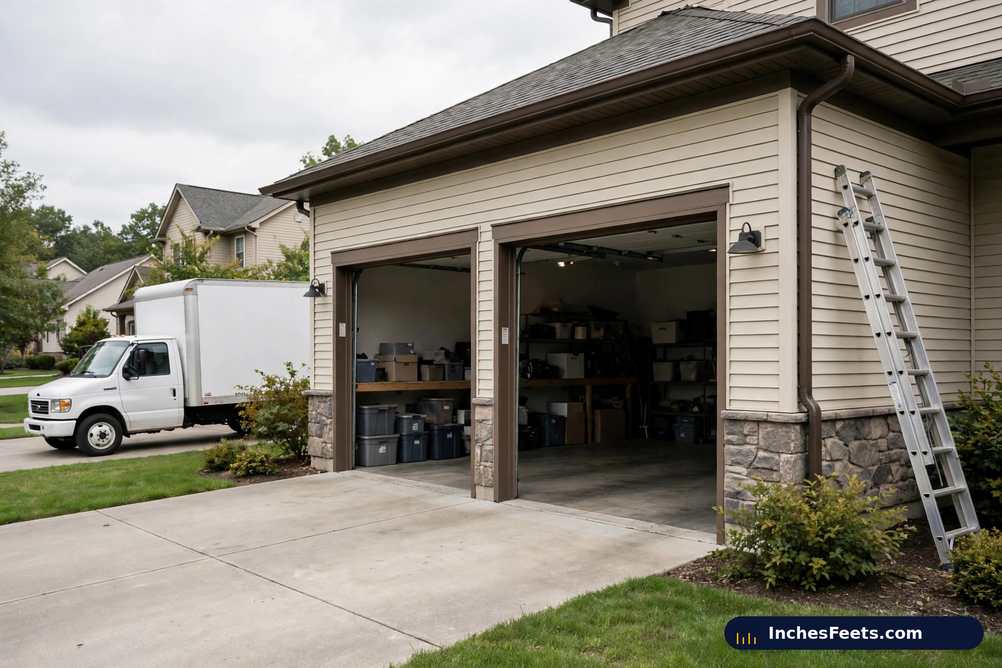
- Two-car garage: the standard minimum two-car garage footprint is 20 × 20 feet — 20 feet of depth and 20 feet of width.
- Three standard doors stacked: 80 inches × 3 = 240 inches = exactly 20 feet, no rounding at all.
- Travel trailer (20-foot class): popular models like the Forest River R-Pod RP-180 measure 20 feet to 20 feet 5 inches overall.
- Great white shark (largest females): the biggest great whites reach up to 20 feet long (Smithsonian Ocean; NOAA Fisheries).
- Saltwater crocodile (large males): big males grow to 6 meters (20 feet); the record captive, Lolong, measured 20.24 feet.
- Reticulated python (large females): the world’s longest snake passes 20 feet, reaching up to about 6.5 meters (21 feet 4 inches).
- Two basketball rims stacked: a regulation rim is exactly 10 feet above the floor (NBA Rule No. 1), so two rim heights equal exactly 20 feet.
Three famous comparisons that do NOT make this list — a giraffe, a bowling approach and two car lengths — are checked honestly in their sections below. Each one is repeated all over the internet, and each one misses 20 feet.
What Does 20 Feet Look Like?
Stand under a basketball hoop and look up. The rim is 10 feet overhead, fixed by rule. Now imagine a second hoop stacked directly on top of the first: the top rim is exactly 20 feet above the floor. That stacked view is the easiest way to feel 20 feet as a height — it is also, roughly, the height of the two-story house across the street.
Laid flat, 20 feet is just as tangible. A twenty-foot string stretched across a large living room will typically reach from wall to wall, and in a parking lot it covers one full-size space with nothing left over. It is long enough to feel like a “distance” rather than an object’s size — the gap between two people talking across a yard, or the depth your car needs in the garage with the door closed behind it.
14 Common Things That Are 20 Feet Long
This is the classic list of things people reach for when they want to show 20 feet — kept in its usual order, but with each item checked against a real source. Most pass. A few are repeated all over the internet and are simply wrong, and those are corrected honestly rather than passed along, with verified replacements added at the end.
Normal Shipping Container
This one earns its place at the top of every list — with one precision worth knowing. The “20-foot” container is a size class defined by the ISO 668 standard, and the standard’s actual outside length is 6,058 mm: 19 feet 10½ inches, about an inch and a half short of a true 20 feet (6,096 mm). The box is 8 feet wide and 8 feet 6 inches high, holds about 1,170 cubic feet inside, and is so universal that shipping capacity worldwide is counted in TEUs — twenty-foot equivalent units. As a visual anchor it is effectively exact: if you have seen a container on a truck or a train, you have seen 20 feet.
Giraffe
Here is the list’s most charming error. Giraffes are the tallest land animals alive, and lists love to round them up to 20 feet — but no giraffe gets there. San Diego Zoo Wildlife Alliance puts adult males at up to 5.5 meters (18 feet) and females at up to 4.3 meters (14 feet). The tallest giraffe ever measured, a Masai bull named George at Chester Zoo, stood 5.8 meters — 19 feet — according to Guinness World Records. So a giraffe is a superb “almost 20 feet” picture, and a big bull comes within a foot of it, but the honest number is 18 feet for a large male, 19 at the all-time record. Never use a giraffe to estimate a true 20 feet. (The sections after this list add verified replacements that do reach the mark.)

Delivery Box Truck
The delivery and moving trucks that work every neighborhood include a genuine 20-foot class — with the same naming quirk as the container. U-Haul’s 20′ truck, the size most families rent for a two-to-three-bedroom move, has an inside cargo length of 19 feet 6 inches (plus a 2-foot-6 “Mom’s Attic” over the cab), a volume of 1,016 cubic feet and a max load of 5,700 pounds per U-Haul’s own spec sheet; the whole vehicle, cab included, is about 26 feet 7 inches long. So the “20 feet” is the cargo box class, and inside the box it is honest to within six inches. When one of these trucks is parked at the curb, the box behind the cab is your 20 feet.
Extension Ladder
A 20-foot extension ladder is a real, standard product size — but the name hides a catch worth understanding before you trust it as a ruler. Louisville Ladder’s specs for its 20-foot models give two 10-foot sections and a “total length” of 20 feet, yet a maximum extended length of only 17 feet: the sections must overlap by 3 feet for safety, so opened against a wall the ladder spans 17 feet, not 20 (its working reach, including a person standing on it, is about 20 feet, which is where the size name earns its keep). Count it as a 20-foot product whose rails total 20 feet — just never pace off 20 feet of height with one fully opened.
Flagpole
This is the cleanest pass on the list. Flagpole makers and installers consistently describe 20 feet as the most common residential flagpole height: tall enough to clear a one-story roofline and read clearly from the street, sized for the standard 3×5 foot flag (or a 4×6 in sheltered yards). If your street has a front-yard flagpole, odds are strong you are looking at exactly 20 feet of pole above the lawn.

Pontoon Boat (Small)
Twenty feet is the heart of the pontoon market, and the spec sheets back it up. Take Bennington’s 20 SVL, a typical family model: its deck measures 20 feet 6 inches and its pontoons 20 feet 4 inches, under a nominal 20-foot class name (the full length overall, swim deck and motor included, runs closer to 22 feet). The living space you actually stand on — the deck — is 20 feet to within a few inches, which is why this size seats a family without feeling like a barge.

Bowling Lane Approach Area
This one fails the check, and it is worth seeing why. The approach — the wooden floor a bowler walks across before the foul line — is set by the United States Bowling Congress at not less than 15 feet in length; most centers give 15 to 17 feet. Nothing in the rulebook puts it at 20. The genuinely big number in bowling is the lane itself: exactly 60 feet from the foul line to the head pin, which makes 20 feet exactly one-third of a lane. Use that instead — a third of the lane you are standing on is a true 20 feet.
Medium Billboard Sign
There is no standard 20-foot billboard. The Outdoor Advertising Association of America recognizes a short list of standard formats, and none of them measures 20 feet in either direction: bulletins are 14 × 48 feet, posters are 12 × 24 feet (12 feet 3 inches × 24 feet 6 inches in the classic 30-sheet size), and junior posters are about 5 × 11 feet. Custom signs can be built at 20 feet, of course, but “a medium billboard is 20 feet” is a claim with no standard behind it. If you need a roadside anchor, a poster billboard’s height of about 12 feet and width of about 24 feet bracket 20 feet from either side.
Parking Lot: 2 Car Lengths
The heading says two car lengths; the arithmetic says otherwise. A typical sedan is 15 to 16 feet long, so two of them nose to tail run 30 to 32 feet — half again as much as 20. What the parking lot genuinely offers is better: the space itself. A standard perpendicular parking stall is 9 feet wide and 18 to 20 feet long in most US codes and design guides, and plenty of municipalities (Eloy, Arizona’s code is a clean example) set the standard stall at exactly 9 × 20 feet. One full-size parking space, line to line, is a true 20 feet — and it is painted on the ground for you.
A Two-Story House
Look up instead of across. A typical two-story house stands about 20 to 25 feet tall from the ground to the roof — two 8-to-9-foot ceilings, the floor structure between them, and a modest roof pitch add up fast — and low-profile two-story designs with 8-foot ceilings and a shallow roof land right at about 20 feet. It is a range rather than a single spec, since no two houses are framed alike, but it is the vertical anchor most people can see from their own street: the smaller two-story homes in your neighborhood are standing at roughly 20 feet.
A Two-Car Garage
The most useful 20 feet in American housing might be the garage. Builder and plan sources put the standard two-car garage at 20 × 20 feet minimum (400 square feet), with 24 × 24 the comfortable upgrade — so the depth your cars park in, from door to back wall, is very commonly exactly 20 feet. If you have ever backed in and watched the garage door close a few inches from your bumper, you have felt how tightly that 20 feet is budgeted.
Three Standard Doors, Stacked
This is the list’s one piece of perfect arithmetic. The standard US door — interior and exterior alike — is 80 inches tall, 6 feet 8 inches. Stack three of them edge to edge and you get 240 inches, which is exactly 20 feet, with no “about” attached. Nobody actually stacks doors, of course; the point is the mental ruler. Any doorway you pass through is a 6-foot-8 measuring stick, and a fraction over three doorways is any 20-foot span you meet.
A 20-Foot Travel Trailer
The RV industry sells a whole class at this size, and the spec sheets cluster tightly around the mark: the Forest River R-Pod RP-180 measures 20 feet overall, the Jayco Jay Feather Air 16RB 20 feet 2 inches, the Airstream Basecamp 20X 20 feet 2 inches and the Airstream Bambi 20FB 20 feet 7 inches. Unlike the ladder and the truck, the trailer’s 20 feet is its real bumper-to-hitch length — a complete small home, exactly one parking-space deep times two, that you can tow behind an SUV.
A Great White Shark
Nature reaches 20 feet at the top of the food chain. The Smithsonian Ocean Portal states that the biggest great white sharks can reach up to 20 feet long, and NOAA Fisheries gives the same figure — up to about 20 feet and over 4,000 pounds for the largest females. Most great whites are smaller (females average 15 to 16 feet, males 11 to 13), so picture the rare giant: a shark the length of a shipping container is what “20 feet” means at sea.
A Saltwater Crocodile
The largest living reptile matches the shark, foot for foot. Male saltwater crocodiles grow to about 6 meters — 20 feet — and the most famous individual ever measured, Lolong, caught in the Philippines in 2011, came in at 6.17 meters (20.24 feet), a Guinness World Records mark for a crocodile in captivity. Typical big males run 17 feet or so, but the species’ honest ceiling is a true 20 feet and a whisker past it.
A Reticulated Python
The world’s longest snake does not stop at 20 feet — it passes through it. Reticulated pythons are documented up to about 6.5 meters (21 feet 4 inches), and the longest snake in captivity on record, a reticulated python named Medusa, measured 7.67 meters (25 feet 2 inches) under Guinness World Records. An ordinary large female of 20 feet is, by this species’ standards, unremarkable — which makes the python the one example on this list where 20 feet is a floor, not a ceiling.
Two Basketball Rims, Stacked
Finish with the rulebook. NBA Rule No. 1 sets the top of the rim exactly 10 feet above the playing surface — the same height used by the WNBA, NCAA and FIBA, unchanged since the first peach basket was nailed up in 1891. Double it and you have exactly 20 feet. A dunker’s rim, times two: it is the most precise vertical reference in sports, and the fastest way to judge anything from a flagpole to a roofline when you are standing on a court.
How Long is 20 Feet in Different Measurements?
One foot is exactly 30.48 centimeters by definition, so every conversion below is exact arithmetic, not estimation.
| Unit | 20 Feet Equals |
|---|---|
| Inches | 240 in |
| Centimeters | 609.6 cm |
| Millimeters | 6,096 mm |
| Meters | 6.096 m |
| Yards | 6.667 yd |
| Kilometers | 0.006096 km |
| Miles | 0.003788 mi |
The two conversions worth memorizing are 6.096 meters and 609.6 centimeters — between them they cover almost every metric listing you will meet.
How to Visualize 20 Feet Without a Tape Measure
Your own stride is the first tool. An average adult’s walking step is about 2.5 feet, so 20 feet is roughly 8 normal steps — a figure the competitor’s own FAQ method relies on, and a fair one if you walk naturally rather than stretching. Count 8 steps and you are within a foot or so for most quick estimates.
Paper works too, if slowly: a US letter sheet is 11 inches long, so sheets laid end to end reach 20 feet (240 inches) after about 22 sheets. Indoors, the garage trick is fastest of all — if you know your two-car garage is the standard 20 feet deep, you already own a calibrated room. And the same object-based method works at the small end of the scale: twenty feet is ten times the length in our guide to how long is 2 inches, so every anchor there scales straight up.
When an Exact 20 Feet Matters
Estimates are fine for picturing a size, but some jobs punish a wrong guess. Delivery and placement is one: a 20-foot container or a 20-foot trailer needs a true 20-plus feet of clear, level ground, plus room for the truck that brings it — the nominal-versus-actual gaps in the container and ladder sections above are exactly the inches that decide whether it fits. Property lines are another: fence and setback rules are enforced in real feet, and a flagpole or shed placed by pacing can easily land a foot over the line. Ladder work is the safety case: a “20-foot” ladder opens to 17 feet, so a gutter at 19 feet is out of safe reach no matter what the box says — check the maximum extended length and the standing height on the spec sheet, not the size name. And in the driveway, a crew-cab pickup can run just over 20 feet long, which is why the “standard” 20-foot garage so often feels a foot too small. In all four cases, measure with a tape rather than trusting a label, and use the objects on this page to sanity-check the result.
Conclusion
Twenty feet is 6.096 meters — the class length of a shipping container and a pontoon boat, the depth of a two-car garage, the height of a small two-story house and a front-yard flagpole, and the full length of the biggest great white sharks and saltwater crocodiles. Just as useful is knowing what it is not: not a giraffe (18 feet, 19 at the record), not a bowling approach (15 feet by rule), not two car lengths (about 30), and not a school bus — as our guide to how long is 8 inches shows for smaller sizes, a few honest anchors beat a long list of almosts.
Keep a tape measure in the truck for the jobs that need precision, and keep these fourteen in mind for everything else, and 20 feet will never be a guess again.
FAQs About 20 Feet
How to Measure 20 Feet Without a Tape Measure?
Use your stride: an adult’s natural step runs about 2.5 to 3 feet, so 7 to 8 even steps cover 20 feet closely enough for most estimates. If you have paper instead, a standard sheet is 11 inches long — lay about 22 sheets end to end to make the full 240 inches.
How Long is 20 Feet in Comparison to a School Bus?
Shorter than you have probably read elsewhere: a conventional (Type C) school bus — the classic long-hood yellow bus — measures about 35 to 40 feet, so 20 feet is roughly HALF a school bus, not the whole thing. Only the smallest Type A minibuses start down around 20 to 25 feet.
What is a 20/20 Vision?
20/20 vision means normal visual acuity: at a distance of 20 feet, you can read letters that a person with average vision should also be able to read at 20 feet. The first “20” in the eye-chart fraction is the testing distance — so the phrase itself is built on exactly the measurement this page is about.