How Long Until 12 PM? Simple Time Calculation Guide
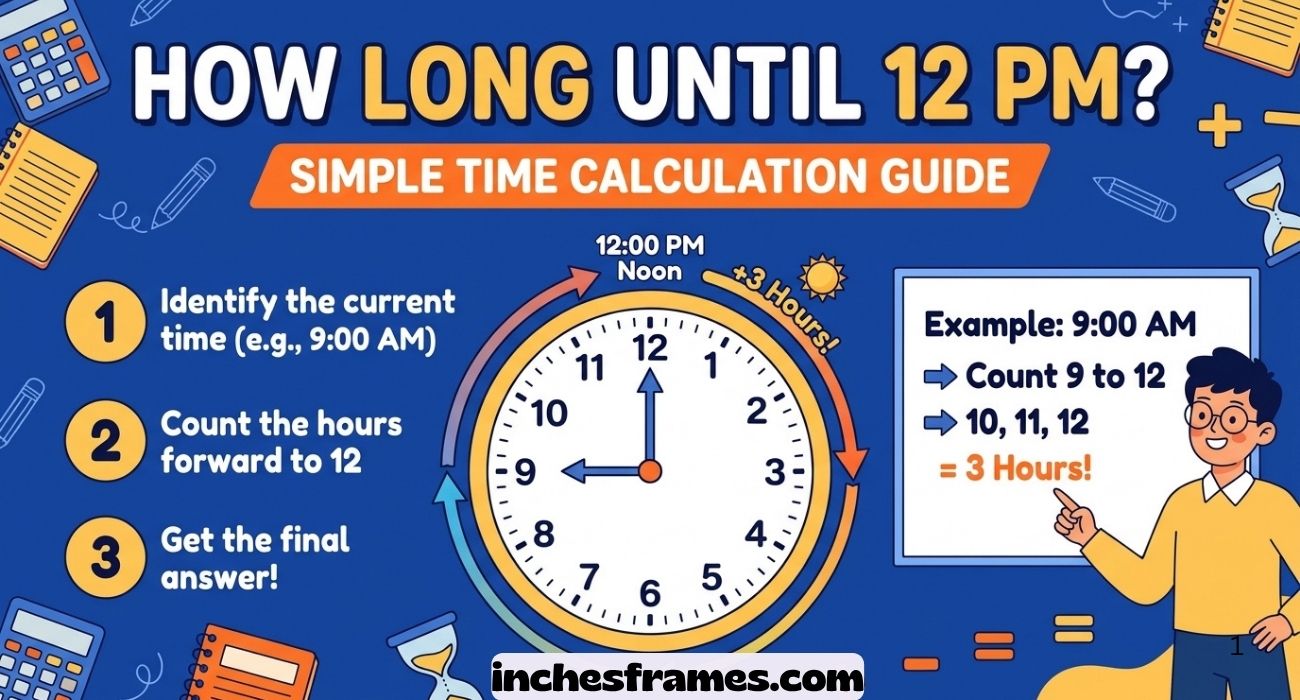
How long until 12 PM depends on your current local time. If it is 9:00 AM, you have 3 hours until noon. If it is 10:30 AM, you have 1 hour and 30 minutes left. If it is 11:45 AM, only 15 minutes remain.
12 PM means noon, or the middle of the day. You can calculate the remaining time by subtracting your current time from 12:00 PM. If noon has already passed, the next 12 PM will arrive the following day.
This guide explains how to calculate the time until noon, convert hours into minutes, use a countdown timer, and avoid common mistakes involving AM, PM, midnight, and time zones. The examples make it easy to plan lunch, prepare for meetings, manage work, and organize your daily schedule.
1. Meaning / Definition
The phrase “How Long Until 12 PM?” asks how much time remains before noon. The answer depends on the current time and whether noon is still ahead of you today.
The 12-hour clock divides the day into two 12-hour periods. AM covers the period from midnight up to noon, while PM covers the period from noon up to midnight. In everyday use, 12 PM represents midday, and 12 AM represents midnight.
For example, if your clock shows 8:00 AM, you have four hours until 12 PM. If the time is 11:00 AM, you have just one hour remaining. These calculations are simple because the target time stays the same while the current time changes.
The 24-hour clock uses 12:00 to represent noon and 00:00 to represent midnight. This format can help prevent confusion when reading schedules, booking appointments, or planning events.
Understanding the meaning of 12 PM is the first step toward calculating an accurate countdown. Once you know the current time and the target time, you can work out the difference in hours, minutes, and seconds.
2. Meaning in Simple Words
In simple words, “How Long Until 12 PM?” means asking how much longer you must wait until noon.
Think of noon as a fixed point on your daily schedule. If it is 7:00 AM, five hours remain. If it is 10:00 AM, two hours remain. As the morning continues, the countdown gets shorter.
You can use this calculation for everyday activities. A student might want to know how much study time remains before lunch. An employee might need to finish a report before a noon meeting. Someone preparing a meal might want to know when lunchtime begins.
The calculation also works after noon, but you must consider the date. If it is 3:00 PM, today’s noon has already passed. If you mean the next occurrence of 12 PM, you must count forward to noon tomorrow.
Quick Answer
How long until 12 PM? Subtract the current time from 12:00 PM if it is still before noon. If noon has passed, calculate the time until noon the following day.
Here is a quick reference table for common times.
| Current time | Time until 12 PM |
|---|---|
| 6:00 AM | 6 hours |
| 7:00 AM | 5 hours |
| 8:00 AM | 4 hours |
| 9:00 AM | 3 hours |
| 9:30 AM | 2 hours 30 minutes |
| 10:00 AM | 2 hours |
| 10:30 AM | 1 hour 30 minutes |
| 11:00 AM | 1 hour |
| 11:15 AM | 45 minutes |
| 11:30 AM | 30 minutes |
| 11:45 AM | 15 minutes |
| 11:55 AM | 5 minutes |
| 12:00 PM | 0 minutes |
These examples assume that the current time and noon fall on the same day. The exact answer changes every minute and second, so check your local clock for a precise result.
3. Real-Life Examples
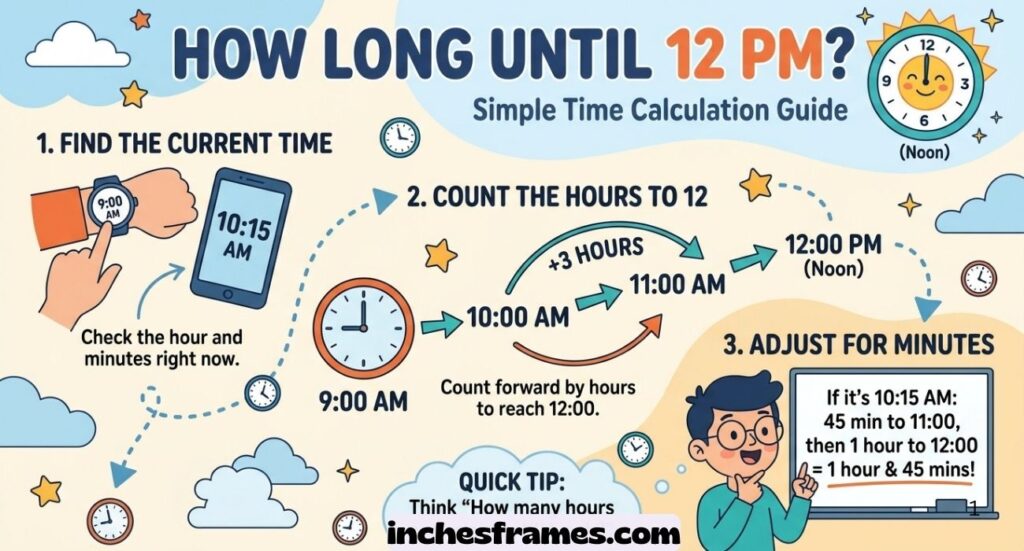
Real-life examples make it easier to understand how to calculate the time remaining until noon. The following situations cover early morning, late morning, midnight, and times after noon.
Example 1: It Is 9:00 AM
Suppose your clock shows 9:00 AM, and you want to know how long until 12 PM. Count forward from 9:00 AM to 10:00 AM, then to 11:00 AM, and finally to noon.
The calculation is simple:
12 − 9 = 3 hours.
Therefore, 3 hours remain until 12 PM. You can use this time to complete morning tasks, attend classes, or prepare for a lunch appointment.
Example 2: It Is 10:30 AM
If it is 10:30 AM, you have one hour and 30 minutes until noon.
From 10:30 AM to 11:30 AM is one hour. From 11:30 AM to 12:00 PM is another 30 minutes. Together, these periods equal 90 minutes, or 1 hour and 30 minutes.
This calculation is useful when you have a meeting scheduled at noon or need to finish a task before taking a lunch break.
Example 3: It Is 11:00 AM
At 11:00 AM, exactly one hour remains until 12 PM.
You can calculate the difference by subtracting 11:00 AM from 12:00 PM. The result is 60 minutes.
For example, if your lunch break starts at noon, you have one hour to finish your current assignment, prepare your workspace, or organize your plans for the afternoon.
Example 4: It Is 11:45 AM
If the current time is 11:45 AM, only 15 minutes remain until noon.
There are 60 minutes in an hour. The difference between 11:45 AM and 12:00 PM is 15 minutes.
This short countdown can help you prepare for an upcoming appointment, save your work, or get ready for lunch. When the remaining time is measured in minutes rather than hours, checking the exact clock time becomes more important.
Example 5: It Is 11:30 AM
At 11:30 AM, you have 30 minutes until 12 PM.
The calculation is straightforward because 11:30 AM is half an hour before noon. In minutes, the remaining time is 30.
Imagine that your workday includes a lunch break at noon. You can use these 30 minutes to finish a small task, prepare your meal, or wrap up a morning meeting.
Example 6: It Is 12:00 AM
12:00 AM means midnight, not noon. If it is midnight at the beginning of the day, exactly 12 hours remain until 12 PM later that day.
For example, midnight on Monday is followed by noon on Monday 12 hours later. This calculation works because the target is midday on the same calendar day.
Remember that the AM and PM labels matter. Confusing 12 AM with 12 PM can create a difference of 12 hours in your calculation.
Example 7: It Is 1:00 PM
If it is 1:00 PM, noon has already passed. To find the time until the next 12 PM, count from 1:00 PM to midnight and then from midnight to noon the following day.
From 1:00 PM to midnight is 11 hours. From midnight to 12:00 PM is another 12 hours.
11 + 12 = 23 hours.
Therefore, 23 hours remain until the next 12 PM. This example shows why you must consider whether the target time has already passed.
Example 8: It Is 6:00 PM
At 6:00 PM, the current day’s noon is already six hours in the past. The next noon arrives the following day.
From 6:00 PM to midnight is six hours. From midnight to noon is 12 hours.
6 + 12 = 18 hours.
Therefore, 18 hours remain until the next 12 PM. This calculation can help when planning a midday appointment or lunch for the following day.
See Also ; How Long Until 3:30 PM? Time Countdown & Timer
4. Synonyms and Related Terms
People use several phrases when looking for the time remaining until noon. These phrases may express the same basic question, although some refer specifically to a countdown, a duration, or a conversion into minutes.
Understanding the related terms can help you choose the right calculation method for your needs.
Time Until 12 PM
Time until 12 PM means the duration between the current time and the next relevant noon. If it is 8:30 AM, the remaining time is 3 hours and 30 minutes.
This phrase is useful when planning a scheduled event, checking a deadline, or deciding how much time remains before lunch.
Time Remaining Until Noon
Time remaining until noon refers to the hours, minutes, and seconds left before midday.
For example, if your clock shows 10:15 AM, you have 1 hour and 45 minutes remaining. This phrase is especially useful when you want to know how much time is available for a morning task.
Countdown to 12 PM
A countdown to 12 PM displays the time left before noon. You can calculate it manually or use a digital countdown timer.
A timer can show hours, minutes, and seconds. However, you should make sure that it uses the correct target date and local time. If you set a timer for noon tomorrow by mistake, it will not give you the countdown you need for today’s noon.
How Many Hours Until Noon?
The question how many hours until noon asks for the duration remaining before 12 PM.
If it is 7:00 AM, five hours remain. If it is 9:00 AM, three hours remain. When the current time includes extra minutes, the answer may include a fraction of an hour or a combination of hours and minutes.
For instance, 10:30 AM is 1.5 hours before noon. You can express the same duration as 1 hour and 30 minutes.
How Many Minutes Until 12 PM?
The question how many minutes until 12 PM expresses the remaining time in minutes instead of hours.
To convert hours into minutes, multiply the number of hours by 60. Then add any extra minutes.
For example, 1 hour and 30 minutes equals:
\(1 \times 60 + 30 = 90\) minutes.
At 11:45 AM, 15 minutes remain until noon. At 10:00 AM, 120 minutes remain. This method is useful when planning short breaks or setting a countdown in minutes.
Noon Countdown
A noon countdown is a timer that tracks the time until midday. It can be useful for lunch breaks, meetings, study sessions, or work deadlines.
You can use a phone clock, computer clock, online timer, or calendar reminder. A countdown is most useful when it matches the intended time zone and target date.
Related Time Terms
Several other terms help explain time calculations.
Midday is another word for noon. A 12-hour clock uses AM and PM to distinguish the two halves of the day. A 24-hour clock uses values from 00:00 through 23:59. A time difference is the duration between two points in time, while a countdown timer shows how much time remains before a target.
These terms describe different parts of the same process: identifying a target time, checking the current time, and calculating the interval between them.
5. When to Use
Knowing how long until 12 PM can help you organize daily activities and make better use of your morning. It is useful whenever an event, task, or personal plan depends on noon.
Planning Lunch
A noon countdown helps you plan when to prepare, serve, or eat lunch. If you have 45 minutes until noon, you can decide whether you have enough time to prepare a meal or finish a short task first.
For office workers, students, and families, knowing the time remaining can also help coordinate lunch breaks. If several people follow the same schedule, checking the target time can reduce confusion about when to meet.
Preparing for a Meeting
If a meeting begins at 12 PM, calculating the remaining time helps you prepare before it starts.
Suppose it is 10:40 AM. You have 1 hour and 20 minutes before the meeting. You can use that period to review documents, prepare notes, or check the meeting link.
If the meeting requires travel, remember to include travel time. Knowing the countdown alone does not guarantee that you will arrive on time.
Managing Study Time
Students can use the time until noon to organize study sessions. If it is 9:00 AM and lunch starts at noon, three hours are available.
A student could divide that period between reading, practice questions, and reviewing notes. Checking the clock between tasks helps keep the schedule realistic.
The same approach works for online classes, homework, exam preparation, and other activities with a fixed midday deadline.
Managing Work Tasks
Employees can use a noon countdown to prioritize work before lunch. If a report is due at 11:30 AM, knowing the current time helps determine how much time remains to complete it.
For example, at 10:45 AM, only 45 minutes remain before the deadline. That information can help you focus on the most important parts of the report and avoid starting a task that cannot reasonably be finished in time.
Setting a Countdown
A countdown timer can help you track the remaining time without repeatedly calculating it.
To set one, check your current local time and choose the correct noon deadline. If the timer asks for a duration, calculate the difference between the current time and noon. If it asks for a target date and time, select 12:00 PM on the correct date.
Check whether the timer uses your device’s local time or a specified time zone. This matters when you are preparing for an online meeting or coordinating with someone in another location.
6. When NOT to Use
A basic countdown works well for ordinary daily planning, but it can produce the wrong result if you misunderstand the target time or use an incorrect reference.
Before relying on your calculation, check the time zone, date, AM/PM label, and minutes. These details become especially important for events scheduled across different locations or calendar days.
Do Not Ignore Your Current Time Zone
Noon occurs at different moments around the world because locations use different time zones. Even within the United States, Eastern, Central, Mountain, and Pacific Time do not share the same local clock time.
For example, a meeting scheduled for 12 PM Eastern Time does not begin at 12 PM Pacific Time. If you are joining remotely, calculate the countdown using the meeting’s time zone or convert the meeting time to your own local time.
For a simple lunch plan, your device’s local clock is usually sufficient. For an event involving other locations, verify which time zone the schedule uses.
Do Not Forget Whether Noon Has Passed
If it is 2:00 PM, today’s noon has already passed. A calculation that treats 12 PM as a future time on the same day will be incorrect.
If you want to know how long until the next noon, count forward to 12 PM tomorrow. From 2:00 PM to midnight is 10 hours, followed by 12 more hours until noon. The total is 22 hours.
Always decide whether you mean today’s noon or the next occurrence of noon.
Do Not Confuse 12 PM With 12 AM
12 PM means noon, while 12 AM means midnight. The two times are exactly 12 hours apart.
If it is 12:00 AM, noon is 12 hours away. If it is 12:00 PM, noon has arrived, so the countdown to today’s noon is zero.
When reading a timetable or entering an appointment, check the AM/PM label carefully. This small detail can change the intended time by half a day.
Do Not Ignore Minutes
Looking only at the hour can lead to an inaccurate answer.
For example, at 10:00 AM, two hours remain until noon. At 10:45 AM, only 1 hour and 15 minutes remain. Both times fall within the 10 AM hour, but their countdowns differ by 45 minutes.
For an accurate result, subtract both the hours and minutes. If you need second-level accuracy, check the current seconds as well.
7. Common Mistakes
Calculating the time until noon is straightforward, but a few common errors can lead to incorrect results. Understanding these mistakes helps you calculate durations accurately.
Mistake 1: Confusing 12 PM With Midnight
The most common source of confusion is treating 12 PM as midnight. In standard time notation, 12 PM is noon and 12 AM is midnight.
For example, if you see a schedule that says 12 PM on Tuesday, it refers to Tuesday at midday. A schedule marked 12 AM on Tuesday refers to the start of Tuesday at midnight.
If the notation seems unclear, check the schedule or ask the organizer to confirm the intended time.
Mistake 2: Forgetting the Next Day
Another mistake is forgetting that noon has already passed.
Suppose it is 3:00 PM on Monday. The next 12 PM is Tuesday at noon, not Monday at noon. The duration is 21 hours: nine hours from 3 PM to midnight, followed by 12 hours from midnight to noon.
When calculating a future occurrence of noon, include the date change whenever necessary.
Mistake 3: Ignoring Minutes
Subtracting only the hour numbers can create errors when the current time includes minutes.
Suppose it is 10:20 AM. Two hours minus 20 minutes gives 1 hour and 40 minutes remaining until noon.
The correct calculation is from 10:20 AM to 11:20 AM, which takes one hour, followed by another 40 minutes to noon.
For more precise results, work with the complete clock time rather than just the hour.
Mistake 4: Using the Wrong Time Zone
A countdown can be mathematically correct but still point to the wrong moment if you use the wrong time zone.
For example, if an online meeting is scheduled for noon in New York, someone in Los Angeles must use the corresponding Pacific Time. They should not simply wait until their own clock reaches 12 PM.
Check the event’s location, stated time zone, and date before calculating the remaining duration.
Mistake 5: Confusing 12-Hour and 24-Hour Formats
The 12-hour clock uses AM and PM, while the 24-hour clock represents the day using hours from 00 to 23.
The most useful conversions for noon calculations are shown below.
| 12-hour time | 24-hour time |
|---|---|
| 12:00 AM | 00:00 |
| 6:00 AM | 06:00 |
| 9:00 AM | 09:00 |
| 11:00 AM | 11:00 |
| 12:00 PM | 12:00 |
| 1:00 PM | 13:00 |
| 3:00 PM | 15:00 |
| 6:00 PM | 18:00 |
| 11:00 PM | 23:00 |
For example, if the current time is 10:30 in the 24-hour format, it is 10:30 AM. Noon is 12:00, so 90 minutes remain.
Mistake 6: Assuming the Answer Never Changes
The time remaining until noon changes continuously. If three hours remain at 9 AM, only two hours remain at 10 AM.
Minutes and seconds also affect the result. A calculation made earlier may no longer be accurate when you check it later.
For an appointment or deadline, use the current clock time rather than relying on an old calculation. A live countdown timer can help when you need the remaining time to update automatically.
See Also ; What Time Was It 5 Hours Ago? Calculate the Exact Time
8. Comparison with Similar Terms
The phrase “How Long Until 12 PM?” is related to several other time questions. However, the target time and the current time determine which calculation you need.
| Time-related question | Meaning | Example |
|---|---|---|
| How long until 12 PM? | Time remaining until noon | At 9 AM, 3 hours remain |
| How long until 12 AM? | Time remaining until midnight | At 9 PM, 3 hours remain |
| How long until 1 PM? | Time remaining until 1 PM | At noon, 1 hour remains |
| How long since 12 PM? | Time elapsed since noon | At 2 PM, 2 hours have passed |
| How many minutes until noon? | Remaining time expressed in minutes | At 11:30 AM, 30 minutes remain |
| What time was it 12 hours ago? | A time calculation in the past | At 8 PM, it was 8 AM |
| What time is noon tomorrow? | The next day’s midday target | 12 PM on the following date |
These questions may sound similar, but they ask for different information. A countdown measures the time before an event. An elapsed-time calculation measures the time since an event. A past-time calculation works backward from the current time.
For an accurate answer, identify the target time first, then determine whether you are calculating forward or backward. If the calculation crosses midnight, include the date change.
9. How to Calculate the Time Until 12 PM Manually
You can calculate the remaining time without an online calculator. The method depends on whether noon is still ahead of you today.
If the current time is before noon, subtract the current time from 12:00 PM. For example, if it is 8:20 AM, the difference is 3 hours and 40 minutes.
If the current time is after noon, calculate the time until midnight and add 12 hours for the following morning. For example, if it is 7:30 PM, 4 hours and 30 minutes remain until midnight. Add 12 hours, and the total becomes 16 hours and 30 minutes until the next noon.
When the current time includes seconds, use the same principle. If it is 11:59:30 AM, 30 seconds remain until 12:00 PM.
Remember that 1 hour equals 60 minutes, and 1 minute equals 60 seconds. These relationships allow you to convert any remaining duration into the format you need.
Frequently Asked Questions
How long until 12 PM from 8 AM?
There are 4 hours from 8:00 AM until 12:00 PM. Subtract 8 from 12 to calculate the difference.
How long until noon from 10:30 AM?
There are 1 hour and 30 minutes until noon from 10:30 AM. This is equal to 90 minutes.
How many minutes are left until 12 PM at 11:45 AM?
There are 15 minutes left until noon at 11:45 AM. The calculation is the difference between 11:45 AM and 12:00 PM.
Is 12 PM noon or midnight?
12 PM means noon, which is the middle of the day. 12 AM means midnight, which marks the beginning of a new calendar day.
How long until 12 PM if it is already 1 PM?
If it is 1:00 PM, the next noon is 23 hours away. Today’s noon has already passed, so the calculation uses noon on the following day.
How do I calculate the time until noon in minutes?
Find the remaining hours and multiply them by 60. Then add any extra minutes. For example, 2 hours and 15 minutes equal 135 minutes.
Does the time until 12 PM change every second?
Yes. The remaining duration decreases continuously as time passes. A live countdown can show the changing hours, minutes, and seconds.
Can I use a phone to calculate the countdown to noon?
Yes. You can check your phone’s clock, use a countdown timer, or create a calendar reminder for 12 PM. Make sure the target date and time zone are correct when setting the reminder.
Does noon occur at the same moment everywhere?
No. Noon is a local clock time, so it occurs at different moments in different time zones. If you are planning an event with people in other locations, use the time zone specified for that event.
What is 12 PM in 24-hour time?
12 PM is written as 12:00 in the 24-hour clock format. Midnight is written as 00:00.
Conclusion
Knowing how long until 12 PM helps you plan lunch breaks, prepare for meetings, manage study sessions, and organize morning tasks. The calculation is simple: subtract your current time from noon when noon is still ahead of you today. For example, three hours remain at 9 AM, 90 minutes remain at 10:30 AM, and just 15 minutes remain at 11:45 AM.
If noon has already passed, calculate the time until 12 PM on the following day. Always check your local time, the AM/PM label, and the target date to avoid mistakes. For an exact, continuously updated countdown, use your device’s clock or a reliable timer. These simple methods make it easy to calculate the time until noon accurately in 2026 and beyond.