What Time Was It 15 Hours Ago? Easy Ways to Calculate It Accurately
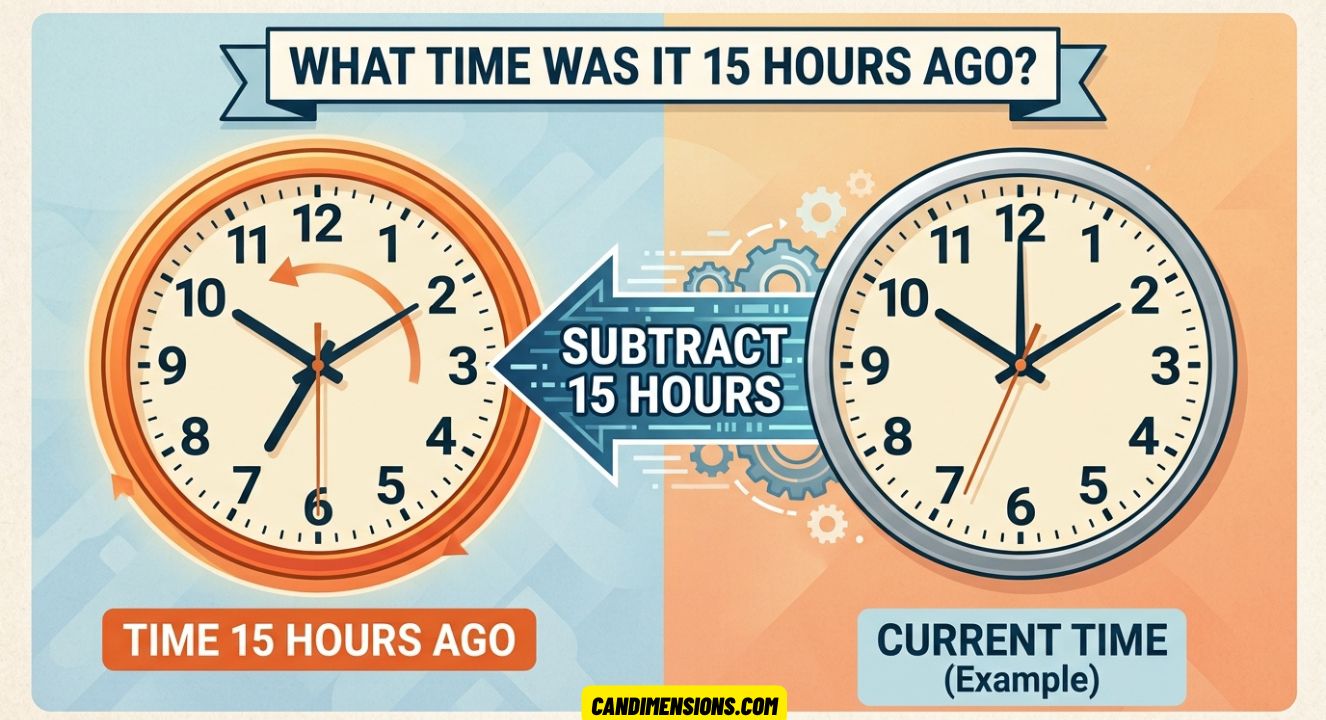
What Time Was It 15 Hours Ago means finding the exact time from 15 hours before the current time. It helps you know the past time by moving the clock backward by 15 hours. This simple calculation shows the correct hour and date from the previous time.
Have you ever wanted to know the exact time of an event that happened earlier? What Time Was It 15 Hours Ago gives a quick and easy way to find that information. It helps people track schedules, activities, and important moments without confusion.
What Time Was It 15 Hours Ago depends on your current time, date, and location. You can find it by subtracting 15 hours from the present time. Understanding this calculation makes daily planning and time management easier.
What Does “15 Hours Ago” Actually Mean?
When someone asks, “What Time Was It 15 Hours Ago?”, they are referring to the exact time that occurred 15 hours before the present moment. It is a simple time subtraction process in which you count backward by 15 hours from the current time.
For example, if the current time is 6:00 PM, then 15 hours ago was 3:00 AM on the same day. However, if the current time is 10:00 AM, then 15 hours ago was 7:00 PM on the previous day. This is why both the time and the date can change.
Understanding this concept is useful because many activities depend on accurate time calculations. Businesses, travelers, healthcare professionals, and individuals often need to determine when an event happened without guessing.
Understanding Time Subtraction
Calculating 15 hours ago means moving backward on the clock instead of forward. Unlike adding hours, subtracting hours may require crossing midnight, which changes the calendar date.
Think of a 24-hour day as a complete circle. Moving backward by 15 hours simply means reversing the clock by that amount while keeping track of the date.
Why This Time Calculation Is Useful
Knowing What Time Was It 15 Hours Ago has many practical applications, including:
- Checking work shift start or end times.
- Reviewing delivery tracking updates.
- Confirming when an online meeting or event occurred.
- Understanding timestamps on emails or social media posts.
- Keeping accurate records for healthcare or legal purposes.
Because people live in different time zones, the exact answer also depends on your location.
How to Calculate 15 Hours Ago Manually
You don’t always need an online calculator to find What Time Was It 15 Hours Ago. With basic clock math, you can calculate it yourself in just a few seconds.
Step 1: Identify the Current Time
Start by looking at your current local time.
For example:
- Current Time: 8:00 PM
Step 2: Subtract 15 Hours
Now subtract 15 hours from the current time.
8:00 PM − 15 hours = 5:00 AM
If your subtraction crosses midnight, remember that the date changes as well.
Step 3: Adjust the Date
Crossing midnight means you’re moving into the previous calendar day.
Example:
Current Time:
- Tuesday, 11:00 AM
Subtract 15 hours:
- Monday, 8:00 PM
This small adjustment is the most common mistake people make when calculating past times.
Easy Mental Shortcut
A quick way to calculate 15 hours ago is to think of it as:
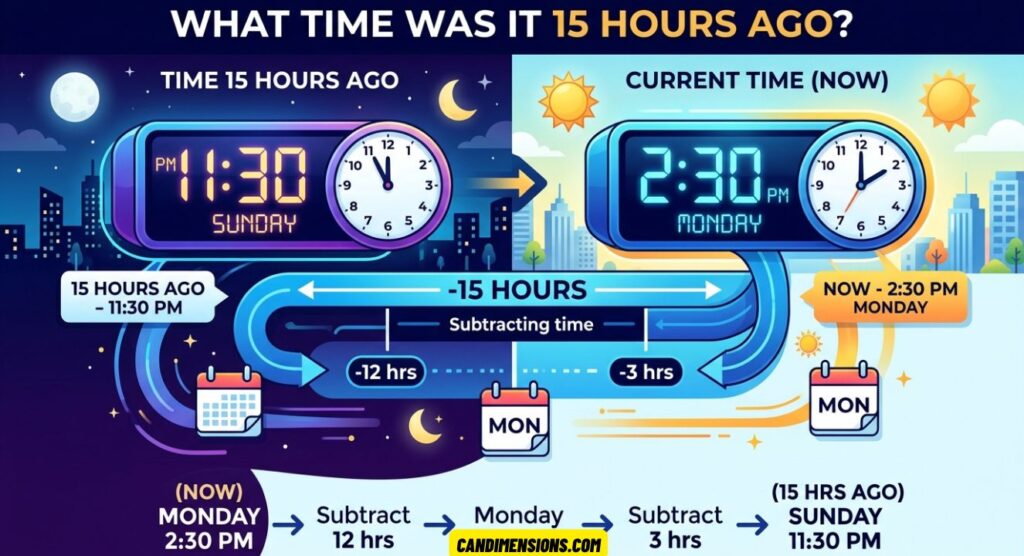
- Subtract 12 hours
- Then subtract 3 more hours
This 12 + 3 method is much easier than subtracting 15 all at once, especially when you’re doing the calculation mentally.
Manual Calculation Examples
| Current Time | 15 Hours Ago |
| 9:00 AM | 6:00 PM (Previous Day) |
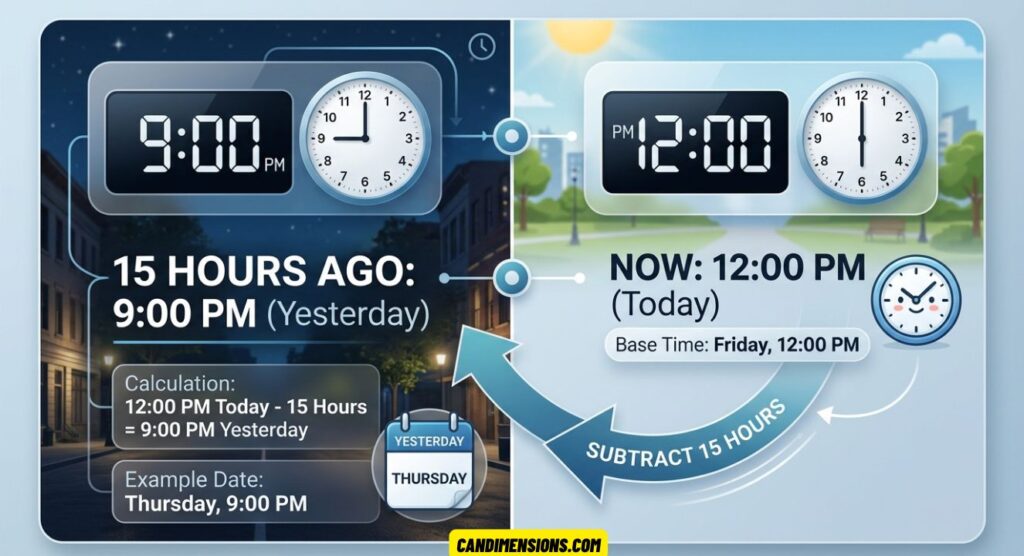
| 12:00 PM | 9:00 PM (Previous Day) |
| 3:00 PM | 12:00 AM |
| 8:00 PM | 5:00 AM |
| 11:30 PM | 8:30 AM |
These examples show why paying attention to both the hour and the date is important.
What Time Was It 15 Hours Ago in Pakistan?
Pakistan follows Pakistan Standard Time (PKT), which is UTC+5 throughout the year. Unlike many countries, Pakistan does not currently observe Daylight Saving Time (DST), making time calculations simpler and more consistent.
If you’re asking “What Time Was It 15 Hours Ago in Pakistan?”, the process is exactly the same as anywhere else:
- Check the current time in Pakistan.
- Subtract 15 hours.
- Adjust the date if the calculation crosses midnight.
Pakistan Standard Time (PKT) Explained
Because Pakistan stays on one standard time all year, there are no seasonal clock changes to consider. This reduces the chance of making errors during time subtraction.
For example:
Current Time:
- Friday, 4:00 PM PKT
15 hours ago:
- Friday, 1:00 AM PKT
Another example:
Current Time:
- Friday, 9:00 AM PKT
15 hours ago:
- Thursday, 6:00 PM PKT
Comparing Pakistan Time with U.S. Time
While Pakistan uses one national time zone, the United States has multiple time zones, including:
- Eastern Time (ET)
- Central Time (CT)
- Mountain Time (MT)
- Pacific Time (PT)
- Alaska Time
- Hawaii-Aleutian Time
This means someone calculating What Time Was It 15 Hours Ago in New York may get a completely different clock time than someone performing the same calculation in Pakistan—even if both calculate correctly.
Why the Answer Changes Depending on Current Time
The result isn’t fixed because time is always moving. Every minute that passes changes what “15 hours ago” refers to.
That’s why online time calculators update in real time, while manual calculations always begin with the current local time.
See Also : Aluminum Can Dimensions: Sizes, Height & Diameter Chart (Complete Guide)
Understanding Time Zones and Why They Matter
One of the biggest reasons people get confused when asking What Time Was It 15 Hours Ago is the impact of time zones.
A time zone is a geographical region where the same standard time is used. Since the Earth rotates, different parts of the world experience daytime and nighttime at different hours.
For example, when it’s afternoon in California, it may already be evening in New York and early morning in parts of Asia.
What Is a Time Zone?
A time zone keeps clocks synchronized within a region. Instead of every city using its own solar time, countries divide land into standard time areas to make travel, communication, and business much easier.
U.S. Time Zones Explained
The continental United States primarily uses four major time zones:
| Time Zone | Abbreviation |
| Eastern Time | ET |
| Central Time | CT |
| Mountain Time | MT |
| Pacific Time | PT |
In addition, Alaska and Hawaii each have their own standard time zones.
Because of these differences, What Time Was It 15 Hours Ago can produce different clock times depending on where you are in the country.
Daylight Saving Time (DST)
Many U.S. states observe Daylight Saving Time, where clocks move forward in spring and backward in fall.
During DST transitions, subtracting 15 hours can occasionally become more complicated because one day may contain 23 or 25 hours instead of the usual 24.
Most online time difference calculators automatically account for these adjustments.
Why Time Zone Differences Affect “15 Hours Ago”
Imagine two people checking the same international event:
- One lives in New York.
- The other lives in Los Angeles.
Although both subtract 15 hours correctly, their answers will differ because their local clocks are already three hours apart.
For international meetings, flights, and online events, always confirm the relevant time zone before calculating past times.
The Mathematics Behind 15 Hours
Understanding the simple math behind What Time Was It 15 Hours Ago makes the calculation much easier.
Time follows a 24-hour cycle. Since 15 hours is less than one full day, you only need to subtract the hours while watching for a date change if you cross midnight.
Converting Hours Into Minutes
15 hours equals:
- 900 minutes
- 54,000 seconds
These conversions are useful in time tracking, scientific calculations, and project management.
Hours vs. Days
Since one day contains 24 hours, 15 hours represents:
- 62.5% of a full day
- Just over half a day
This explains why calculations often move into either the same day or the previous day depending on the starting time.
Simple Time Arithmetic
Here’s an easy formula:
Current Time − 15 Hours = Time 15 Hours Ago
If the subtraction results in a negative hour, simply move to the previous calendar day and continue counting backward.
For example:
Current Time: 2:00 AM
Subtract 15 hours:
2 − 15 = -13
Adding 24 hours gives:
11:00 AM on the previous day.
This simple approach works whether you’re using a 12-hour or 24-hour clock.
What Time Was It 15 Hours Ago? Real Examples
The easiest way to understand What Time Was It 15 Hours Ago is by looking at real-world examples. These scenarios show exactly how time subtraction works and when the date changes.
Remember, every calculation starts with the current local time. If subtracting 15 hours crosses midnight, the answer falls on the previous day.
Example One
Current Time: 10:00 AM
Subtract 15 hours:
- 10:00 AM → 10:00 PM (12 hours earlier)
- 10:00 PM → 7:00 PM (3 more hours earlier)
Answer: 7:00 PM on the previous day
This is a common example because morning times usually move back into the evening before.
Example Two
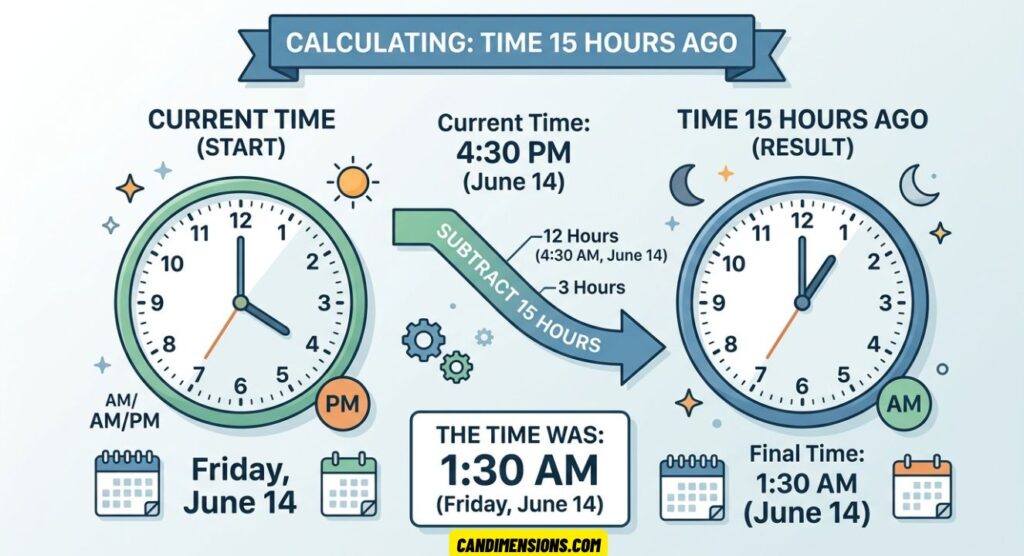
Current Time: 4:30 PM
Subtract 15 hours:
- 4:30 PM → 4:30 AM (12 hours)
- 4:30 AM → 1:30 AM (3 more hours)
Answer: 1:30 AM on the same day
Since midnight wasn’t crossed after the full subtraction, the date stays the same.
Example Three
Current Time: 12:00 Midnight (12:00 AM)
Subtract 15 hours:
- 12:00 AM → 12:00 PM (previous day)
- 12:00 PM → 9:00 AM (previous day)
Answer: 9:00 AM on the previous day
Midnight often causes confusion because it marks the beginning of a new day.
Example Four
Current Time: 8:45 AM
Subtract 15 hours:
- 8:45 AM → 8:45 PM (previous day)
- 8:45 PM → 5:45 PM (previous day)
Answer: 5:45 PM on the previous day
Always keep the minutes the same unless instructed otherwise.
Example Five
Current Time: 11:59 PM
Subtract 15 hours:
- 11:59 PM → 11:59 AM
- 11:59 AM → 8:59 AM
Answer: 8:59 AM on the same day
Because you’re starting late at night, the subtraction usually remains within the same calendar day.
Quick Reference Table
| Current Time | 15 Hours Ago | Date Change |
| 6:00 AM | 3:00 PM | Previous Day |
| 9:00 AM | 6:00 PM | Previous Day |
| 12:00 PM | 9:00 PM | Previous Day |
| 3:00 PM | 12:00 AM | Same Day |
| 6:00 PM | 3:00 AM | Same Day |
| 9:00 PM | 6:00 AM | Same Day |
| 11:00 PM | 8:00 AM | Same Day |
This table provides a fast reference for some of the most common calculations.
When Was 15 Hours Ago From Now?
If you’re asking, “When was 15 hours ago from now?”, the answer depends entirely on the exact moment you’re reading this page.
For example, if the current time is:
- 8:00 AM, then 15 hours ago was 5:00 PM yesterday.
- 2:00 PM, then 15 hours ago was 11:00 PM yesterday.
- 9:00 PM, then 15 hours ago was 6:00 AM today.
Unlike fixed calculations, the answer changes every minute because time never stops moving.
Using the Current Time
The most accurate method is to begin with your device’s clock.
Whether you’re using a smartphone, computer, smartwatch, or digital assistant, always verify your current local time before subtracting 15 hours.
This prevents mistakes caused by manually estimating the time.
Why the Answer Is Always Changing
Many people assume there’s one universal answer to What Time Was It 15 Hours Ago, but that’s not true.
Since every second changes the present moment, the answer also changes continuously.
For instance:
- At 1:00 PM, 15 hours ago was 10:00 PM yesterday.
- One minute later, at 1:01 PM, 15 hours ago becomes 10:01 PM yesterday.
Even a small difference matters when accuracy is important.
Live Time Calculators vs. Manual Math
There are two reliable ways to calculate past time.
| Manual Calculation | Online Calculator |
| No internet required | Updates automatically |
| Good for learning | Highly accurate |
| Can be slower | Instant results |
| Easy to make mistakes | Handles Daylight Saving Time automatically |
For everyday use, a live hours ago calculator is usually the fastest option.
See Also : Can Koozie Size Dimensions: Height and Length (Complete Size Guide)
Tools That Can Help You Calculate 15 Hours Ago
Modern technology makes finding What Time Was It 15 Hours Ago almost effortless.
Instead of performing manual calculations, several digital tools can provide an instant answer.
Online Time Calculators
An online time calculator is one of the easiest solutions.
Simply enter the current time or let the tool detect your local time automatically. It immediately subtracts 15 hours and displays the correct answer.
These calculators are especially useful when dealing with different time zones or Daylight Saving Time changes.
Smartphone Clock Apps
Most smartphones include built-in clock applications that can help you estimate past times.
Some world clock apps even allow you to compare multiple cities simultaneously, making international calculations much easier.
Google Search
Google can answer many time calculation questions directly.
Searching phrases like:
- “15 hours ago”
- “What time was it 15 hours ago?”
- “15 hours before now”
often displays an instant answer or links to reliable time difference calculators.
Digital Assistants
Voice assistants such as Google Assistant, Siri, and Alexa can perform simple time arithmetic using voice commands.
For example:
“What time was it 15 hours ago?”
Within seconds, you’ll receive the correct calculation without opening another app.
Spreadsheet Formulas
If you regularly calculate past times at work, spreadsheets can save significant time.
Programs like Microsoft Excel and Google Sheets include formulas that automatically subtract hours from timestamps.
This is particularly useful for:
- Employee scheduling
- Time tracking
- Attendance logs
- Project management
- Business reporting
What Time Was It 15 Hours Ago and Why Do People Ask?
At first glance, asking “What Time Was It 15 Hours Ago?” may seem like a simple curiosity. However, millions of people perform similar time calculations every day for practical reasons.
Knowing an exact past time helps people make better decisions, verify records, and coordinate activities across different locations.
Work and Shift Scheduling
Many employees work rotating or overnight shifts.
Imagine a nurse who finishes work at 7:00 AM and wants to know when their shift started 15 hours earlier. Accurate time subtraction helps maintain proper work records and ensures compliance with labor regulations.
Employers also use this calculation to review attendance and overtime.
Delivery Tracking
Shipping companies record every package scan with an exact timestamp.
If a package was updated 15 hours ago, customers often want to determine exactly when that scan occurred.
This helps estimate delivery progress and identify possible delays.
Event Planning
Conference organizers, wedding planners, and sports coordinators often review schedules based on past events.
Knowing What Time Was It 15 Hours Ago helps confirm when an activity started, ended, or was last updated.
Social Media Posts
People frequently check when someone published a photo, video, or announcement.
Rather than relying on “15 hours ago” displayed by an app, they may want to know the exact clock time.
This is especially useful for journalists, marketers, and content creators monitoring engagement.
Gaming and Online Activities
Many online games use cooldown timers, daily rewards, and event schedules.
Players often calculate 15 hours ago to determine when an event started or when rewards will reset.
Medical and Health Records
Healthcare professionals rely on accurate timestamps for medications, treatments, and patient monitoring.
For example, if medication was administered 15 hours ago, nurses must know the precise time before giving the next dose.
Even small errors can affect patient safety.
Aviation and Travel
Airlines, airports, and international travelers constantly work across multiple time zones.
Understanding when something happened 15 hours earlier helps coordinate departures, arrivals, and connecting flights more accurately.
The Human Side of Time: Memory and Perception
Although calculating What Time Was It 15 Hours Ago is a mathematical process, our understanding of time is also influenced by human memory and perception. People do not always experience time exactly as the clock measures it.
Sometimes 15 hours can feel extremely short, while at other times it can feel much longer. This difference happens because our brains judge time based on experiences, emotions, activities, and attention.
Understanding this human side of time helps explain why people often need tools like time calculators and clock converters even for simple calculations.
Why People Estimate Time Incorrectly
Humans are not naturally perfect at measuring the passing of hours without a clock.
For example, a busy workday may feel like it passed quickly, while waiting for important news can make a few hours feel much longer.
When someone asks “What Time Was It 15 Hours Ago?”, they may remember an event happening “recently” but struggle to identify the exact hour.
Common reasons people misjudge time include:
- Being distracted by work or entertainment
- Sleeping during part of the 15-hour period
- Confusing yesterday and today
- Forgetting the exact starting time
- Crossing different time zones
This is why exact timestamps are more reliable than human memory alone.
How Memory Affects Time Awareness
Memory plays a major role in how we understand past events.
For example, you might remember:
- “I checked my email last night.”
- “The meeting happened yesterday evening.”
- “The package update appeared this morning.”
However, these descriptions do not provide an exact time.
A timestamp tells you something much more precise:
- Email checked at 8:45 PM
- Meeting started at 6:00 PM
- Package scanned at 7:30 AM
This is why businesses rely on digital records instead of memory when tracking important activities.
Why 15 Hours Can Feel Longer or Shorter
The same 15-hour period can feel completely different depending on what happens during that time.
Example:
A person sleeping for 8 hours may feel like 15 hours passed quickly.
A person waiting for an important medical result may feel that the same 15 hours lasted much longer.
Psychologists often describe this as subjective time perception, meaning our experience of time does not always match actual clock time.
Improving Personal Time Awareness
You can become better at estimating time by developing simple habits:
- Check the clock before starting important activities.
- Use calendars and reminders.
- Record important events with timestamps.
- Learn basic time arithmetic.
- Use digital tools when accuracy matters.
These habits are especially useful for professionals managing deadlines, appointments, and international communication.
What Was 15 Hours Ago Across Different Parts of the Day?
The answer to What Time Was It 15 Hours Ago changes depending on the part of the day you start from.
A morning calculation may move into the previous evening, while an evening calculation may remain on the same date.
The table below provides a quick overview.
| Current Time | 15 Hours Earlier |
| 6:00 AM | 3:00 PM Previous Day |
| 9:00 AM | 6:00 PM Previous Day |
| 12:00 PM | 9:00 PM Previous Day |
| 3:00 PM | 12:00 AM Same Day |
| 6:00 PM | 3:00 AM Same Day |
| 9:00 PM | 6:00 AM Same Day |
| 12:00 AM | 9:00 AM Previous Day |
Morning
Morning calculations are usually the ones that confuse people most because subtracting 15 hours often moves into the previous evening.
Example:
Current time:
7:00 AM Tuesday
Subtract 15 hours:
- 7 hours backward takes you to midnight.
- 8 more hours takes you to 4:00 PM Monday.
Answer: 4:00 PM Monday
Morning calculations often require careful attention to the date.
Afternoon
Afternoon calculations are generally easier because many results stay close to midnight.
Example:
Current time:
2:00 PM Wednesday
Subtract 15 hours:
- 12 hours earlier = 2:00 AM Wednesday
- 3 more hours = 11:00 PM Tuesday
Answer: 11:00 PM Tuesday
This example shows how even afternoon times can cross into the previous day.
Evening
Evening times usually produce early morning answers.
Example:
Current time:
8:00 PM Friday
Subtract 15 hours:
- 12 hours earlier = 8:00 AM Friday
- 3 more hours = 5:00 AM Friday
Answer: 5:00 AM Friday
No date change occurs because the calculation stays within the same day.
Night
Night calculations depend heavily on whether you mean early night or near midnight.
Example:
Current time:
11:00 PM Saturday
Subtract 15 hours:
- 12 hours earlier = 11:00 AM Saturday
- 3 more hours = 8:00 AM Saturday
Answer: 8:00 AM Saturday
Late-night calculations are often easier because the answer remains on the same date.
See Also : Dollar Bill Dimensions: Size, Height, and Length
Common Mistakes When Calculating 15 Hours Ago
Even though What Time Was It 15 Hours Ago seems simple, many people make small errors that lead to incorrect answers.
Understanding these mistakes helps you calculate more accurately.
Forgetting Date Changes
The most common mistake is finding the correct time but forgetting that the date changed.
Example:
Current time:
5:00 AM Monday
Wrong answer:
2:00 PM Monday
Correct answer:
2:00 PM Sunday
When subtracting 15 hours, always check whether you passed midnight.
Ignoring Time Zones
A calculation can be correct but still appear wrong if the location is different.
For example:
A person in California and a person in New York may calculate 15 hours ago at the same moment but get different clock times because their local times are different.
Always confirm the relevant time zone conversion when dealing with international or U.S. locations.
Confusing AM and PM
The 12-hour clock can create confusion.
For example:
- 12:00 AM means midnight.
- 12:00 PM means noon.
Mixing these up can completely change the answer.
Using a 24-hour clock can reduce mistakes:
- 12:00 AM = 00:00
- 12:00 PM = 12:00
Ignoring Daylight Saving Time
In countries like the United States, clocks may shift during Daylight Saving Time.
During these transitions, a 15-hour calculation may require additional care because the clock changes by one hour.
Reliable online calculators usually handle this automatically.
Miscounting Hours
A frequent mistake is subtracting incorrectly.
Some people subtract 15 hours by counting clock numbers instead of actual elapsed hours.
A better method:
- Subtract 12 hours first.
- Subtract 3 additional hours.
This reduces errors and works quickly.
How to Quickly Calculate 15 Hours Ago in Your Head
You can solve What Time Was It 15 Hours Ago mentally using a few simple techniques.
The goal is to break the calculation into smaller steps instead of trying to subtract 15 immediately.
The 12 + 3 Hour Trick
The easiest method:
- Move backward 12 hours.
- Move backward another 3 hours.
Example:
Current time:
6:00 PM
Step 1:
6:00 PM − 12 hours = 6:00 AM
Step 2:
6:00 AM − 3 hours = 3:00 AM
Answer:
3:00 AM
This approach works for almost every situation.
Using Clock Visualization
Imagine a traditional clock face.
Moving backward:
- One hour = one clock number
- Five hours = five positions
- Fifteen hours = more than half a clock cycle
This visual method can help when doing quick calculations without writing anything down.
Fast Mental Math Tips
Here are practical tips for faster calculations:
Tip 1: Remember 24 Hours
If subtraction creates a negative number, add 24.
Example:
2 AM − 15 hours
2 − 15 = -13
-13 + 24 = 11
Answer:
11 AM previous day
Tip 2: Keep Minutes the Same
Unless another calculation is involved, minutes usually stay unchanged.
Example:
Current time:
4:35 PM
15 hours ago:
1:35 AM
Only the hour changes.
Tip 3: Use the Previous-Day Rule
If your current time is before 3:00 PM, subtracting 15 hours usually moves you to the previous day.
If your current time is after 3:00 PM, the answer usually stays on the same date.
When to Use an Online Calculator Instead
Manual calculations are useful for learning and quick estimates.
However, an online tool is better when you need:
- Exact timestamps
- Multiple time zones
- International scheduling
- Historical dates
- Daylight Saving Time adjustments
For professional tasks, automated tools reduce human error and save time.
Frequently Asked Questions
What was 15 hours ago from now?
15 hours ago means going backward 15 hours from the current time. The exact answer depends on your present time and date.
What time is 15 hours after now?
15 hours after now means moving forward 15 hours from the current time. The result depends on your current local time.
What time is 15 hours?
15 hours equals 900 minutes or 54,000 seconds. It is a period of time lasting fifteen complete hours.
What is the clock in 15 hours?
The clock in 15 hours can be found by adding 15 hours to your current time. The answer changes continuously as time passes.
Conclusion
What Time Was It 15 Hours Ago is simple to find when you understand basic time calculation. You only need to move the clock back by 15 hours from the current time. Always check the date because the answer may move to the previous day. Knowing this skill helps with planning, schedules, travel, and daily activities.
Learning time differences makes people more organized and careful. A simple clock method or an online time calculator can help you find accurate results quickly. Understanding hours, minutes, and time zones also improves your time management skills. With practice, anyone can easily calculate past and future times in a clear and confident way.