
How Far Is 1 Kilometer? 16 Things That Are 1 Kilometer Long
If you are wondering how far is 1 km, here is the direct answer: one kilometer is exactly 1,000 meters — 0.621371 miles, 3,280.84 feet or 1,093.61 yards. It is about ten to twelve minutes on foot, about a minute in a car at 60 km/h, and two and a half laps of a standard running track.
A kilometer is also a distance the internet describes loosely. Lists of “things that are 1 kilometer long” routinely include soccer fields, city blocks and dog parks that measure a tenth of it, so every example below has been checked against a rulebook, an official record or an authority’s own published figures.
This guide gives you 16 things that genuinely measure 1 kilometer — races that sport fixes at exactly 1,000 meters, a runway charted at exactly 1,000 meters, a seawall documented at 1 kilometer. The popular claims that fail the check stay in too, with their real measurements printed beside them.
How Long Is A Kilometer?
A kilometer is the metric system’s everyday long distance: 1,000 meters, a thousand adult strides, roughly six-tenths of a mile. It is long enough that you cannot see detail at the far end of it, and short enough to walk before a coffee goes cold. Most people meet it as a road distance — the gap between kilometer markers on a highway — or as a race distance, because sport keeps fixing events at exactly this length.
| Unit | Equivalent of 1 Kilometer |
|---|---|
| Meters (m) | 1,000 m |
| Centimeters (cm) | 100,000 cm |
| Millimeters (mm) | 1,000,000 mm |
| Miles | 0.621371 miles |
| Inches (in) | 39,370.1 inches |
| Feet (ft) | 3,280.84 feet |
| Yards (yd) | 1,093.61 yards |
| Walking time | Around 10–12 minutes at a normal pace |
| Driving time | Around 1 minute at 60 km/h (37 mph) |
1 Kilometer at a Glance: The Verified List
- A small-airport runway charted at exactly 1,000 m (Kubin Airport, Queensland)
- A freight train (kilometer-long freight trains run daily)
- A small aerodrome strip listed at exactly 1,000 m (Dargaville, New Zealand)
- The road segment between two kilometer markers
- A seawall built to a documented 1 km design (Hong Kong boundary crossing facilities)
- A signed 1 km nature trail (the park size class)
- The “kilo” — track cycling’s 1,000 m time trial
- The 1,000 metres in athletics (a World Athletics record distance)
- The speed skating 1,000 m (2.5 laps of the 400 m oval)
- The short track 1,000 m (9 laps of the 111.12 m oval)
- The canoe sprint 1,000 m (an Olympic distance)
- A masters rowing race (1,000 m by the World Rowing rules)
- A Vertical Kilometer® race (1,000 m of climb, by definition)
- A five-furlong horse race (1,005.84 m — five meters over, disclosed)
- The main span of Stonecutters Bridge, Hong Kong (1,018 m, disclosed)
- The gap between metro stations (documented average: 1,000 m)
Every item on this list is checked in its own section below. The claims that did not survive checking stay in the article too, with their real measurements printed beside them — knowing that a soccer field is barely a ninth of a kilometer is nearly as useful as the list itself.
Things That Are 1 Kilometer Long
A standard running track is 400 meters around, so runners complete two and a half laps to cover a kilometer — the first honest anchor for this distance. The things below go further: each one is, or measures, a full kilometer itself, checked one by one.
Runway at Small Airport
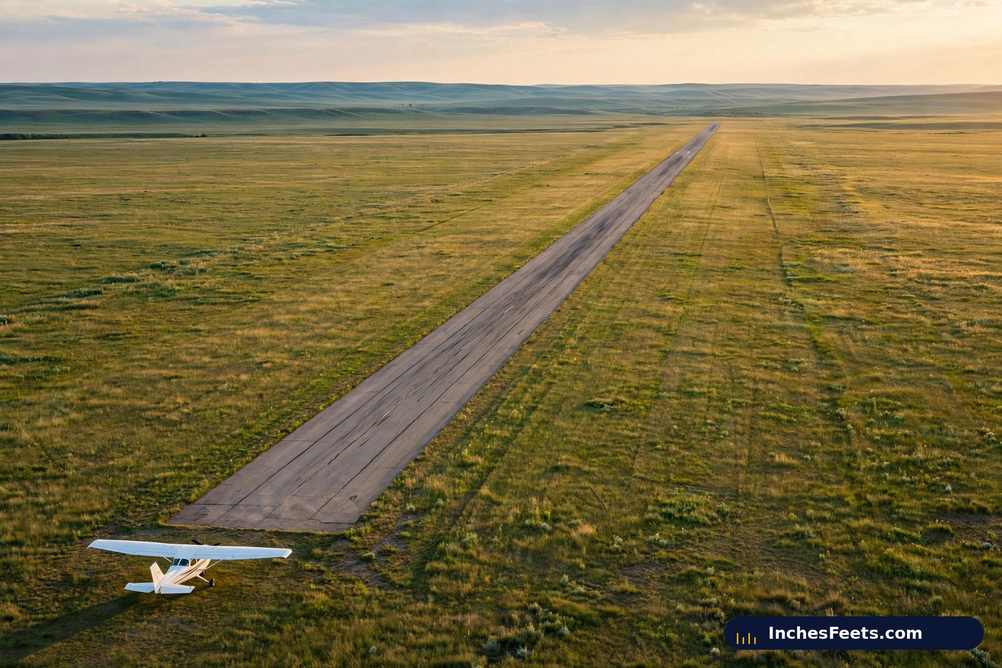
The competitor’s range for small-airport runways — “typically 1.2 to 2.5 kilometers” — overshoots this page’s distance entirely: a 1.2 km runway is already a fifth longer than a kilometer, and 2.5 km is a regional airport’s strip. Genuinely small airfields run shorter, and some are charted at exactly this length. Kubin Airport, on Moa Island in Queensland, Australia, has a single runway, 11/29, that measures exactly 1,000 m by 18 m in the aeronautical record — extended from 680 m to precisely 1,000 m in 1999.
Counted: as corrected, on the named-airfield basis — Kubin Airport’s runway is charted at exactly 1,000 m. The competitor’s 1.2–2.5 km range describes larger fields and is corrected above. FLAGGED for the gate — see the spare in the SEO block.
Train
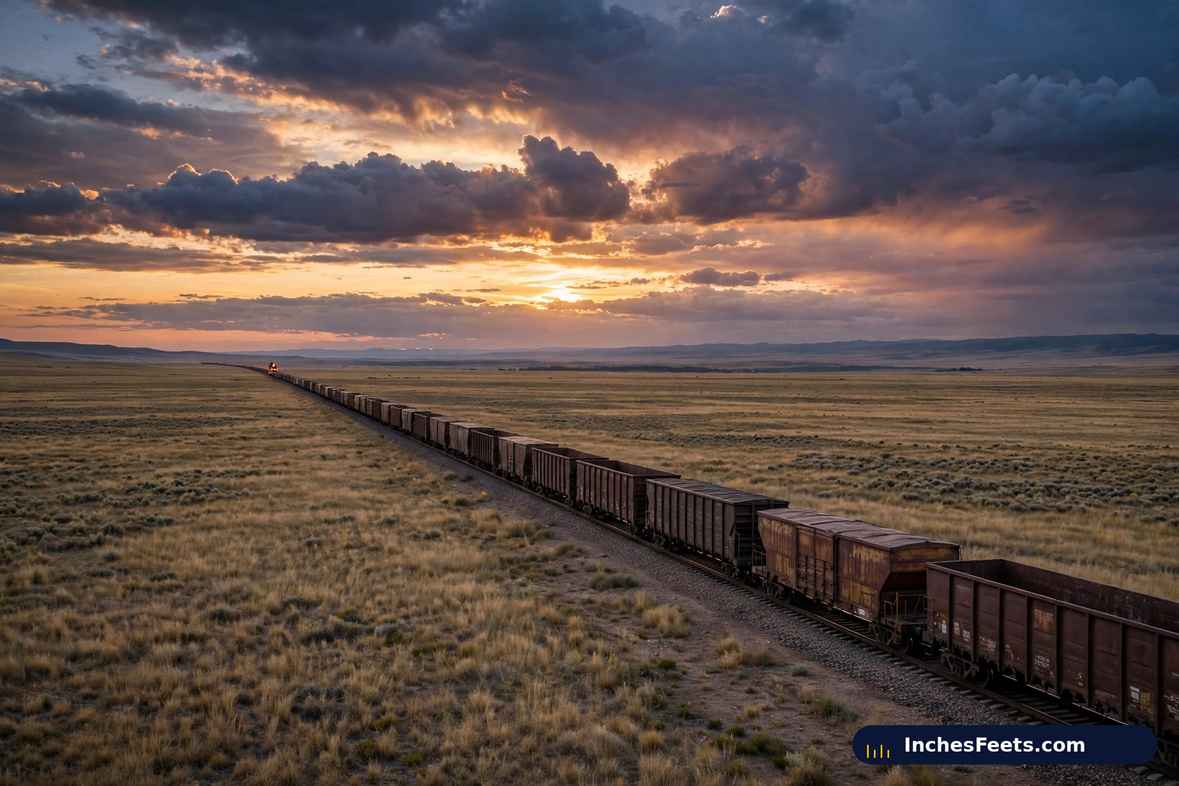
“Train” needs splitting in two. A passenger train is a few hundred meters at most — even long intercity sets rarely pass 400 m. Freight is where the kilometer lives: in the United States, typical Class I freight trains run 5,000 to 10,000 feet (about 1.5 to 3 km), the median freight train measured 5,347 feet — roughly 1,630 m — in 2022, and thousands of trains over a kilometer long run every day. Europe, by contrast, limits most freight trains to 740 m, so the kilometer train is chiefly a North American, Australian and heavy-haul sight.
Counted: as corrected, on the freight basis — kilometer-long freight trains are routine and documented; no passenger train is claimed.
Airstrip
An airstrip is the runway’s rougher cousin — the unsealed or lightly built strip at a small aerodrome — and it is counted separately here because a different named field verifies it. Dargaville Aerodrome, in Northland, New Zealand, lists its main strip, 04/22, at exactly 1,000 m (3,280 ft) of rolled limestone. Small strips like this are built to round lengths because their traffic — light aircraft, air ambulances, topdressing planes — needs hundreds of meters, not thousands; a strip of exactly one kilometer is a standard outcome, not a coincidence.
Counted: as corrected, on the named-strip basis — Dargaville’s main strip is listed at exactly 1,000 m, a distinct facility from the Kubin runway above. FLAGGED for the gate — see the spare in the SEO block.
Road Segment
This is the one example that is true by measurement rather than by manufacturing. Highways across the metric world are marked with kilometer posts, and the road segment between two consecutive kilometer markers is exactly 1 km — surveyed, signed and driven over millions of times a day. Road builders and race measurers treat the marked kilometer as the reference standard: a certified 1 km road segment is how running and cycling courses are calibrated. The competitor’s framing (“usually measures 1 kilometer”) undersells it — a segment only earns the name when it is measured, and when it is, the figure is exact.
Counted: on the defined basis — the distance between consecutive kilometer markers is exactly 1 km by survey. The softest-framed of the competitor’s examples, but the basis is disclosed here in full.
Seawall
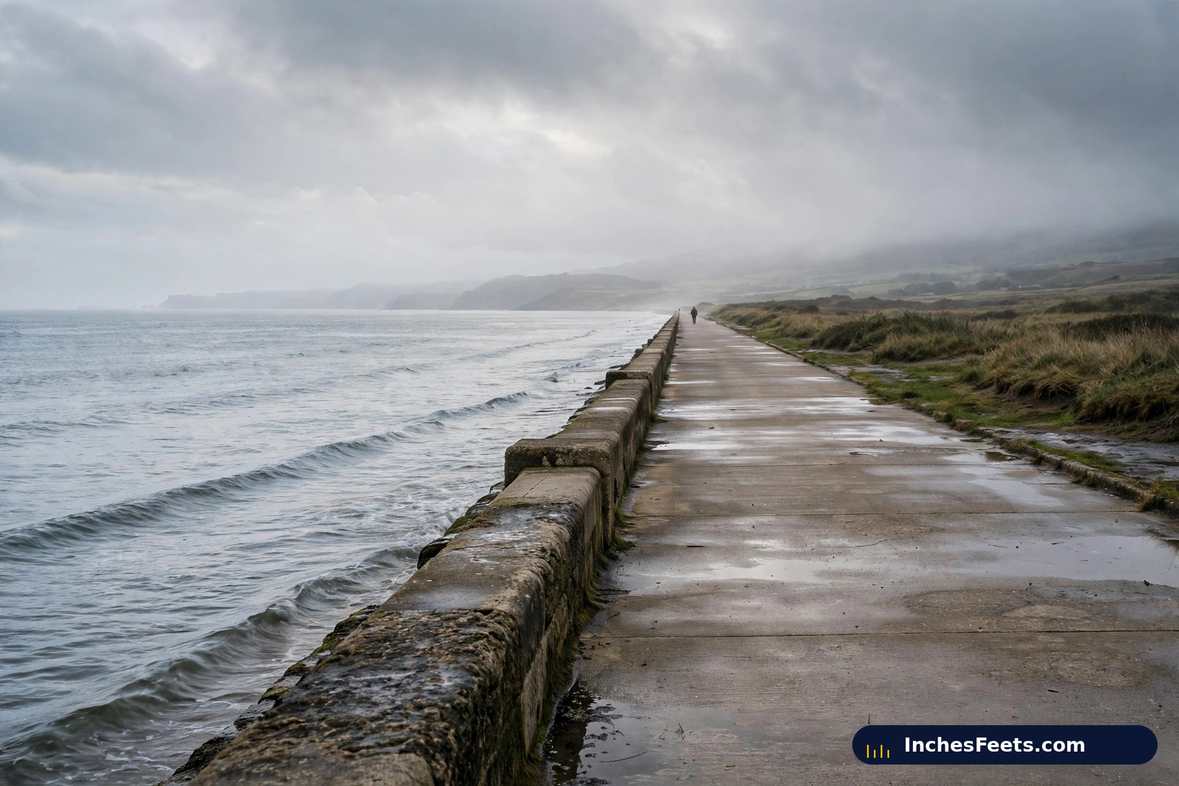
Seawalls are built where the sea insists, and the famous ones run far past a kilometer: the Galveston Seawall in Texas stretches about 10.3 miles (16.6 km), South Korea’s Saemangeum seawall runs 33.9 km, and even modest harbor walls are usually measured in kilometers plural. But seawalls are engineered in sections, and a 1 km seawall is a documented design unit: Hong Kong’s Highways Department, describing the Hong Kong–Zhuhai–Macao Bridge boundary crossing facilities in 2011, specified “a 1 km long rubble mound seawall” as part of the reclamation works — a real seawall, drawn and costed at exactly this length (the design was later amended and the wall extended to 2.5 km, which is disclosed here rather than hidden).
Counted: as corrected, on the named documented-design basis — a 1 km seawall segment is an officially documented structure; the typical whole seawall is far longer, and the later extension of the Hong Kong design is disclosed. FLAGGED for the gate — see the spare in the SEO block.
A Soccer Field
This claim fails on the competitor’s own numbers. His text gives a soccer field’s length as 90 to 120 meters — the range the Laws of the Game allow — and then calls it “close to 1 km”. It is not close: FIFA’s standard pitch is 105 m long, and even the maximum legal field, at 120 m, is barely an eighth of a kilometer. You would need about nine and a half standard pitches laid end to end to make a kilometer. A soccer field is a fine unit for 100-meter thinking; for a kilometer it is the wrong tool by a factor of nine.
Not counted: a regulation soccer field is 90–120 m long (105 m standard) — roughly a ninth of a kilometer, not “close to 1 km”. The competitor’s own figures contradict his claim; the correction is printed above.
The Length of a Football Field
An American football field measures 100 yards between the goal lines — 91.44 m — or 120 yards (109.7 m) counting both end zones. The competitor’s own text concedes the arithmetic: ten fields end to end make about a kilometer. A multiple is not a measurement. Ten goal-line-to-goal-line fields make 914 m, and nine full fields with end zones make 987 m — close, but still 13 m short, which is why the honest version of this claim appears in the Visualize section below rather than in the count.
Not counted: one football field is 91.44 m (109.7 m with end zones) — a tenth of a kilometer, not a kilometer. The “ten fields” framing is a multiple and is corrected above.
The Distance of Four City Blocks
There is no standard city block, which is the first problem — and even on the most generous famous grid, four blocks fall well short. In Manhattan, the street-to-street block is about 264 feet (80 m), twenty to a mile, so four blocks make roughly 320 m — under a third of a kilometer; you would need about twelve to thirteen Manhattan blocks to walk a kilometer. Chicago’s grid is bigger, at 330 feet (100 m) on the short side, and four of those still make only 400 m. Four blocks is a useful way to say “a short walk”. It is not a kilometer in any city with a documented grid.
Not counted: four typical city blocks make about 320–400 m — roughly a third of a kilometer. About twelve Manhattan blocks, not four, make 1 km; the correction is printed above.
The Sturdy Running Track
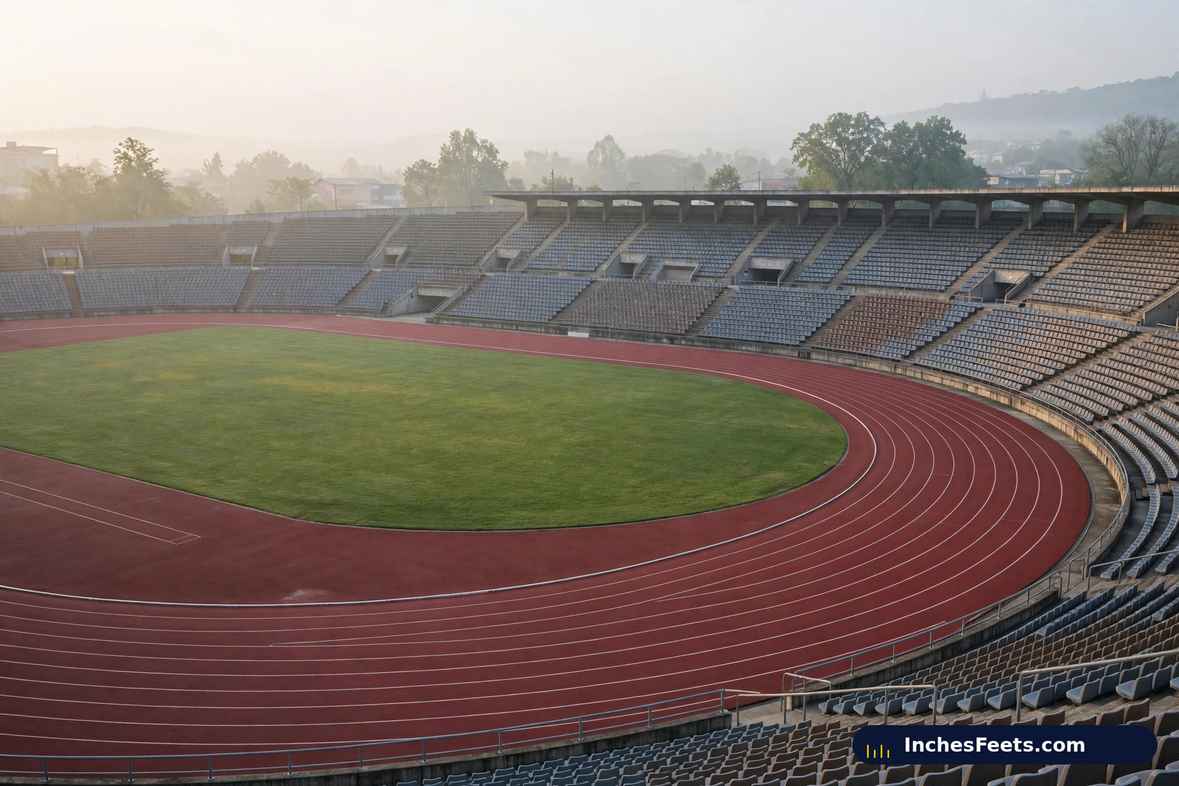
The competitor’s own text gives this one away: a standard running track’s inner lane is 400 meters, and runners complete two and a half laps to cover a kilometer. That makes the track the measuring tool, not the measured thing — the track itself is 400 m long, not 1,000 m. The 1 km that happens on a track is a race, and races over exactly this distance are counted in their own sections below (the kilo, the 1,000 metres, the skating distances). A track is where you go to experience a kilometer on foot; it is not itself a kilometer long.
Not counted: a standard athletics track is 400 m around. The 2.5-lap figure is a multiple — the distance run, not the track’s length; the correction is printed above.
The Scenic Nature Trail
“A nature trail” has no standard length — trails run from a few hundred meters to hundreds of kilometers — so the claim only works where a park has actually laid one out at this distance, and parks do. Short interpretive loops are routinely designed and signed at exactly 1 km: the Bushland Nature Trail in Kings Park, Perth, is listed at 1 km (walkers’ GPS traces run 0.94–0.97 km against the signed figure, which is the park’s design distance), and the Helmholtzia Loop in Border Ranges National Park is likewise listed at 1 km. A signed 1 km trail is a real, walkable kilometer — the friendliest way on this page to feel the distance.
Counted: as corrected, on the named-trail basis — parks design and sign loop trails at exactly 1 km, and named examples are listed above; GPS traces running a few percent under the signed distance are disclosed. FLAGGED for the gate — see the spare in the SEO block.
The Expansive Dog Park
Dog parks are sized by area, not by length, and the areas are small: design guidance and kennel-club advice put a workable dog park at roughly half an acre to a couple of acres. A single acre, laid out as a square, is only about 64 m on each side — so even a generous multi-acre dog park measures in the tens of meters across, not the thousands. For a dog park to “stretch to 1 km in length” it would have to be a ribbon of land dozens of acres in area, and no documented dog park is built that way. A big dog park feels expansive to a dog. On a surveyor’s chain it is a small field.
Not counted: dog parks are documented in acres (typically 0.5–2 acres, sides of a few tens of meters) — no verified basis exists for a typical dog park measuring 1 km in length.
The Kilo: Track Cycling’s 1,000 m
Track cycling calls its 1,000 m time trial simply “the kilo”, and it is exact by rule: under the UCI, the senior men’s kilo is 1,000 m — four laps of a standard 250 m velodrome — raced alone against the clock. It is one of the oldest championship distances in the sport, and its world record, 55.433 seconds, was set by Jeffrey Hoogland in 2023: the fastest anyone has covered a kilometer under their own power from a standing start on the flat.
Counted: exact — the UCI fixes the kilo at 1,000 m; it is a race distance defined to the meter.
The 1,000 Metres on the Track
Athletics keeps the kilometer as an official record distance: World Athletics ratifies a world record over 1,000 m, a middle-distance test between the 800 m and the 1500 m. Noah Ngeny’s 2:11.96, run in Rieti in 1999, stood as the men’s world record for over a quarter of a century — a measure of how precisely the distance is defined and how rarely it is raced at the very top level. Club and school athletics run 1,000 m races routinely; the distance on the track is surveyed, not estimated.
Counted: exact — 1,000 m is a World Athletics record distance, measured to the centimeter on certified tracks.
Speed Skating’s 1,000 m
Long-track speed skating races a classical 1,000 m: two and a half laps of the 400 m oval, skated in pairs against the clock, and a fixture of the Olympic programme and the ISU World Cup circuit. The ISU’s own explainer uses the distance to teach the sport — at 2.5 laps it is the race where skaters cross the finish line’s side of the oval exactly halfway through a lap count, which is why it is the distance casual viewers find easiest to follow.
Counted: exact — the ISU’s classical 1,000 m, 2.5 laps of the standard 400 m oval.
Short Track’s 1,000 m
Short track speed skating — pack racing on a 111.12 m oval inside an ice rink — also races exactly 1,000 m: nine laps of the small oval, and an Olympic individual title for both men and women under the ISU programme, alongside the 500 m and 1500 m. Same number, very different race: where the long-track 1,000 m is a time trial, the short-track version is nine laps of jostling, overtaking and photo finishes.
Counted: exact — the ISU short track programme includes the individual 1,000 m (9 laps of the 111.12 m oval) for men and women.
Canoe Sprint’s 1,000 m
Flatwater canoeing and kayaking race over the ICF’s set distances — 200, 500, 1,000 and 5,000 m — and the 1,000 m is the sport’s endurance classic: the men’s K-1 1000 and C-1 1000 are long-standing Olympic events, raced in lanes on a straight, buoyed course measured to exactly a kilometer. If you want to watch a kilometer travelled at racing speed without wheels or skates, this is the slowest and most honest version: about three minutes of maximal paddling.
Counted: exact — 1,000 m is an ICF competition distance and an Olympic event class (men’s K-1 and C-1).
A Masters Rowing Race
Rowing’s standard international course is 2,000 m — but not for everyone. World Rowing’s rules set the racing distance for Masters rowers (adults racing in age categories from 27 upward) at exactly 1,000 m, straight, and the World Rowing Masters Regatta — the largest rowing event of its kind, drawing over 3,000 rowers — is raced over that kilometer. A masters crew covers it in roughly three to four minutes depending on boat class and age category: a kilometer at full pressure, in lane, from a standing start.
Counted: exact — World Rowing’s rules fix the Masters racing distance at 1,000 m.
A Vertical Kilometer
One kilometer on this list points up. The Vertical Kilometer® is a defined skyrunning discipline under the International Skyrunning Federation: a race with 1,000 m of vertical climb — the rules allow a 5% tolerance — over a course no more than 5 km long. The Chamonix Vertical Kilometer packs its full kilometer of ascent into a 3.8 km route under the cable car lines. It is a kilometer of height rather than of horizontal length, and it is labelled that way here — but as a measured, governed, exact 1,000 m, it earns its place.
Counted: exact by definition — the discipline is defined as 1,000 m of vertical gain (5% rule tolerance disclosed); it is a vertical kilometer, disclosed in the heading and the text.
A Five-Furlong Sprint
Horse racing measures its shortest races in furlongs, and its shortest standard flat class is five furlongs. A furlong is exactly 201.168 m — an eighth of a mile — so a five-furlong sprint is exactly 1,005.84 m: five meters and change past a kilometer, the closest the imperial system gets to this page’s distance. The class is so standard that Epsom Downs marks a “five-furlong (1000 m) post” on the course, and metric racing nations simply card the same races as 1,000 m.
Counted: on the defined-distance basis, FLAGGED — five furlongs is exactly 1,005.84 m, which is 5.84 m (0.58%) over a kilometer; the overshoot is printed here, not rounded away.
Stonecutters Bridge’s Main Span
Stonecutters Bridge, the cable-stayed bridge carrying Hong Kong’s Route 8 over the Rambler Channel, hangs its roadway from a main span of 1,018 m — at its opening one of the longest cable-stayed spans on earth. The whole bridge is 1,596 m long, but the span is the honest comparison: a single unsupported crossing of just over a kilometer, 18 m (1.8%) past the mark, with the overshoot stated rather than trimmed. Stand on the shore at Tsing Yi and the gap between the two towers is, near enough, this page’s distance made visible.
Counted: on the span basis, FLAGGED — the main span is documented at 1,018 m by Hong Kong’s Highways Department (+18 m, +1.8%, disclosed); the total bridge length (1,596 m) is not the figure claimed.

The Gap Between Metro Stations
Cities space their metro stations about a kilometer apart, and some space them at exactly one. Sofia Metro’s official general scheme puts the average distance between its stations at 1,000 m; planning guidance in Taipei designs for 800–1,000 m between downtown stations; and a study of 138 subway systems worldwide (Louf and Barthelemy, published in PLoS ONE) found station spacing clustering tightly around the kilometer, averaging about 1.2 km. The reason is this page’s walking figure: stations a kilometer apart are a ten-minute walk apart, which is the spacing city travellers accept. When a metro map says “one stop”, it usually means one kilometer.
Counted: on the documented-average basis, FLAGGED — an official scheme average of exactly 1,000 m (Sofia) inside a worldwide pattern clustered at ~1–1.2 km; individual station gaps vary, and that basis is disclosed here in full. This is the softest of the added counts — see the spare in the SEO block.
How to Visualize 1 Kilometer
Start with vertical drama: Angel Falls, the world’s tallest waterfall, drops 979 m — picture that immense cliff of water, then add 21 m, and you have a kilometer stood on end. On the ground, use the track: two and a half laps of a standard 400 m stadium. In a city, count blocks the honest way — about twelve Manhattan street-to-street blocks, not four. On a sports field, lay out nine full American football fields including their end zones (987 m) and pace the last 13 m yourself; ten fields goal-line to goal-line (914 m) leave you nearly a tenth short, which is why the popular shortcut misleads.
From the air it is easier: the runway at a small airfield, the span between a great bridge’s towers, the gap between two metro stations under your feet. A kilometer is the distance at which familiar things become small — a person at the far end is a figure, not a face.
1 Kilometer Compared With Other Lengths
Set against this site’s other benchmarks, a kilometer is fifty times 20 meters — fifty cricket-pitch lengths, or fifty long rooms, end to end. It is about six and a half times 500 feet (152.4 m), and about forty-one times 80 feet (24.384 m) — a blue whale’s length laid down forty-one times in a row. Measured against another of the site’s distances, it is about thirty-three times 100 feet (30.48 m) — the comparison to reach for when a height in feet needs converting into a walk.
In the other direction, a kilometer is 0.62 of a mile — call it five-eighths of a mile. It is also 1,000 meters, 100,000 centimeters and a million millimeters; the million is the figure that makes machinists smile and the rest of us reach for the table at the top of this page.
How to Measure Out 1 Kilometer
Pacing works if you calibrate first. Most adults stride 0.7–0.8 m, so a kilometer takes roughly 1,250–1,400 steps — count your own over a known short length first (a single 3 meters plank, or a room you have taped once), multiply up, and walk it off; expect to land within a few percent, which is plenty for a hike estimate and useless for a fence line. On roads, don’t estimate at all: the kilometer markers are already there, surveyed and signed, and the segment between two of them is the standard itself.
For anything that must be right — a race course, a training loop, a plot boundary — use a measuring wheel or a surveyor, the tools the road markers themselves were set with. A phone’s GPS track is a good middle option over a full kilometer: its per-point errors largely cancel across forty or fifty track points, typically landing within a few meters, but it drifts under tree cover and between tall buildings, exactly where city kilometers get walked.
Conclusion
One kilometer is 1,000 meters — 0.621371 miles, 3,280.84 feet — and the 16 verified examples above show where it genuinely lives: fixed to the meter in the rulebooks of cycling, skating, canoeing and rowing, charted exactly on a Queensland runway, engineered into a Hong Kong seawall’s design, and surveyed between two roadside markers on almost any highway. The claims that fail teach the same lesson from the other side: a soccer field is a ninth of it, four city blocks a third of it, and a running track is the 400 m tool you measure it with, not the distance itself.
Keep the anchors that survive checking: two and a half laps of a standard track, about twelve city blocks, a ten-minute walk. And spare a thought for the racecourse, where the shortest sprint is still measured in the old furlong — five of them make 1,005.84 meters, the nearest the imperial system ever came to inventing the kilometer by accident.
FAQs
How Big is a Kilometer?
1,000 meters: 0.621 miles, or 3,280.84 feet. Picture about twelve Manhattan-style city blocks end to end, or two and a half laps of a standard athletics track.
How Far is 1 km?
0.621 miles — about 10 to 12 minutes’ walk at a normal pace, about one minute’s drive at 60 km/h, and roughly 1,300 average adult steps.
How Long is 1 km?
1,000 meters end to end. The popular “ten football fields” shortcut undershoots: ten fields goal-line to goal-line make 914 meters, and nine full fields including end zones make 987 meters — close, but still 13 meters short.