How Far Is 500 Feet? 44 Comparisons That Show the Distance
If you are asking how far is 500 feet, here is the exact answer first: 500 feet is 152.4 meters — 6,000 inches, or 166.67 yards — about the height of a 50-story building, the length of one and two-thirds football fields, and just under a tenth of a mile.
Five hundred feet is a scale the built world keeps landing on: office towers, cruise ships, Ferris wheels, and observation decks all cluster around it, while the famous giants — suspension-bridge spans, waterfalls, racetracks — are best understood as stacks of 500-foot lengths laid end to end.
This guide gives you the exact conversions first, then walks through 44 comparisons whose sizes are checked against official standards, manufacturer and institutional specifications, and record books — and corrects the popular comparisons, including several on the page this one replaces, that quietly get 500 feet wrong.

Things That Are About 500 Feet: The Short List
If you only remember a short list, make it this one. Every entry below sits within about five percent of 500 feet, or reaches it exactly, by an official record — not by eyeballing:
- Frost Bank Tower, Austin — 515 feet to the roof, the closest famous skyscraper to the mark.
- The Star of Nanchang Ferris wheel — 160 meters, or 525 feet, once the tallest wheel in the world.
- MS Star Pride cruise ship — 522 feet long, per Windstar Cruises’ own ship facts.
- The Space Needle’s observation deck — 520 feet above Seattle, per the Needle’s official figures.
- The Spring Temple Buddha monument — 502 feet including its lotus throne and pedestal building.
- Smith Tower, Seattle — 484 feet to the tip of its spire.
- Two and a half NHL ice rinks — a regulation rink is exactly 200 feet long, so 2.5 rinks end to end is exactly 500 feet.
- Six Amtrak Superliner cars — each car is 85 feet long, so six coupled together run 510 feet.
Two comparisons you will see elsewhere need correcting straight away. There is no “Windsor House” in Perth standing 150 meters tall — no building by that name and size exists in any reliable record, as the buildings section below shows. And the Statue of Unity does not have a “150-meter total height”: the statue alone is 182 meters. The honest anchors are the 44 below.
500 Feet in Other Units: The Exact Conversions
Five hundred feet converts exactly, with no rounding anywhere in the chain, because the foot is defined as precisely 0.3048 meters:
| Unit | 500 feet equals |
|---|---|
| Inches | 6,000 in |
| Yards | 166.67 yd |
| Meters | 152.4 m |
| Centimeters | 15,240 cm |
| Millimeters | 152,400 mm |
| Kilometers | 0.1524 km |
| Miles | 0.0947 mi |
Put against this site’s other guides, 500 feet is 16.7 times 30 feet, and it takes about two minutes to cover on foot: at an average walking speed of 3 mph you cross it in roughly 1 minute 55 seconds, or about 1 minute 25 seconds at a brisk 4 mph. Driving at 50 mph, you pass it in about 7 seconds — which is why 500 feet feels long on foot and vanishes through a windshield.
How to Visualize 500 Feet
The most reliable everyday ruler for 500 feet is the city block. Downtown Portland, Oregon is platted in 200-foot square blocks, so 500 feet is exactly two and a half Portland blocks. A standard Chicago block runs 660 feet on its long side, so 500 feet is about three-quarters of one. In Manhattan, where the short blocks are about 264 feet, it is just under two blocks. Anyone who tells you “500 feet is about five blocks” is using a 100-foot block that almost no city actually has.
Sports venues give cleaner anchors, because their dimensions are set by rule books. A football field is 300 feet from goal line to goal line, so 500 feet is one and two-thirds fields — or about 1.39 fields if you count the end zones. An NBA basketball court is 94 feet long, so five and a third courts laid end to end make 500 feet. Three lengths of an Olympic swimming pool (50 meters each) come to 492 feet, just short. And your own body works too: at the roughly 2,000 steps per mile that step-count studies use as an average, 500 feet is about 190 ordinary walking steps. It is also 25 times twenty feet — pace out the smaller distance from our earlier guide twenty-five times and you have marked the full 500.
Tall Buildings and Landmarks Around 500 Feet
Frost Bank Tower
Austin’s Frost Bank Tower is the honest headline act for this size: it stands 515 feet (157 m) to its roof, with 33 floors, completed in 2004. It was the tallest building in Austin when it opened and the first major US high-rise begun after the September 11 attacks. At 3 percent over the mark, it is what a real 500-foot-class building actually looks like — a genuine downtown landmark, not a supertall.
Smith Tower
Seattle’s Smith Tower, finished in 1914, reaches 484 feet (148 m) to the tip of its antenna spire; its roof is 462 feet. One claim about it needs correcting: it was never “the tallest building in the world” — New York’s Woolworth Building, at 792 feet, already held that title in 1914. What Smith Tower genuinely was is the tallest building west of the Mississippi River, and it stayed the tallest on the US West Coast for nearly half a century, until the Space Needle passed it in 1962.
Windsor House
This entry has to be corrected rather than counted. The comparison as usually printed — a “22-storey Windsor House in Perth, 150 meters tall” — matches no real building: no Windsor House of that height exists in Perth or anywhere else in the reliable records. The one well-documented Windsor House is in Belfast, Northern Ireland: 80 meters (262 feet), 23 floors, completed in 1974, and now converted into the Grand Central Hotel. Even two of those stacked would overshoot oddly at 524 feet, so there is no honest version of this example, and it is not one of the 44.
Iconic Structures Measuring Around 500 Feet
Observation Deck
Observation decks are often described as sitting “at exactly 500 feet,” and that needs a small correction: the famous one in this class, the Space Needle’s deck in Seattle, actually sits at 520 feet by the Needle’s official figures, with the structure topping out at 605 feet. Treat “about 500 feet” as the honest wording for decks in this class — 520 feet is close enough to picture the height, and it is one of the 44 because the real figure is verified, not rounded into place.
Star Pride Cruise Ship
Windstar Cruises’ own facts for MS Star Pride give the ship’s length as 522 feet (159 m) — a small luxury cruise ship carrying just a few hundred guests. A ship is a useful 500-foot picture because it is horizontal: walk her from bow to stern on the dock and you have walked almost exactly 500 feet, with 22 feet to spare.
Star of Nanchang
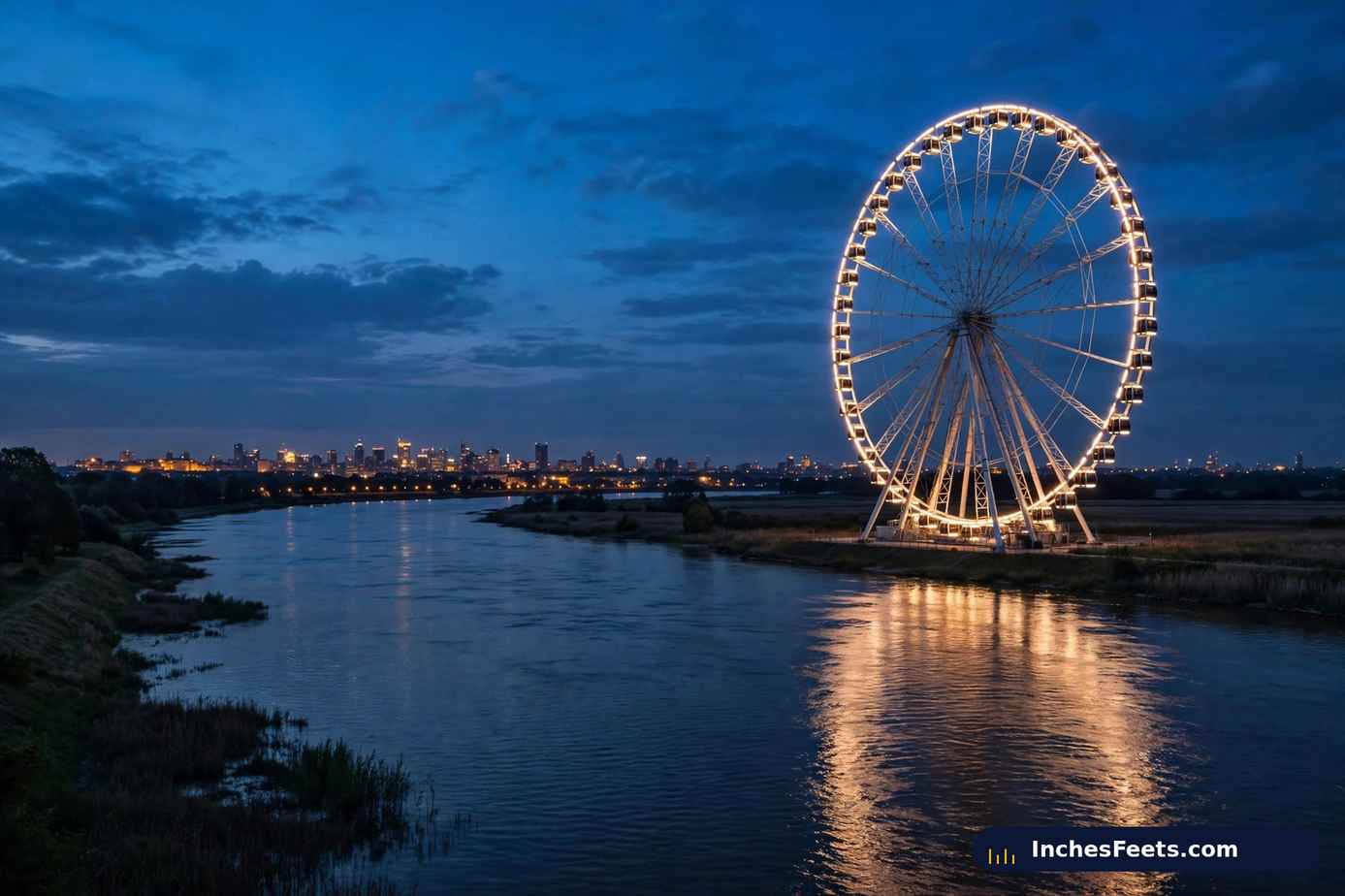
The Star of Nanchang, in Jiangxi, China, stands 160 meters — 525 feet — and was the world’s tallest Ferris wheel when it opened in 2006, before the Singapore Flyer passed it in 2008. Its wheel alone has a diameter of about 153 meters. Stand it next to the Frost Bank Tower and the two silhouettes, one a wheel and one a tower, are within ten feet of each other.
Famous Towers That Dwarf 500 Feet
Eiffel Tower
The Eiffel Tower is sometimes introduced in these lists as if it were a near miss; it is not. Including its antennas it stands 330 meters — 1,083 feet — which is 2.17 times 500 feet. The honest way to use it: the tower’s second floor sits at about 377 feet, and its summit is more than two full 500-foot lengths stacked up.
Tokyo Skytree
Tokyo Skytree, the world’s tallest tower, stands 634 meters — 2,080 feet, or a little over four 500-foot lengths. Its two observation decks, at 350 and 450 meters, are themselves each in the 1,150–1,475-foot range, far above the 500-foot mark this page is about.
CN Tower
Toronto’s CN Tower stands 553.3 meters overall — 1,815 feet, or about 3.6 times 500 feet. Its main observation level is at 342 meters (1,122 feet), and even the tower’s concrete shaft alone passes 500 feet before the pod begins. It remains the tallest free-standing structure in the Western Hemisphere.
Oriental Pearl Tower
Shanghai’s Oriental Pearl Tower stands 468 meters — 1,535 feet, almost exactly three 500-foot lengths. Its highest sphere holds an observation area at 350 meters. When it was completed in 1994 it was China’s tallest structure, a title it kept until 2007.
City Skyscrapers That Stand Over 500 Feet
Empire State Building
The Empire State Building stands 1,250 feet to its roof and 1,454 feet to the tip of its antenna — so its roof alone is two and a half times 500 feet, and the often-quoted “1,454 feet” includes the antenna. Its 86th-floor observatory, at 1,050 feet, is itself a fraction over two 500-foot lengths up.
Burj Khalifa
The Burj Khalifa in Dubai, the world’s tallest building, stands 828 meters — 2,717 feet, or about 5.4 times 500 feet. At this scale the comparison flips: 500 feet is less than a fifth of the building, roughly the height of its first 40-odd floors, and its observation deck on level 148 sits at 555 meters, already higher than three of our units end to end.
The International at Imperial House
This entry is corrected rather than counted. The claim that a Bangkok condominium called “The International at Imperial House” (TIAH) stands 493 feet comes with no verifiable published height behind it: the name appears in no reliable building database with that figure, and Bangkok’s documented residential towers of that era are recorded at quite different heights. A number that cannot be checked cannot anchor a comparison, so it is not one of the 44.
Historical Monuments Compared to 500 Feet
Statue of Liberty
The Statue of Liberty, measured the way the National Park Service measures it — from the ground to the tip of the torch — stands 305 feet 1 inch. So 500 feet is about 1.64 times the whole monument, pedestal included. The copper statue itself is 151 feet, meaning you could stack the figure a little over three times inside 500 feet.
Lincoln Memorial Building
The Lincoln Memorial building in Washington, DC measures 192 feet long, 132 feet wide, and 99 feet tall, per the National Park Service. Five hundred feet is about 2.6 times its length — picture two and a half memorial buildings in a row, plus most of a third. The seated Lincoln inside is 19 feet tall, a reminder of how much of this monument’s power is proportion rather than sheer size.
Gateway Arch
St. Louis’s Gateway Arch stands 630 feet tall — and, less famously, exactly 630 feet wide at its base, per the National Park Service. That makes it 1.26 times our mark in both directions: a perfect square of 500-foot-plus scale, and the tallest monument in the United States.
Statue of Unity
The Statue of Unity in Gujarat, India is routinely misquoted in these comparisons as having “a total height of 150 meters.” It does not. The statue itself is 182 meters — 597 feet — and the whole structure, including its 58-meter base, reaches 240 meters, or 790 feet. Either way it clears 500 feet outright; the 150-meter figure appears to be a garbled version of its 153-meter viewing gallery level.
Spring Temple Buddha
China’s Spring Temple Buddha needs the same kind of care. The statue itself is 128 meters (420 feet) — under our mark. The 153-meter figure (502 feet) that gets quoted is the monument’s total including its 20-meter lotus throne and the 25-meter pedestal building beneath it, and on that basis it honestly belongs in the 500-foot class and is counted here. Later landscaping raised the full monument to a claimed 208 meters, which is not the figure used.
Architectural Marvels Featuring 500 Feet Measurements
General Motors Technical Center
The GM Technical Center in Warren, Michigan is sometimes given a tidy set of dimensions — a campus “2,000 by 2,500 feet, 500,000 square feet in all, with over 500 feet of scenic paths.” None of that survives checking. The arithmetic alone fails: 2,000 × 2,500 feet is 5,000,000 square feet (about 115 acres), not 500,000. GM’s own fact sheet describes a 710-acre campus — roughly 31 million square feet — with 38 buildings and 18.7 miles of roads, organised around a 22-acre lake. No official source publishes a “500 feet of paths” figure at all, so this example is corrected and not counted: the real campus is vastly bigger than the tidy version suggests.
Natural Wonders Spanning 500 Feet
Niagara Falls
Niagara Falls is a width comparison, not a height one. Niagara Parks puts the Canadian Horseshoe Falls at about 2,200 feet wide and the American Falls at about 950 feet, for a combined crestline of roughly 3,950 feet — nearly eight 500-foot lengths side by side. The drop itself is about 188 feet, so the falls are far wider than they are tall, which is exactly why the 500-foot frame fits them sideways.

Angel Falls
Angel Falls in Venezuela, the world’s tallest waterfall, has a total height of 979 meters (3,212 feet) in Guinness World Records’ figures, with a single uninterrupted drop of 807 meters (2,648 feet). That one drop alone is more than five 500-foot lengths of falling water — and it is worth being precise, because the 979-meter total includes the sloped rapids below the main plunge.
Famous Bridges and Their Spans
Bridge spans are where 500 feet stops being the whole story and becomes a counting unit: every famous span below is a whole number of 500-foot lengths, and each span here is the published main-span figure, not the bridge’s total length.
Golden Gate Bridge
The Golden Gate Bridge’s main span is 4,200 feet (1,280 m) — 8.4 times 500 feet between its two towers. The whole bridge, including approaches, runs 8,981 feet. When it opened in 1937 it was the longest suspension span in the world, a record it held until 1964.

Mackinac Bridge
Michigan’s Mackinac Bridge has a main span of 3,799 feet (1,158 m) — often rounded to 3,800 — which is about 7.6 of our units. Its total length of 26,372 feet made it, at its 1957 opening, one of the longest bridges on earth, and it remains the longest suspension bridge in the Western Hemisphere by total length between anchorages.
Rainbow Bridge
A classification correction first: Niagara’s Rainbow Bridge is a steel arch bridge, not a suspension bridge, though it is often filed with them. Its main arch spans 950 feet (290 m) — just under two 500-foot lengths — and the deck stands 202 feet above the Niagara River. It opened in 1941, replacing the Honeymoon Bridge that an ice jam destroyed in 1938.
Williamsburg Bridge
New York’s Williamsburg Bridge has a main span of exactly 1,600 feet — 3.2 times 500 feet. When it opened in 1903 that span was the world’s longest for a suspension bridge, a title it held for two decades, and it still crosses the East River a few miles north of its older sibling.
Brooklyn Bridge
The Brooklyn Bridge’s main span is 1,595 feet 6 inches (486.3 m) — only four and a half feet shorter than the Williamsburg’s, and about 3.2 times our unit. In 1883 it was the first steel-wire suspension bridge and by far the longest span in the world; the 4.5-foot gap between the two New York spans is one of engineering history’s famous near-ties.
Pierre Laporte Bridge
Quebec City’s Pierre Laporte Bridge carries Canada’s longest suspension main span: 667.5 meters, or 2,190 feet — about 4.4 times 500 feet. Opened in 1970 across the St. Lawrence River, it runs parallel to the older Quebec Bridge, whose pier sits in the water while both of the Laporte’s tower piers stand on shore.
Puente Bicentenario
This entry needs its name and number corrected. Panama’s bridge over the canal is the Puente Centenario (Centennial Bridge), not “Bicentenario,” and no published source gives it a 2,507-foot span. The verified figures: a cable-stayed main span of 420 meters (1,380 feet) and a total length of 1,052 meters (3,451 feet), opened in 2004. On its real numbers it still earns its place here — its main span is about 2.8 of our units.
Pontchartrain Causeway Bridge
The Lake Pontchartrain Causeway in Louisiana is the extreme case: two parallel bridges of 23.875 miles — 126,060 feet, or about 252 times 500 feet. Guinness World Records lists it as the world’s longest continuous bridge over water. Crossing it, you are out of sight of land in both directions for much of the drive.
Racetracks Around the World Compared to 500 Feet
A racetrack’s “length” is its lap, so every circuit below holds dozens of 500-foot lengths per lap — the useful exercise is counting how many, and noticing how wrong the casual figures can be.
Daytona International Speedway
Daytona’s tri-oval is 2.5 miles per lap — 13,200 feet, or 26.4 times 500 feet. And a naming point worth making on a page about this number: the Daytona 500 is 500 miles, not feet — 200 laps of the tri-oval. At 200 mph a car covers 500 feet in about 1.7 seconds, which is the real relationship between this track and our distance.

Automotodrom Brno
The Brno Circuit in the Czech Republic — the Masaryk Circuit — runs 5.403 km per lap, which is 17,726 feet, or about 35 times 500 feet. The permanent circuit opened in 1987 with 14 turns and roughly 74 meters of elevation change, replacing the enormous public-road course, nearly 29 km long, that hosted racing from 1930.
Autodromo Enzo e Dino Ferrari
Imola, in Italy, runs 4.909 km per lap on its Grand Prix layout — 16,106 feet, or about 32 times 500 feet. The circuit, named for Enzo Ferrari and his son Dino, is one of the few on the Formula 1 calendar to run counter-clockwise, with 19 turns packed into that lap.
Guangdong International Circuit
A location correction: the Guangdong International Circuit is in Sihui, near Zhaoqing — not in Zhuhai. Zhuhai has its own, separate, older circuit of 4.319 km. Guangdong International’s lap is 2.824 km — 9,265 feet, or about 18.5 times 500 feet — with 13 turns and a main straight of 0.718 km.
Circuito di Bremgarten
Switzerland’s Bremgarten circuit, near Bern, ran 7.280 km per lap — 23,885 feet, or about 48 times 500 feet. It also needs a tense correction: it is a historic circuit, not a contemporary one. It hosted the Swiss Grand Prix from 1934 to 1954, and Switzerland’s ban on circuit racing after the 1955 Le Mans disaster ended its life; the surviving roads are ordinary forest streets today.
Contemporary Racetracks and Their Lengths
Autódromo José Carlos Pace
Interlagos, in São Paulo, Brazil, runs 4.309 km per lap — 14,137 feet, or about 28 times 500 feet. Formula 1’s own circuit guide confirms the figure for the current 15-turn layout, in use since the 1990 rebuild shortened the original 7.96 km course.
Silesia Ring
Poland’s Silesia Ring, at Kamień Śląski, runs 3.636 km per lap — 11,929 feet, or about 24 times 500 feet — with 15 turns, on the site of a former airfield. It opened in 2016 and is Poland’s most modern circuit.
Slovakia Ring
This entry exists to untangle a mix-up. The Slovakia Ring is a different circuit from the Silesia Ring, in a different country: it sits at Orechová Potôň, Slovakia, and its Grand Prix layout runs 5.935 km (19,469 feet). Lists that merge the two — a Polish name with a Slovak length or the reverse — are combining two real tracks into one imaginary one. The Silesia Ring above is the counted example; this one is kept separate and not double-counted.
Famous Kart Tracks Around the World
Kartodromo de Granja Viana
Brazil’s Kartódromo Granja Viana, in Cotia near São Paulo, runs about 1,235 meters per lap — roughly 4,052 feet, or about eight times 500 feet. It is one of South America’s benchmark kart circuits, a regular host of the Rotax Max Challenge Grand Finals, and a track where several Formula 1 drivers learned their craft as juniors.
Killarney Kart Circuit
Cape Town’s Killarney complex includes a karting circuit of about one kilometre — published figures cluster around 1,020 meters (3,346 feet), or roughly 6.7 times 500 feet. The club built it alongside the main 3.267 km circuit, an 800-meter drag strip, and a short circuit, at a venue whose racing history goes back to 1947.
LeMans Karting
A precise figure sometimes quoted for LeMans Karting’s Sacramento track — “976 feet” — cannot be verified against any published source, so it is not used here. What can be verified is the class it belongs to: FIA Karting’s circuit licence rules set minimum lap lengths of 800 meters (2,625 feet) for a Grade 3 licence, 1,000 meters for Grade 2, and 1,150 meters for Grade 1. Any licensed kart circuit, in other words, holds at least five 500-foot lengths per lap.
Pat’s Acres Racing Complex
Pat’s Acres, in Canby, Oregon, is often quoted at a precise “0.66 miles with 22 turns.” The precise pairing cannot be verified from published sources, so it is not counted. What the complex’s own history supports: the original paved sprint course of 1967 was a little over half a mile, and a later “long track” extension brought the full course to just under a mile — somewhere between roughly 2,900 and 5,200 feet depending on configuration, on 43 wooded acres that have hosted karting since the 1960s.
How to Measure 500 Feet Accurately
Five hundred feet is exactly the distance where casual tools start to lie, so measure it like a surveyor, in verified steps. A standard 25-foot tape needs twenty pulls, and every re-anchor adds error — a 100-foot fiberglass tape, five pulls, is the practical minimum, with each end marked before you move. Better tools exist for a reason: a measuring wheel counts the distance in one pass (check its calibration against a known 100 feet first), a laser rangefinder reads it in one shot to a target, and a phone’s GPS is fine for a rough check but can drift by 10–15 feet over this distance, which matters if a setback or boundary is at stake. However you do it, the sanity check is built into this page: the same 500 feet holds 3,000 of the two inches from this site’s smallest guide — if your count of paces, at roughly 190 average steps, lands far from that, measure again.
Conclusion
Five hundred feet turns out to be one of the most useful rulers in the built world: tall enough to hold a 50-story tower, a 522-foot cruise ship, and a 525-foot Ferris wheel almost exactly, and short enough that the famous giants — the Golden Gate’s 4,200-foot span, Angel Falls’ 2,648-foot drop, Daytona’s 13,200-foot lap — read most clearly as multiples of it. The catch, as this page’s corrections show, is that the internet’s favourite 500-foot comparisons are often rounded, misnamed, or invented outright: a statue quoted 100 feet short, a campus whose area is wrong by a factor of ten, a bridge wearing another bridge’s name.
So keep the verified anchors and drop the folklore. When someone tells you a thing is “about 500 feet,” picture Austin’s Frost Bank Tower, pace out two and a half city block lengths in a 200-foot-block city, and ask which of the two the claim really matches — the real 500 feet, or the rounded one.
FAQs
How many city blocks is 500 feet?
It depends entirely on the city, because a block is not a standard unit. In downtown Portland’s 200-foot grid it is exactly 2.5 blocks; against a Chicago long block of 660 feet it is about three-quarters of one block; in Manhattan’s roughly 264-foot short blocks it is just under two. There is no single answer, and any source that gives one without naming a city is guessing.
How many football fields is 500 feet?
One and two-thirds fields, measured goal line to goal line: a field is 300 feet between the goal lines, and 500 ÷ 300 = 1.67. If you include both end zones, the full 360-foot field fits into 500 feet about 1.39 times. Either way, “about a field and a half” is the honest picture.
How many basketball courts fit in 500 feet?
About 5.3 NBA courts end to end: a regulation NBA court is 94 feet long, and 500 ÷ 94 = 5.32. A FIBA court is slightly shorter at 28 meters (91.9 feet), which makes it about 5.4 courts. Five full courts plus a third of another is the picture to keep.
Is 500 feet a standard distance for swimming pools?
No. Competitive pools are standardized in meters — 50 meters for Olympic-size (164 feet) and 25 meters for short-course — so 500 feet is not a pool distance at all. It equals almost exactly three Olympic lengths (492 feet) plus eight feet, which is a workout set, not a venue dimension.
How many yards are in 500 feet?
Exactly 166.67 yards, since a yard is 3 feet and 500 ÷ 3 = 166.67. For a sports picture, that is one and two-thirds American football fields without the end zones, or just over one and a half soccer pitches laid lengthwise, since a typical pitch is about 115 yards long.
How many steps is 500 feet?
About 190 average walking steps. Step-count research puts an average walker at roughly 2,000 steps per mile, which works out to one step every 2.64 feet; 500 ÷ 2.64 ≈ 190. Taller walkers with longer strides will do it in fewer — nearer 170 — and shorter walkers in more.
How long does it take to walk 500 feet?
Just under two minutes at an average pace: at 3 mph you move at 4.4 feet per second, so 500 feet takes about 114 seconds. At a brisk 4 mph it is about 85 seconds, and at a slow 2 mph stroll about 2 minutes 50 seconds. Driving the same distance at 50 mph takes about 7 seconds.
How tall is a 50-story building compared to 500 feet?
Usually a little more than 500 feet, but there is no fixed answer: floor-to-floor heights run about 10 feet in apartments and up to 14 feet in offices, before any lobby or crown. Fifty residential stories can land near 500–550 feet, while fifty office stories can reach 700 feet. The Frost Bank Tower makes the point from the other direction — 515 feet with only 33 office floors.
How far is 500 feet in a marathon?
Almost nothing: a marathon is 26.2 miles, which is 138,336 feet, so 500 feet is about 0.36 percent of the race — roughly 1/277th of it. A runner at a steady 8-minute-mile pace covers it in about 29 seconds. It is, quite literally, the distance the field covers while the crowd is still applauding the start.
What is 1,000 meters in feet?
Exactly 3,280.84 feet — not the round 3,000 feet sometimes printed. A meter is 3.28084 feet by definition, so 1,000 meters is 3,280.84 feet, or about six and a half of this page’s 500-foot units. The same exact factor is what makes 500 feet precisely 152.4 meters in the other direction.
How does 500 feet compare to ski jumping hills?
It is longer than almost all of them. FIS rules classify hills by hill size — the distance from takeoff to the end of the landing area: normal hills run 85–109 meters and large hills 110–149 meters. Five hundred feet is 152.4 meters, beyond even the large-hill class; only the giant ski flying hills, at 185 meters and up, are built bigger.
How many hockey rinks is 500 feet?
Exactly two and a half NHL rinks: a regulation NHL rink is 200 feet long by 85 feet wide, so 2.5 rinks end to end is exactly 500 feet, with nothing left over. An international rink is a touch longer at 60 meters (196.85 feet), which makes it about 2.54 rinks — close, but the NHL figure is the one that lands exactly.