How Long Is 20 Inches? 17 Common Things That Are 20 Inches Long
When people type “20 inches example” into a search box, they want one thing: a real object that makes the size click. Here is the direct answer: 20 inches is exactly 50.8 centimeters (508 millimeters) — 1 foot 8 inches, and the short side of every standard bed pillow.
Twenty inches sits in an awkward middle zone: far longer than your hand, well short of a doorway, and just big enough that guessing it badly has consequences — a case that will not fit the overhead bin, a wheel that takes the wrong tyre.
This guide gives you the exact conversions first, then walks through familiar objects whose sizes are checked against manufacturer specifications, official standards, and published size charts — and corrects the popular comparisons, including several on the page this one replaces, that quietly get 20 inches wrong.
How Long is 20 Inches?
Twenty inches is exactly 50.8 centimeters. It is 1 foot 8 inches — a standard 12-inch ruler plus 8 inches of a second one — and a little over half a yard. In metric terms it is 508 millimeters, or 0.508 meters.
Two claims you will see elsewhere need correcting straight away. A laptop screen is not a 20-inch object: mainstream laptops run 13 to 16 inches, and even large desktop-replacement models top out around 17 to 18 inches. And 20 inches is not “the length of a typical basketball”: a men’s basketball measures about 9.5 inches across, so the ball itself is less than half of 20 inches — two of them side by side come to roughly 19 inches. The honest anchors are below.
Everyday Objects That Are Exactly 20 Inches
If you only remember a short list, make it this one. Every object below is 20 inches by a manufacturer’s specification, an official standard, or a published size chart — not by eyeballing:
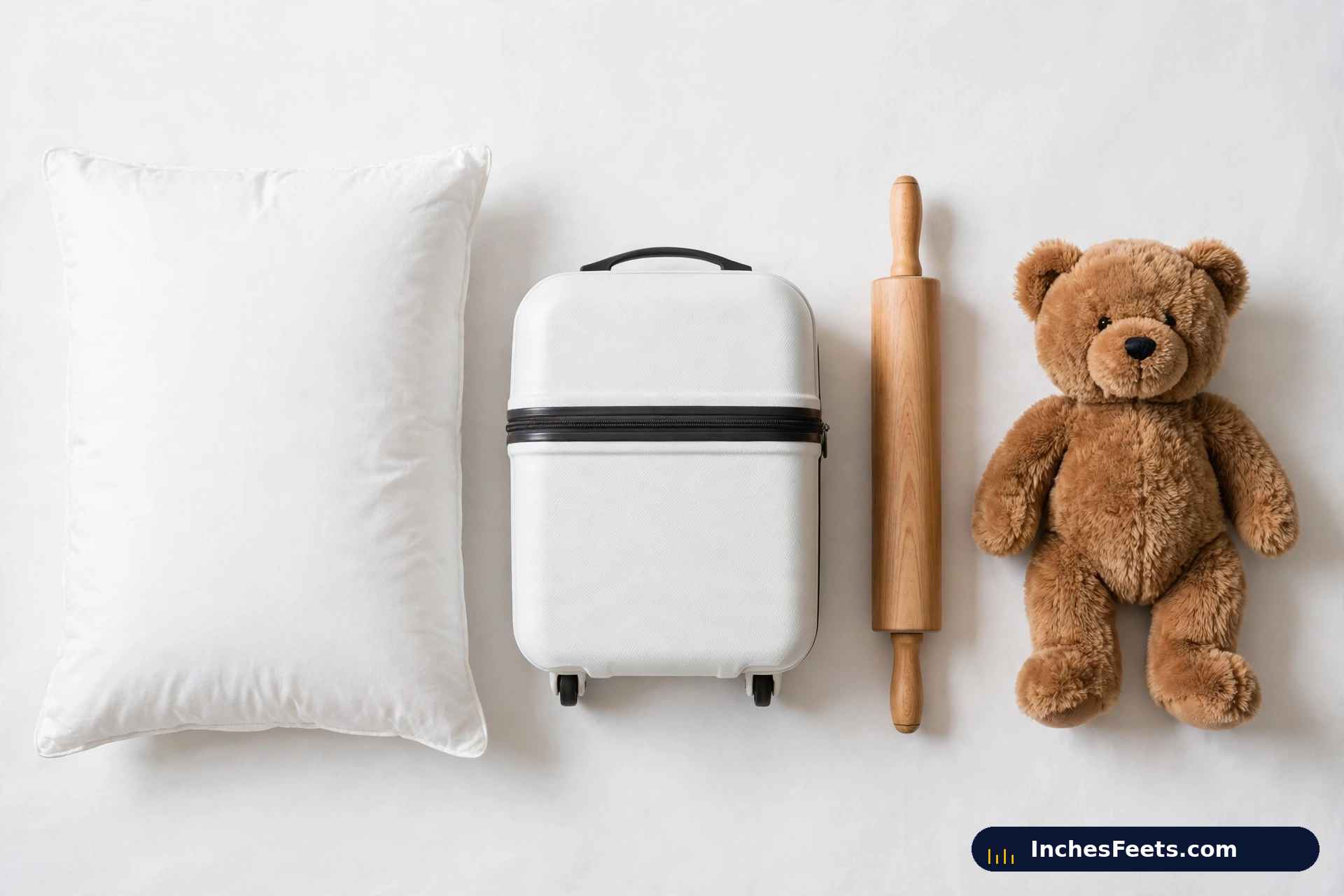
- The short side of a standard bed pillow — Standard (20 × 26 in), Queen (20 × 30 in), and King (20 × 36 in) pillows are all exactly 20 inches on their short side.
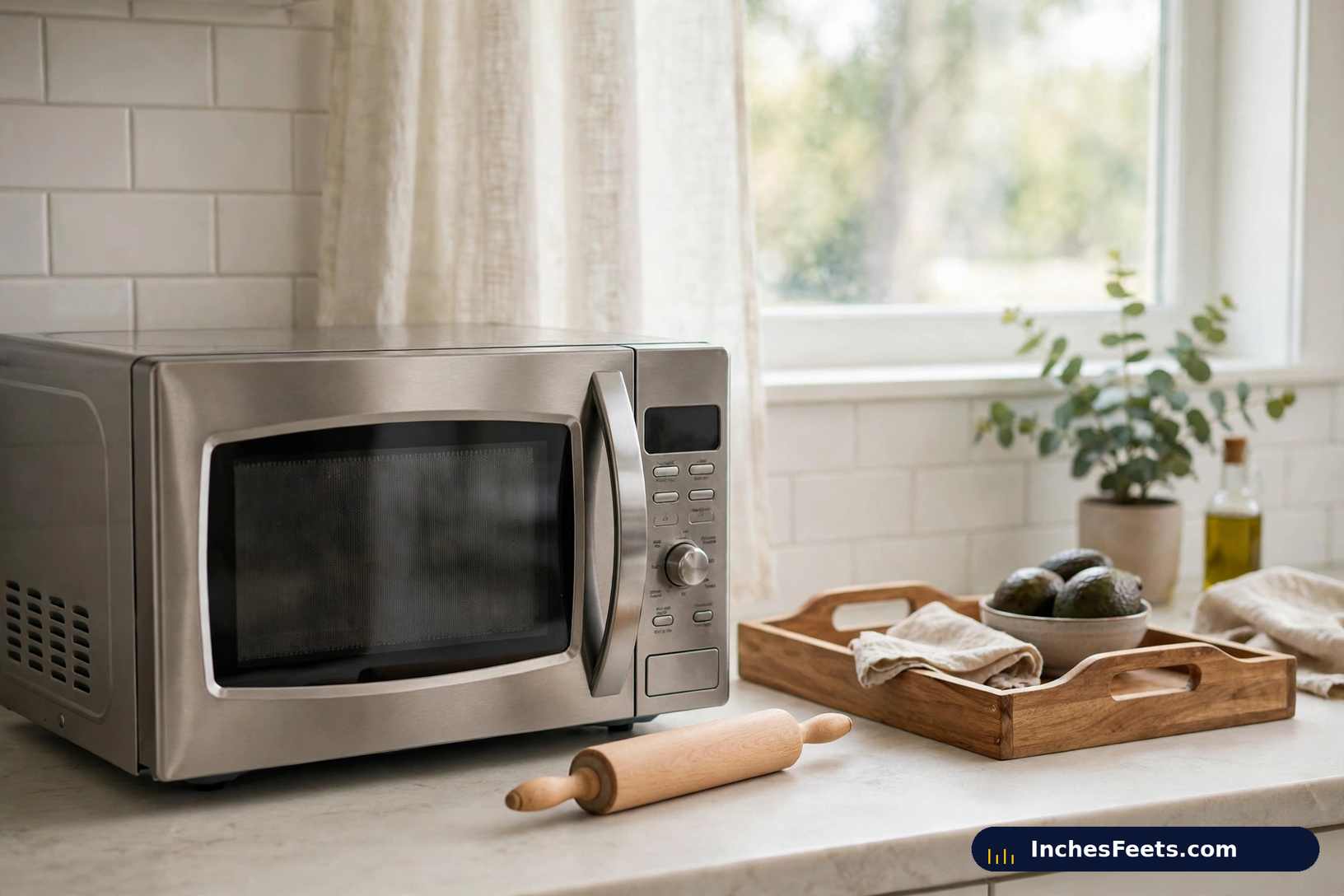
- The width of a typical 1.1 cu ft countertop microwave — named models spec 20.1 to 20.2 inches wide (the height is only about 12 inches).
- A 20-inch teddy bear — a standard sold plush size, listed at 20 inches tall.
- A 20-inch carry-on suitcase — the standard cabin-case class; the case body is about 20 inches, and wheels and handle bring the overall height to roughly 22 inches.
- A French-style rolling pin — Ateco’s 20175 and Made In’s tapered French pin are both sold and specced at exactly 20 inches.
- A large serving or breakfast tray — sold at 20 inches on the long side (20 × 14 in is a common maker size).
- A substantial desk or table lamp — lamp heights are not standardised, but named models from makers such as Wildwood, Currey & Company, and Chelsea House are specced at exactly 20 inches high.
- A 20-inch bicycle wheel — the standard wheel size for kids’ bikes, BMX, and folding bikes.
- A 20-inch box fan — the fan blade itself is specced at exactly 20 inches across.
- A 20-inch chainsaw bar — a standard catalog guide-bar size across the major makers.
- A dreadnought guitar body — Taylor’s own body-shape guide specs its Dreadnought body length at exactly 20 inches.
- A 20-inch necklace chain — one of the standard jewellery chain lengths, and the most common men’s length.
- A newborn baby — the average length at birth in the US is about 20 inches.
- A 20-inch pizza — the extra-large or party size; at least one US chain sells a 20-inch pizza as its signature largest pie.
- A 20 × 20 throw pillow — the standard “go-to” sofa cushion size on published charts.
- A bath mat — the common standard size is 20 × 34 inches.
- A 20-inch truck or SUV wheel — a factory wheel size on full-size pickups and SUVs; the “20” in a 275/55R20 tyre code is the rim diameter in inches.
Two honest neighbours complete the picture. A regulation basketball rim is 18 inches across — just under. Two US Letter sheets laid end to end overshoot to 22 inches — just over. Several famous “20-inch” claims in between turn out to be wrong, and they are corrected in their sections below.
17 Common Things That Are 20 Inches Long
Here is the full set. Each entry is checked against a manufacturer’s specification, an official standard, or a published size chart. Five of the most repeated comparisons on the internet turn out to be wrong at this size, and they are corrected in place rather than quietly dropped — which is why this list counts only the entries that check out.
Laptop Screen
This one does not check out, and it is worth saying plainly because it is the most repeated comparison of all. No mainstream laptop has a 20-inch screen. Everyday laptops run 13 to 16 inches measured diagonally, and the largest desktop-replacement models reach about 17 to 18 inches. Screens of 20 to 21 inches existed on a handful of discontinued machines from the mid-2000s, but they are collector curiosities, not something you can picture from a modern desk. Where 20 inches genuinely lives in computing is the desktop monitor, covered further down this page. Not counted in the 17.
Medium Pillow
The pillow is a real 20 — on its short side. Every standard US bed-pillow size is exactly 20 inches wide: Standard is 20 × 26 inches, Super Standard 20 × 28, Queen 20 × 30, and King 20 × 36, figures that agree across published pillow size charts. So the pillowcase end you fold over each morning is a true 20-inch measure, and the pillow lying on your bed gives you a 20-inch span any time you need one.
Microwave Height
The heading has the dimension backwards — and correcting it is what makes this entry honest. A typical 1.1 cu ft countertop microwave is not 20 inches tall; it is about 20 inches wide and only 12 to 14 inches high. Manufacturer specifications make it concrete: Avanti’s 1.1 cu ft model lists assembled dimensions of 20.10 inches wide by 12.00 inches high, and a Farberware 1.1 cu ft model lists 20.2 inches wide by 12.03 inches high. So picture the front face of the microwave stretching left to right — that span, not the height, is your 20 inches.
Basketball Hoop
Close, but the rulebook says no. A regulation basketball rim has an inside diameter of exactly 18 inches — set by NBA Rule No. 1 and by FIBA’s 450–459 mm specification. Eighteen is not “close to 20” when the number is written into the rules of the game, so the hoop does not make the counted list. For the ball itself: a men’s basketball is about 9.5 inches in diameter (29.5 inches around), which is why two balls side by side land just short of 20 inches. Not counted in the 17.
Electric Guitar Neck
There is no verified 20 here either, because guitar makers simply do not publish a “neck length.” What they publish is the scale length — 25.5 inches on a Fender Stratocaster, 24.75 inches on a Gibson — and the overall length of the whole instrument, about 38.8 inches for a Stratocaster. No major manufacturer’s specification sheet lists a 20-inch neck, so the claim cannot be checked and should not be repeated. The guitar measurement that genuinely is 20 inches is the acoustic dreadnought body, and it has its own section below. Not counted in the 17.
Standard Sheet Of Paper (Stacked)
This entry arrives garbled, so take it in two parts. A single US Letter sheet is 8.5 × 11 inches: two laid end to end make 22 inches, not 20 — a fact worth remembering because it is the most common paper mistake at this size. As for a stack: one ream of 500 sheets of standard copy paper stands only about 2 inches tall, so a 20-inch stack is roughly ten reams — about 5,000 sheets. The often-repeated claim that 1,000 sheets stand 20 inches tall is out by a factor of five; 1,000 sheets are about 4 inches. Not counted in the 17.
Teddy Bear
Twenty inches is a standard sold size for teddy bears and large plush toys: retailers list 20-inch teddy bears with product dimensions of 20 inches tall, and many makers offer the same size. That makes the big teddy on a child’s bed a genuine anchor — measure from the top of its head to the bottom of its feet and you are looking at 20 inches, give or take the squish of the stuffing.
Travel Size Suitcase
“20-inch carry-on” is the standard name of the cabin-baggage class, and the case body is indeed about 20 inches. One honest disclosure: with wheels and handle included, the overall height of most 20-inch cases runs to about 22 inches — deliberately so, because the cases are built to slide inside the common US airline carry-on limit of 22 × 14 × 9 inches. So when a shop sells you a “20-inch suitcase,” the 20 describes the case class and body; measure the whole thing before you fly.
A Rolling Pin
True — for the right pin. The 20-inch rolling pin is the French-style pin: Ateco sells its model 20175 explicitly as a “French Rolling Pin, 20-Inches Long,” Made In lists its tapered French rolling pin at exactly 20 inches in total length, and Wilton’s large fondant pin is also 20 inches. Handled American-style pins vary more and are usually measured by the barrel alone, so the style matters. Picture the long, handle-less French pin a baker uses on pastry, and you have 20 inches.
A Desk Lamp
Lamp heights are not standardised, so treat any blanket claim with suspicion — but 20 inches is a height manufacturers spec exactly, again and again. Wildwood’s Arches table lamp lists overall dimensions of 8 inches wide × 5.5 inches deep × 20 inches high; Currey & Company’s Antique Earth Beton lamp and Chelsea House’s Milton lamp are likewise specced at 20 inches high. A lamp of that size is a substantial bedside or desk lamp, taller than the small task lamps most people picture — and that is precisely why it works as an anchor when you meet one.
A Standard Dinner Tray
There is no official tray standard, so this one splits in two. The classic cafeteria and fast-food tray is 14 × 18 inches — not 20. The verified 20 lives one size up: large serving and breakfast trays are commonly sold at 20 inches on the long side, with 20 × 14 inch breakfast trays a standard maker size, and Cambro’s handled Camtray line includes a 15 × 20 inch model. Picture the big tray that carries a full breakfast to the table, not the cafeteria tray, and the measurement is right.
A Garden Spade
Not close. Real garden spades are roughly twice 20 inches overall: a border spade measures about 960 mm (37.8 inches) end to end, a transplant spade about 42 inches, common garden spades 46 to 47 inches, and a drain spade 48 inches overall with a 16-inch blade. Even the blade alone of most spades approaches 20 inches only on the largest drain models. If you need a garden anchor for 20 inches, use the bicycle wheel below instead. Not counted in the 17.
A 20-Inch Bicycle Wheel
The 20-inch wheel is the standard size for older children’s bikes (roughly ages 5 to 9), BMX bikes, and most folding bikes. One technical honesty note: “20 inch” is the nominal wheel-and-tyre class, not a tape-measure reading of the rim — the common decimal-tyre class is built on a 406 mm bead-seat diameter, and a rarer fractional class uses 451 mm, which is why 20-inch tyres are not all interchangeable. As a size picture, though, the wheel on a BMX is exactly the class this measurement names.

A 20-Inch Box Fan
The box fan is one of the cleanest anchors on this list: in Lasko’s 20-inch class — the box fans found in millions of homes — the blade length and diameter are specced at exactly 20 inches. The honest disclosure is the frame: the housing around the blade measures roughly 20.5 to 21.3 inches wide and about 21.75 to 22 inches tall. So the spinning circle is 20 inches; the box it sits in is a little more.
A 20-Inch Chainsaw Bar
Twenty inches is a standard guide-bar size in every major catalog — Stihl, Husqvarna, and Oregon all list 20-inch bars in their fitment charts — and it is the most popular bar length for farm and ranch saws. The disclosure that matters for safety and buying alike: bar length is nominal, measured from the tip to where the chain enters the housing, so the usable cutting reach is about 2 inches less, around 18 inches of actual cut.
A Dreadnought Guitar Body
Here is the guitar’s real 20. Taylor’s own body-shape guide specifies its Dreadnought body — the classic big-bodied acoustic shape — at exactly 20 inches long (and 16 inches wide), and retailer specification sheets for Taylor dreadnoughts repeat “Body Length: 20″”. The body is only part of a guitar that stands about 40 inches overall, which shows why whole-instrument comparisons mislead: at this size, the verified measurement is one component, honestly labelled.

A 20-Inch Necklace Chain
Twenty inches is one of the standard lengths on every jewellery chain chart. Jewelers Mutual describes 20 inches as the most common men’s necklace length, falling right at the collarbone; on women, 20 inches is where the longer “matinee” range (20 to 24 inches) begins. A chain you already own is therefore one of the most portable 20-inch measures you have — lay it out straight and it is 20 inches end to end.
A Newborn Baby
The most human anchor on the list: the average newborn in the United States is about 20 inches long at birth. University of Washington Medicine’s newborn guide puts the average at 20 inches for boys and 19¾ inches for girls, within a normal range of roughly 18 to 22 inches. It is also the honest correction to a claim you may meet further down this page — 20 inches is a newborn’s length, not a toddler’s height.
A 20-Inch Pizza
Twenty inches is a real pizza size — but it is the extra-large or party size, not a “large.” At most chains a large pizza is 14 to 16 inches across. The verified 20: Mountain Mike’s Pizza sells its signature “Mountain” pizza at a full 20 inches, a size the chain states in its own announcements. Order one and the box alone tells you the scale — it barely fits through a standard door held flat.

A 20 × 20 Throw Pillow
Decorative pillows follow a standard size ladder — 18 × 18, 20 × 20, 22 × 22, 24 × 24 inches — and published size charts call the 20 × 20 the go-to sofa size, big enough to anchor a couch corner. (The common lumbar pillow, 12 × 20 inches, carries a 20-inch long side too.) If your sofa has square cushions with removable covers, there is a good chance you already own this measurement.
A Bath Mat
Bath mats are sold in a standard 20-inch width: the common size is 20 × 34 inches. Martex’s hotel bath-mat specification reads literally “Width 20 in, Length 34 in,” Target’s Threshold bath rug is sold at 20 × 34 inches, and size guides put the standard bath-mat width in the 20-to-24-inch band. The strip of terry cloth in front of your tub is very likely a 20-inch measure lying on the floor.
A 20-Inch Truck or SUV Wheel
Twenty-inch wheels are factory equipment on full-size trucks and SUVs — the Silverado 1500, Tahoe, Suburban, and F-150 class. The tyre sidewall proves the class without any measuring: in a common fitment like 275/55R20, the number after the R is the rim diameter in inches — 20. When a truck rolls past on its factory wheels, each wheel’s rim spans the same 20 inches as the pillow on your bed.
How Big is 20 Inches?
Stand a 20-inch object on the floor and it reaches roughly to an adult’s mid-shin to knee, depending on the person. On a desk, it is the span of a wide monitor. Spread across a bed, it is the short side of the pillow your head is on.
Three comparisons from around the web need adjusting. The claim that 20 inches is “the width of a large pizza” overshoots: large pizzas are 14 to 16 inches, and 20 inches is the party size above them. The claim that two sheets of paper end to end make “about 17 inches” is arithmetic gone wrong — 11 + 11 is 22. And while desktop monitors are sold in a 20-inch class, that figure is the screen measured diagonally, corner to corner, so the visible panel is a little less than the headline number. What holds up: standard backpacks do stand about 18 to 20 inches tall, and a medium dog’s back height is in this neighbourhood — useful pictures, as long as you treat both as approximations rather than specifications.
How to Visualize 20 Inches Without a Ruler
Start with the ruler trick: mark off a full 12-inch ruler, then add 8 more inches of a second one. If it helps to build up from smaller guides on this site, 20 inches is ten times how long is 2 inches, or four lengths of the objects in our guide to measuring 5 inches long laid in a row.
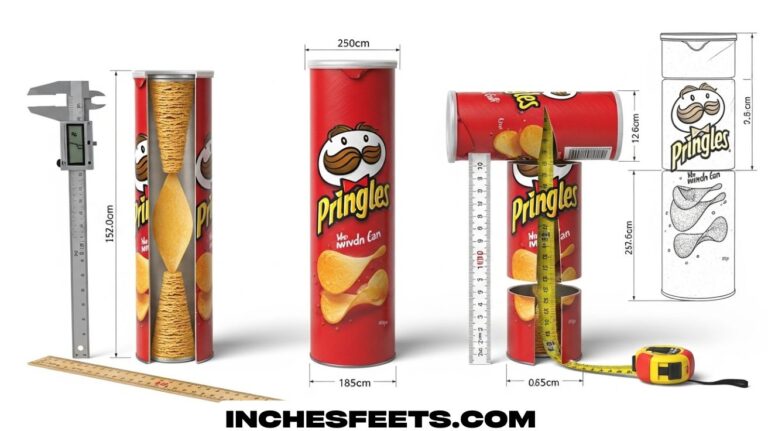
Your kitchen offers two more. A standard microwave’s front is about 20 inches wide, and two cans from our Pringles can dimensions guide, stacked one on top of the other, stand roughly 20 inches tall — each can is about 10 inches. Your body offers rough checks rather than measures: about two and a half of your own hand spans, or just under two of your own foot lengths, land near 20 inches for most adults. Measure your span and your foot once against a real ruler, remember your own numbers, and those checks become genuinely useful.
20 Inches Compared to Human Body Parts
Forearm
Your forearm alone is not 20 inches. Published anthropometric averages put the forearm — elbow to wrist — at roughly 11 to 13 inches for adults, a figure even the pages that claim “about 20 inches” end up citing. Add the hand and measure elbow to fingertip and most adults land around 17 to 19 inches: closer, and the old cubit measure was standardised near 18 inches on exactly that span, but it is still short of 20. Treat the forearm as a three-quarter measure, not a full one.
Hand Span
A stretched hand span — thumb tip to little-finger tip — averages about 8 to 9 inches for adults. That makes the maths simple: two spans are 16 to 18 inches, and about two and a half spans make 20. Any claim that a single average hand span is itself “about 20 inches when fully extended” is simply wrong; it would require hands nearly twice the human average. Calibrate your own span once and it becomes one of your best built-in estimators.
Foot
An average adult foot is roughly 10 to 11 inches long — a men’s size 9 foot measures about 10.3 inches, a size 10 about 10.7. So 20 inches is just under two of your own foot lengths, heel to toe, twice. It is one of the more reliable body estimates precisely because feet vary less, proportionally, than hands — and because you can check your own against a ruler in seconds.
Height Proportion
Twenty inches is about 31% of a 5-foot-5 adult (65 inches) — roughly one-third of their height, not the quarter it is sometimes called (a quarter of 65 inches would be just over 16). Against a 6-footer it is about 28%. And the toddler comparison needs fixing: a typical two-year-old stands about 34 to 36 inches tall, so 20 inches is barely past a toddler’s waist. The age whose full length really is 20 inches is a newborn, as the baby section above shows.
A Comparison of 20 Inches with Other Standard Measurements
| Unit | 20 Inches Equals |
|---|---|
| Centimeters (cm) | 50.8 cm |
| Millimeters (mm) | 508 mm |
| Meters (m) | 0.508 m |
| Feet (ft) | 1.6667 ft |
| Yards (yd) | 0.5556 yd |
| Miles (mi) | 0.000316 miles |
Two relationships in that table do most of the everyday work. In metric, 20 inches is almost exactly half a meter — 0.508 m — which is why 20-inch products sold internationally are so often labelled 50 cm class. In imperial, it is 1 foot 8 inches, or five-thirds of a foot. Set beside other familiar lengths: it is two-thirds of a yard, about 1.7 standard rulers, and just under the 22-inch width of an airline carry-on sizer — the comparison that decides more purchases than any other in this article.
20 Inches vs 24 Inches: What’s the Difference?
Four inches sounds small until you picture it: 24 inches is a full fifth longer than 20, and it crosses a clean threshold — 24 inches is exactly 2 feet, while 20 inches stops 4 inches short of it. The difference is the length of a standard sheet of paper’s short side, roughly, or a large adult hand.
In shops, the gap decides categories. A 20-inch suitcase is a carry-on; a 24-inch suitcase is the standard medium checked bag, too big for the cabin. A 20-inch monitor is a compact desk screen; a 24-inch monitor is the mainstream office size. A 20-inch bicycle is a child’s or BMX bike, while 24 inches is the next wheel size up for older children. When a product line offers both, the 20 is almost always the “fits in the smaller space” option — which is exactly why confusing the two causes returns.
When an Exact 20 Inches Matters
Some 20s are approximations you can picture with; others are specifications you must hit. Air travel is the strictest: airlines cap carry-ons at an overall 22 × 14 × 9 inches, so whether a “20-inch” case measures 20 inches at the body or 22 with its wheels decides whether it flies in the cabin or gets gate-checked. Bicycle wheels are just as unforgiving — a tyre built for the 406 mm 20-inch class will not seat on a 451 mm rim, despite both being sold as “20 inch.” Chainsaw bars and chains must match by bar length, so the nominal 20 on the bar is a buying specification, not a description. Pillowcases are sized to the pillow’s 20-inch short side, which is why Standard, Queen, and King cases all fit the same width and differ only in length. And screen classes — monitors, and the pizzas of the tech world — are measured diagonally by convention, so an exact 20 there means something slightly different from an exact 20 on a pillow. Knowing which kind of 20 you are dealing with is most of the battle.
Conclusion
Twenty inches is 50.8 centimeters, 1 foot 8 inches, and — once you know where to look — a measurement hiding in plain sight: the short side of your pillow, the width of your microwave, the wheels on a BMX and a pickup truck, and the length of the average newborn. The honest list matters because the internet’s favourite comparisons at this size include a laptop screen that does not exist, a hoop that is really 18 inches, and a spade that is really twice as long.
Keep two anchors and you will rarely guess wrong: picture the pillow for anything flat and rectangular, and the rolling pin for anything long and thin — the French pin in a baker’s hand is exactly this length, and it is surprising how often “about a rolling pin” settles an argument. When the number has to be exact — a case, a wheel, a bar — measure the real thing, because at 20 inches the difference between the class name and the true size is where the mistakes live.
FAQs
How Long is 20 Inches Compared to Your Height?
For most adults, 20 inches is a little under a third of your height. It is about 30% of a 5-foot-6 person (66 inches) and about 28% of a 6-footer (72 inches). Stood on the floor beside you, a 20-inch object reaches somewhere around your knee — a quick visual check that works in a shop when no ruler is handy.
What is 20 Inches in Terms of Size?
In other units, 20 inches is exactly 50.8 centimeters, 508 millimeters, 0.508 meters, 1.6667 feet, or 0.5556 yards. In everyday terms it is the size class of carry-on suitcases, box fans, BMX wheels, and standard pillow widths — a “fits on a desk, fits in a cabin, fits across a bed” size rather than a furniture size.
How to Estimate 20 Inches Without a Ruler?
Use what you have, and know its error. The classic paper trick overshoots: two US Letter sheets end to end make 22 inches, so measure 2 inches back from the far end to land on 20. Your own body gives closer checks once calibrated — about two and a half hand spans, or just under two foot lengths. And the objects beat the tricks: if a pillow, a microwave front, or a 20-inch case is nearby, measure against that instead.