How Much Is 50 KG? 16 Things That Weigh 50 Kilograms
If you are wondering what 50kg actually feels like in everyday terms, here is the direct answer: 50 kilograms is exactly 110.231 pounds — 1,763.70 ounces, or 50,000 grams. In the real world it is the weight of a standard trade sack of rice or potatoes, a single 50 kg dumbbell standing on the gym rack, or fifty litres of water in a drum.
Fifty kilograms is also the world’s sack weight: the load one strong worker is expected to shoulder, which is why cement, fertilizer, sugar and grain have been packed at exactly this size for generations. It is a serious two-hand lift — and it is a weight the internet describes very loosely, because several of the most repeated “50 kg” examples turn out, on checking, to be wrong by ten kilos or more.
This guide gives you 16 things that genuinely weigh 50 kilograms, each checked against a maker’s specification, an official standard or reference data. Just as usefully, it keeps the popular claims that fail the check — the dog food bag, the airline suitcase, the ten-year-old child — and prints their real weights beside them.
How Much Is 50 kg?
Fifty kilograms is a mass, not a mystery: it is 50,000 grams, and converted exactly it comes to 110.231 pounds, 1,763.70 ounces or 7.87365 stone. Two comparisons often attached to it need correcting straight away. It is not reliably “the weight of a full-grown adult deer”: white-tailed deer vary enormously by sex and region — bucks usually run 60 to 100 kg — so a deer is a range, not a unit. And the dog in the competitor’s version of this section, the Labrador Retriever, is roughly a 30 kg animal (AKC males 65–80 lb, females 55–70 lb); the dog that honestly sits on this page’s weight is the Rottweiler, and it has its own section below.
The full conversion table sits below, printed exactly. For the things themselves — the sacks, dogs, anvils and gym iron that honestly land on this weight — read on.
| Unit | Equivalent of 50 Kilograms |
|---|---|
| Grams (g) | 50,000 g |
| Pounds (lb) | 110.231 lb |
| Ounces (oz) | 1,763.70 oz |
| Milligrams (mg) | 50,000,000 mg |
| Metric tonnes (t) | 0.05 t |
| Stones (st) | 7.87365 st |
50 KG at a Glance: The Verified List
- A standard sack of potatoes (Kenya’s Irish Potato Regulations fix the single package at a maximum of 50 kg)
- Two 25 kg Olympic plates (a pair of Eleiko IWF training plates — exactly 50 kg of plates by specification)
- Two standard 25 kg bags of cement (the trade sack, doubled — the competitor’s own text concedes the single bag is 25 kg)
- A commercial rice sack (the 50 kg woven sack is the international trade standard, covered by ISO 23560)
- 50 litres of water (exactly 50 kg by definition)
- An adult male Rottweiler (the FCI breed standard sets males at 50 kg)
- A blacksmith’s anvil (VEVOR’s 110 lb cast steel anvil — the maker’s stated net weight is exactly 50 kg)
- A single 50 kg dumbbell (Technogym’s Hexagon Dumbbell, sold individually at 50 kg)
- A 50 kg kettlebell (a standard heavy size, manufactured and sold singly)
- A 50 kg bag of urea fertilizer (the standard farm-gate sack across the world)
- A 50 kg bag of sugar (the standard wholesale and export sack)
- A 15 hp outboard motor (Yamaha’s F15 — dealer specifications list the lightest model at 111 lb, which is 50 kg)
- An adult capybara (the species monograph puts a typical adult at 49–50 kg)
- A female Newfoundland (the AKC standard brackets bitches at 100–120 lb, with 50 kg inside the band)
- An adult cheetah (the Smithsonian’s National Zoo brackets adults at 34–64 kg)
- A semi truck tire (a standard 11R22.5 runs about 105–125 lb — the common fitments sit on this page’s weight)
Every item on this list is checked in its own section below. The claims that did not survive checking stay in the article too, with their real weights printed beside them — knowing that an airline will not accept a 50 kg suitcase at all is nearly as useful as the list itself.
Common Things That Weigh 50 Kilograms
Large Bag Of Dog Food
This one fails on the products themselves. Dog food is simply not sold in a 50 kg bag: the biggest bags on ordinary shelves are the 50 lb class — 22.7 kg, less than half this page’s weight — and the European breeder and bulk lines top out at 20 kg. Fifty kilograms of dog food is real enough, but it is two of the biggest bags side by side and a third started, not one bag anybody manufactures.
Not counted: no standard 50 kg dog food bag exists to verify — the largest standard bags are about 50 lb (22.7 kg). Corrected figure printed above.
Adult German Shepherd
The competitor puts the adult German Shepherd at “about 50 kilograms,” and the breed standards say otherwise. The FCI standard brackets males at 30–40 kg, and the AKC’s figures (males 65–90 lb, females 50–70 lb) agree: even the largest standard male tops out near 41 kg, a full nine kilos short of this page. The Shepherd is a big dog, but it is a 40 kg-page dog — this site’s 40 kg article counts it there, at the top of its standard, which is where it belongs.
Not counted: a standard adult German Shepherd weighs 30–40 kg (FCI) — it falls about 9–10 kg short. Corrected figures printed above.
Big Sack Of Potatoes
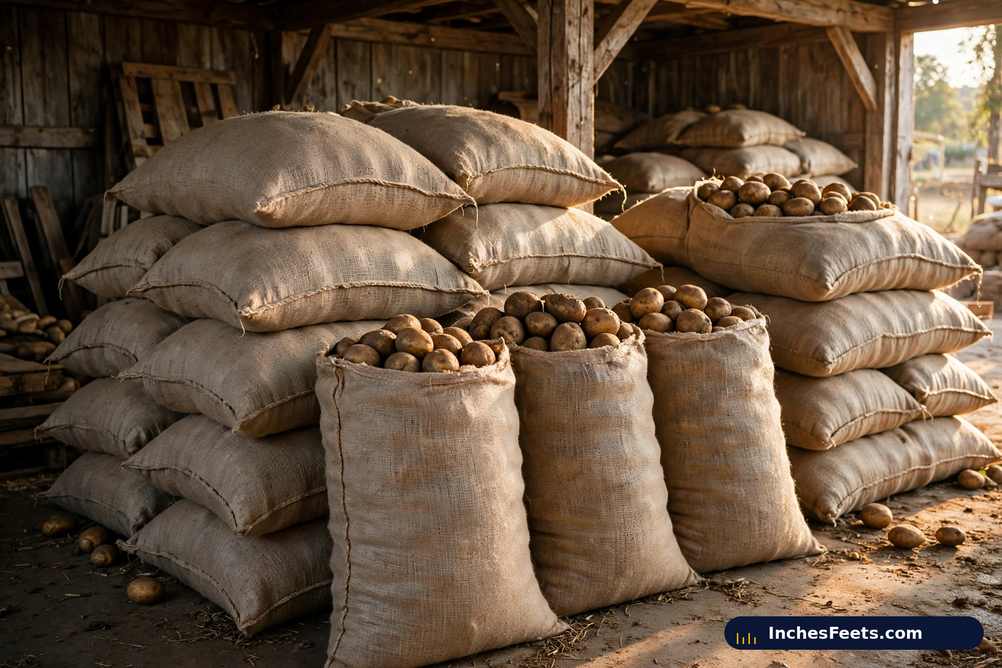
Here the claim survives, because potato sacks are regulated into standard sizes. Kenya’s Crops (Irish Potato) Regulations 2019 state the rule plainly: the unit of measurement is the kilogram, and “the maximum weight for each single unit of package of Irish potatoes shall be 50 kilograms” — a law written to stop traders forcing farmers into oversized sacks. The standard trade sack of potatoes is, by regulation, this page’s weight filled to the line.
Counted: on the regulatory-standard basis — Kenya’s Irish Potato Regulations 2019 fix the standard single package at 50 kg.
Large Gym Barbell Plate Set
The competitor’s version — plates that “range from 25 kg to 50 kg” — is too loose to verify, but the honest version of the claim is exact. Competition plates are manufactured and calibrated to their stated weight, and they are sold in pairs: Eleiko’s IWF Weightlifting Training Plates include the red 25 kg disc, calibrated to within ±200 g and sold as a pair. One pair of standard 25 kg plates is 50 kg of iron, to within a few hundred grams — the cleanest arithmetic in the gym.
Counted: as corrected — on the pair basis: two standard 25 kg IWF plates (Eleiko IWF training plates, sold in pairs) are exactly 50 kg by specification.
Full Suitcase At Airline Weight Limit
This is the competitor’s most consequential error, because a reader could act on it. No mainstream airline accepts a single 50 kg checked bag: the standard hard limit for one bag is 32 kg, a health-and-safety ceiling for the people who lift it, and a heavier bag is refused or must be split. The 50 kg figure confuses a passenger’s total baggage allowance — which can reach 50 kg across several bags on some tickets — with the weight of one suitcase, which never can.
Not counted: a single checked suitcase is capped at 32 kg on mainstream airlines. Corrected figure printed above.
Bag Of Cement
The competitor’s heading says one bag, and his own text immediately concedes the truth: “a standard bag of cement weighs 25 kilograms, so two bags weigh 50 kilograms.” He is right the second time. Cement is sold across the UK and much of the world in the standard 25 kg paper sack — Heidelberg Materials’ general-purpose cement data sheet states it is “supplied in 25 kg bags” — so the counted object is the pair of sacks a builder actually loads, one on each shoulder trip from the truck.
Counted: as corrected — two standard 25 kg bags of cement (the competitor’s own text concedes the single bag is 25 kg; the 25 kg trade sack is the documented standard).
10-Year-Old Child
A typical ten-year-old does not weigh 50 kg, and the reference data is not close. WHO growth-reference and CDC growth-chart medians at age ten sit at about 32 kg for both boys and girls; 50 kg at ten is far above the median, up where an average fourteen-year-old stands. This site’s 40 kg page makes the same correction one step down — the reference-median child for a round weight is twelve, not ten — and the pattern is the same here: the claim borrows an age two to four years too young.
Not counted: the reference median at age ten is about 32 kg (WHO/CDC). Corrected figure printed above.
Commercial Rice Sack
Rice moves around the world in woven polypropylene sacks, and the 50 kg sack is the trade’s standard unit — standardised so formally that an ISO standard, ISO 23560:2008, exists specifically for 50 kg woven PP sacks for foodstuffs. The competitor’s “25 to 50 kilograms” range is true but timid: the sack the rice trade actually runs on, from mill to market stall, is the 50 kg one.
Counted: on the standard basis — the 50 kg woven sack is the international rice-trade unit, covered by ISO 23560:2008 (50 kg sacks for foodstuffs).
Large Goat Or Small Calf
Both halves of this heading fail, in opposite directions. Goats span an enormous range — pygmy goats at 20–27 kg, Boer does at 90–100 kg and Boer bucks at 110–135 kg — so “a large goat” names no standard animal at 50 kg. And the calf claim is simply wrong: the competitor has small calves ranging “from 50 to 90 kg at birth,” but dairy-science studies put the newborn Holstein calf at about 40 kg (study averages run 39.6–41.4 kg). A calf passes 50 kg a few weeks into its life, growing all the while — a moving target, not a weight.
Not counted: goats run from about 20 kg to 135 kg by breed with no standard at 50 kg, and a newborn Holstein calf averages about 40 kg, not 50–90 kg. Corrected figures printed above.
Fully Loaded Tool Chest
“Fully loaded” is where this claim hides: it has no specification, because the load is whatever the owner owns. The empty cabinets alone span this page’s weight and far beyond it — Husky’s 26-inch four-drawer rolling cabinet is listed in its manual at 34.02 kg empty, while the same maker’s 52-inch mobile workbench weighs 211 lb, about 95 kg, before a single tool goes in a drawer. The competitor’s “40–80 kg” range therefore describes nothing checkable: a real chest is lighter than this page empty and heavier than it loaded, or the reverse, by model.
Not counted: no standard “fully loaded tool chest” weight exists — empty cabinets alone run from about 34 kg to about 95 kg by model. Corrected figures printed above.
Home Treadmill
The competitor gives home treadmills a range “from 50 kilograms to over 150,” and a range that wide verifies nothing. The budget end cannot even agree with itself: XTERRA’s TR150 folding treadmill is listed by its own sellers at 97 lb in one specification and 108 lb assembled in another — 44 to 49 kg — while typical motorised home treadmills are far heavier machines than either figure. No mainstream model is specified at exactly 50 kg, so the heading cannot be counted honestly; what can be said is that a home treadmill is a wide weight class, not an example of this one.
Not counted: home treadmills span a wide range (a budget folder’s own listings disagree between 44 and 49 kg) and no mainstream model is specified at 50 kg. Corrected figures printed above.
50 Litres Of Water
Water is the anchor every other weight on this page quietly depends on, because the kilogram was built around it: one litre of water weighs one kilogram. So a drum holding exactly 50 litres of water is carrying exactly 50 kg of water — the standard blue drum and jerry-can class is built in this size for precisely that reason. The filled drum itself reads a kilo or two higher on a scale, for the plastic; the honest statement is that the water is exactly this page’s weight, and the container is the packaging.
Counted: exact — on the water basis (1 litre of water = 1 kg); the drum’s own kilo or two is disclosed above.

An Adult Male Rottweiler
This is the dog the German Shepherd section was looking for. The FCI breed standard — standard number 147, the breed’s official specification — sets the Rottweiler male’s weight at 50 kg, at a height of 61–68 cm; females are set at approximately 42 kg. It is the rare animal example that needs no range and no apology: the standard for one of the world’s most familiar large breeds names this page’s weight outright.
Counted: on the breed-standard basis — the FCI standard (N° 147) sets the adult male Rottweiler at 50 kg (females approximately 42 kg).
A Blacksmith’s Anvil
Anvils are sold by weight because weight is the point — mass is what absorbs the hammer blows. The popular 110 lb size lands exactly here: VEVOR’s cast steel single-horn anvil in the 110 lb class carries a maker-stated net weight of exactly 50 kg. It completes a family this site has been weighing page by page — the same maker’s 66 lb anvil is the 30 kg page’s example, and its 88 lb anvil is the 40 kg page’s; this is the big brother of the three.
Counted: exact — maker-stated net weight 50 kg (VEVOR 110 lb cast steel anvil).

A Single 50 KG Dumbbell
Different from the plate count above: this is one single heavy dumbbell. Premium dumbbells are sold individually at the heavy end, and Technogym’s Hexagon Dumbbell range — sold one at a time — includes a 50 kg size, listed by the manufacturer at exactly 50 kg. One dumbbell, one hand (if you are strong enough), the whole of this page’s weight. It is the same range that supplied the single dumbbells on this site’s 30 kg and 40 kg pages, one size further up the rack.
Counted: exact — a standard single product, manufacturer-listed at 50 kg and sold individually (Technogym Hexagon Dumbbell 50 kg).
A 50 KG Kettlebell
Kettlebells are cast and sold by nominal weight, in standard steps — and at the top of the ordinary ladder the steps reach this page. Tag Fitness’s rubber-encased kettlebell range runs in 5 kg increments from 5 kg up to a 50 kg bell, sold in the United States as part of its standard set. Pick one up and there is no estimation to argue about: the product is manufactured to be this page’s weight. It is a bell most lifters will only ever deadlift, never swing.
Counted: exact — a standard manufactured size, sold at 50 kg (Tag Fitness kettlebell range, in 5 kg steps to 50 kg).
A Bag Of Urea Fertilizer
Walk into any farm-supply market in the world and the fertilizer is stacked in 50 kg sacks. Urea, the world’s most-used nitrogen fertilizer, is packed in 50 kg polypropylene woven bags as the trade standard — manufacturers list 50 kg among their standard pack sizes, and suppliers’ own specifications state it outright, as Maser Gas Berhad’s urea N46 sheet does: “Packing in 50 kg PP woven bags.” One sack is one worker’s load and one field-day’s unit, which is exactly why the size has never changed.
Counted: on the standard-packaging basis — urea fertilizer is packed in 50 kg woven bags as the documented trade standard.
A Bag Of Sugar
Sugar follows the same logic one aisle over. Wholesale and export sugar is packed in 25 kg and 50 kg polypropylene bags, and the 50 kg sack is the standard unit of the international trade — the size refineries pack for industrial buyers, bakeries and beverage makers, and the size container-load contracts are written in. The kilo and two-kilo bags in a supermarket are repacked from sacks of exactly this page’s weight.
Counted: on the standard-packaging basis — the 50 kg bag is a documented standard wholesale and export pack for sugar.
A 15 HP Outboard Motor
A portable outboard is a machine one person carries down a dock, and the 15 hp four-stroke class sits right on this page. Yamaha dealer specification sheets for the F15 list its weight range as “111 lbs (50 kg) – 132 lbs (59 kg),” with the lightest model — the short-shaft, manual-start version — at the 111 lb figure. One honest disclosure: Yamaha’s owner’s manual for the same family lists that model’s dry weight at 51 kg, so the maker’s own documents bracket this page’s weight between 50 and 51 kg depending on the sheet you read; the count stands on the dealer specification’s 50 kg, with the manual’s figure printed here rather than smoothed over.
Counted: FLAGGED — on the maker-specification basis: Yamaha F15 lightest variant listed at 111 lb (50 kg) in dealer specifications; the owner’s manual’s 51 kg figure for the same model is disclosed above.
An Adult Capybara
The world’s largest rodent turns out to be one of the tidiest animal matches on this page. The capybara’s scientific monograph (Mones and Ojasti’s species account, the standard reference) puts adults at 49–50 kg, across a full range of 35–65 kg. Zoo and field references print wider bands, but the monograph figure is the careful one: a typical adult capybara, standing knee-high at the edge of a South American pond, is a 50 kg animal.
Counted: on the reference basis — the species monograph (Mones & Ojasti) puts the typical adult capybara at 49–50 kg (full range 35–65 kg, disclosed).

A Female Newfoundland
The Newfoundland is a giant breed, and its official standard puts the female squarely across this page’s weight. The AKC standard for the breed gives adult bitches an approximate weight of 100 to 120 lb — 45 to 54 kg — with males heavier again at 130–150 lb. A bitch in the middle of her standard band is a 50 kg dog: the count stands on the documented band, with the band printed, exactly as this run treats range-based dog weights.
Counted: FLAGGED — on the documented-range basis: AKC standard, adult bitches 100–120 lb (45–54 kg), with 50 kg inside the band (disclosed).
An Adult Cheetah
The cheetah is built for speed, and its weight surprises people: the Smithsonian’s National Zoo brackets the adult cheetah at 75 to 140 lb — 34 to 64 kg. Fifty kilograms therefore sits inside the documented adult range, in its upper-middle — a big adult, typically a well-grown male, weighs this page’s weight exactly. The band is printed and the count stands on the band, the same documented-range logic as the Newfoundland above.
Counted: FLAGGED — on the documented-range basis: Smithsonian’s National Zoo adult range 34–64 kg, with 50 kg inside it (disclosed).
A Semi Truck Tire
One tire off an eighteen-wheeler is a two-arm lift, and the standard size explains why. The 11R22.5 is the trucking industry’s default fitment, and manufacturer data books list its tires at roughly 114–125 lb for many models, with retailer listings for the size running from about 104 lb to about 134 lb. The common steer and trailer fitments cluster right around 110 lb — this page’s weight, in black rubber and steel belt, before the wheel it mounts on adds its own share.
Counted: FLAGGED — on the size-class basis: a standard 11R22.5 semi truck tire typically runs about 105–125 lb (48–57 kg) across maker data books and retailer listings, with common fitments at about 110 lb ≈ 50 kg (disclosed).
How to Visualize 50 KG
Start with the sacks, because that is how most of the world meets this weight: picture two standard 25 kilograms cement sacks — one trip from the truck each — or a single 50 kg fertilizer sack standing waist-high against a farm-store wall. Or picture the drum: fifty litres of water in a blue plastic drum is the same load, and it is the version of 50 kg you can make exactly, at home, with a measuring jug.
Then use the living comparisons. Fifty kilograms is an adult male Rottweiler standing patiently on the vet’s scale, or a capybara at the pond’s edge. One strong adult can deadlift 50 kg off the floor and carry it a short way, preferably with both arms and a straight back; almost nobody carries it far, and nobody sensible carries it in one hand — unless it is the 50 kg dumbbell, and then only for a few steps to the bench.
50 KG Compared With Other Weights
Against the bigger benchmarks, 50 kg is a useful fraction. It is exactly half of 100 kilograms — the heavyweight benchmark this site uses for adult-sized comparisons — and it is ten kilos more than 40 kilograms, the German-Shepherd-and-anvil weight from the previous page in this series, and twenty more than 30 kilograms before that. Against the run’s starting point it is two and a half times 20 kilograms.
In the units most people meet day to day: 110.231 pounds, 7.87365 stone, 50,000 grams, or 0.05 of a metric tonne. And in the kitchen’s own unit, it is about 176 of the 10-ounce weights from our ounce guide — 1,763.70 ounces of anything is a two-person carry.
How to Measure 50 KG Accurately
The simplest accurate method is a bathroom scale and subtraction: weigh yourself, then weigh yourself holding the object, and take the difference. It works for anything you can safely lift — a packed bag, a dog that will sit still in your arms — and a decent scale is accurate to a few hundred grams, which is plenty at this size. For sacks and gym gear, a hanging scale is better than a luggage scale here: most luggage scales top out at exactly 50 kg, so buy one rated above the load you expect.
Two calibration tricks are worth knowing. First, water: a drum filled with exactly 50 litres of water is a 50 kg reference (add the drum’s own weight, weighed empty). Second, gym iron: dumbbells, kettlebells and plates are manufactured to their stated weights within a few percent, so a marked 25 kg plate is a fair check on a doubtful scale. What not to trust: package and shipping weights on spec sheets — the outboard section above shows one maker’s two documents disagreeing by a kilo — and any figure that does not say which unit it was measured in, because pounds wearing a kilogram costume is how half the wrong examples on the internet are born.
Conclusion
Fifty kilograms is 110.231 pounds of everyday reality: the world’s standard sack — of rice, potatoes, fertilizer, sugar or cement — a Rottweiler at exactly its breed standard, an anvil, a kettlebell, and fifty litres of water standing in a drum. It is also a weight surrounded by confident mistakes: a dog food bag that does not exist, a suitcase no airline will take, and a ten-year-old who would have to be a fourteen-year-old.
Checked properly, the honest list is a good one, and its biggest correction is the competitor’s opening flourish. The white-tailed deer is a fine animal, but it is not a unit of measure: with bucks usually running 60 to 100 kg and does varying widely by region, “a full-grown adult deer” can outweigh everything on this page or fall short of it — which is precisely why this list is built from standards, specifications and sacks instead.
FAQs
What is 50 kg?
50 kg is a metric unit of mass equal to exactly 110.231 pounds, 1,763.70 ounces or 50,000 grams. In everyday terms it is the weight of a standard trade sack of rice, an adult male Rottweiler, or fifty litres of water — a serious two-hand lift.
How Much is 50kg in lbs?
Multiply kilograms by 2.20462. For this page’s weight: 50 × 2.20462 = 110.231 lb (often rounded to 110.23 lb). The method is all there is to it — the only errors come from rounding the factor too early.
What are Some Common Things that Weigh 50 kg?
Standard 50 kg sacks of rice, potatoes, fertilizer, sugar and cement; fifty litres of water; an adult male Rottweiler; a 50 kg kettlebell or dumbbell; and a 110 lb anvil. Not a German Shepherd (30–40 kg) and not a single airline suitcase (capped at 32 kg), whatever other lists say.