How Much Is 50 Ounces? 17 Things That Weigh 50 Ounces
If you are asking how much is 50 oz of water, the honest answer starts with a question back: which ounce do you mean? Fifty ounces by weight is exactly 3.125 pounds — 1,417.48 grams, or 1.42 kg. Fifty fluid ounces is a volume, 1.48 litres, and that much water actually weighs about 52.2 ounces, not 50.
The two ounces share a name and almost nothing else, and the old rhyme “a pint’s a pound the world around” papers over the gap: a US pint of water weighs about 1.04 pounds — close, but not exact — and a British fluid ounce is smaller again. The confusion matters because 50 ounces is a number people meet in both forms: a daily water target poured in fluid ounces, and a parcel, a recipe or a gym bag weighed in ounces of weight.
This guide keeps the two apart. It gives you the exact conversions for both, then 17 things that genuinely weigh 50 ounces by weight, each checked against a maker’s specification, an official standard or reference data. Just as usefully, it keeps the popular claims that fail the check — the wine bottle, the small dog, the six cups of milk — and prints their real weights beside them.

How Much Is 50 Oz?
Fifty ounces by weight is 1,417.48 grams, and converted exactly it comes to 3.125 pounds, 1.41748 kilograms or 0.223214 stone. The catch sits in the conversion table that usually follows, and the competitor’s version of this page is a perfect example: its table lists pounds, kilograms and grams — all true of 50 ounces of weight — and then, in the same breath, cups, millilitres, litres, tablespoons and teaspoons, which are true only of 50 fluid ounces of volume. Two different quantities are presented as one. The table below keeps the competitor’s rows but labels every one of them, so you can see which ounce each row belongs to.
The two meet only through water, and even then only approximately. Water is the bridge: 50 fluid ounces of it weighs about 52.16 ounces, and 50 ounces by weight of it measures about 47.93 fluid ounces. Every “50 ounces of water” claim — including the popular advice to drink around 50 ounces a day — is a volume claim wearing a weight label, and this article treats it that way throughout.
| Unit | 50 Ounces Equals |
|---|---|
| Pounds (weight) | 3.125 lb |
| Kilograms (weight) | 1.41748 kg |
| Grams (weight) | 1,417.48 g |
| Cups, US (fluid volume) | 6.25 cups |
| Milliliters (fluid volume) | 1,478.68 mL |
| Liters (fluid volume) | 1.48 L |
| Tablespoons (fluid volume) | 100 tbsp |
| Teaspoons (fluid volume) | 300 tsp |
50 Oz To lbs
Fifty ounces is exactly 3.125 pounds — the arithmetic is simply 50 ÷ 16, and it never changes. What changes is the thing being weighed: 3.125 pounds of feathers, flour or water all weigh the same, but only the water can also be poured as “50 ounces” from a measuring jug, and then it is a different 50. If a recipe, a parcel quote or a hydration target gives you ounces, check which kind before you convert: the pounds answer belongs to the weight ounce only.
One more conversion is worth printing because it fools so many tables: in British imperial measure, a fluid ounce is smaller (28.413 mL against the US 29.574 mL), so 50 imperial fluid ounces is 1,420.65 mL — and that volume of water weighs about 50.11 ounces. The near-match is a coincidence of the imperial definitions, not a rule, and it does not hold for the US units this page uses.
50 Ounces at a Glance: The Verified List
- A laptop (HP’s Elite x360 1040 G11 starts at 1.39 kg on HP’s own specification sheet)
- A steam iron (a named Sunbeam 1700-watt steam iron is listed at 3.15 lb)
- Five volleyballs (five balls at the top of the FIVB weight band come to 49.38 oz)
- 12 cups of flour (on King Arthur Baking’s standard 120 g cup)
- 7 cups of sugar (1,400 g on the standard 200 g cup)
- A bag of pet food (the standard small bag is labelled 50.4 oz net)
- 50 ounces of water, weighed (exactly 1,417.48 g by definition)
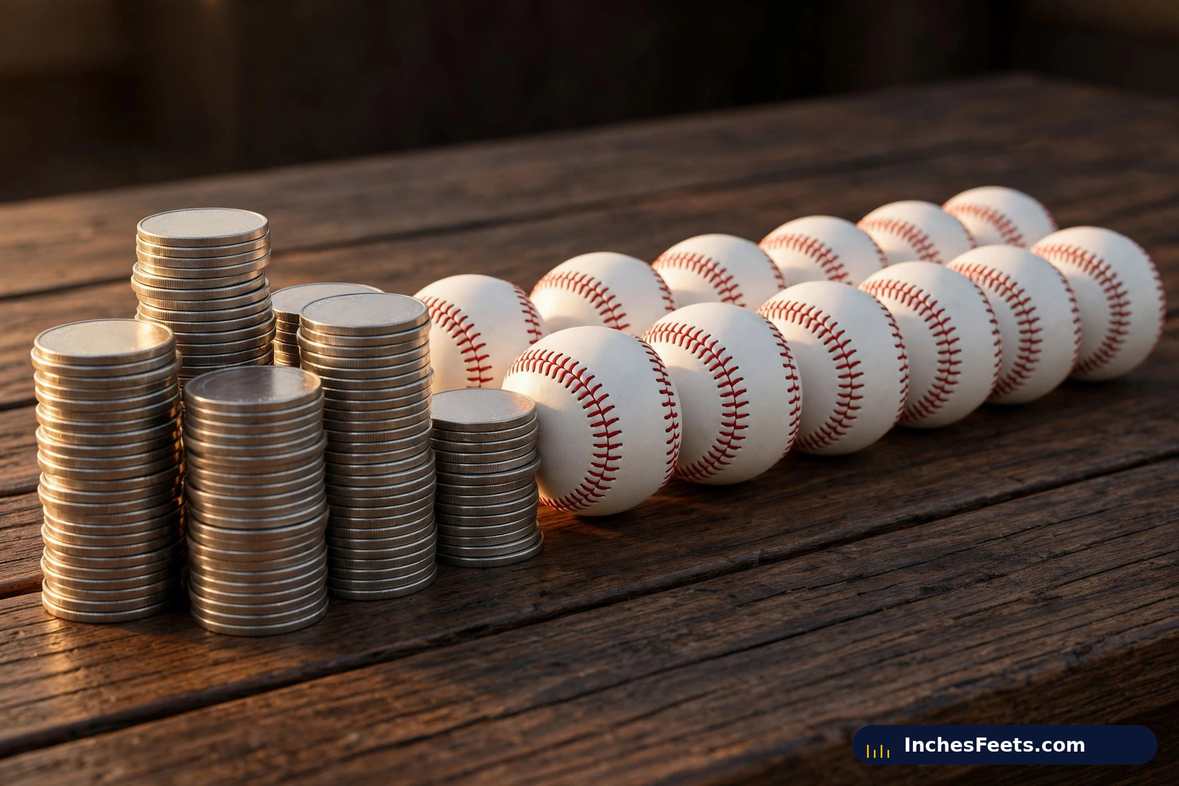
- 250 US quarters (exactly 50.0 oz on the US Mint’s specification)
- Ten regulation baseballs (50 oz is the floor of the official MLB weight band)
- A professional camera body (Canon’s EOS-1D X Mark III weighs 1,440 g with battery and card)
- A camera drone (DJI’s Phantom 4 weighs 1,380 g with battery and propellers)
- An 8-inch cast iron skillet (Lodge lists its 8-inch skillet at 3.2 lb)
- A 1.5-litre bottle of water (the water alone weighs 1,500 g)
- An adult human brain (the published average band tops out at 1,400 g)
- A quart of honey (1,356 g on the USDA’s cup figure)
- Twenty-five large eggs (the federal size class works out to exactly 2 oz per egg)
- A full 32-ounce steel water bottle (48.57 oz with its water inside)
Six more of the competitor’s examples are kept below as corrected sections and are NOT in this count: a standard bottle of wine (about 44 ounces full), a small dog (the breeds he names run 224 to 448 ounces), water cooler bottles (a 5-gallon bottle holds about 667 ounces of water alone), eight raw chicken breasts (no standard breast size exists), a male Australian Shepherd puppy (50 ounces is a passing moment at about three weeks old) and six cups of milk (51.65 ounces by weight — over the mark, not under it).
Things That Weigh About 50 Ounces
A Standard Bottle Of Wine
The competitor gives a full 750 mL bottle of wine a range of “approximately 45 to 50 ounces,” which takes the very heaviest glass on the shelf and presents it as the standard. A spec-sheet-based breakdown tells the real story: the wine itself is about 745 g, and a standard bottle’s glass adds 400 to 550 g, so a full bottle of still wine lands between roughly 1.15 and 1.3 kg — 40 to 46 ounces — with about 1.25 kg (44 ounces) the working average.
The bottle that does overshoot this page’s weight is the Champagne bottle, built thick to hold pressure: its glass alone runs 835 to 900 g and a full bottle about 1.6 kg, or 56 ounces. So the wine shelf brackets 50 ounces from both sides without ever landing on it.
Not counted: a standard full bottle of wine weighs about 44 ounces, not 50; only unusually heavy premium glass approaches the top of the competitor’s range.
A Laptop
“Laptop” is a class, not a weight: netbooks start near 2 pounds and gaming machines pass 6. The claim survives only when it is pinned to a named model, and the competitor’s own text points at professional machines — so take HP’s Elite x360 1040 14-inch G11, a professional 2-in-1. HP’s QuickSpecs sheet lists its product weight as “starting at 1.39 kg (3.05 lb)” — 49.03 ounces, inside two percent of this page’s weight.
The disclosure matters: “starting at” is the lightest configuration, and independent reviewers who weighed a higher-specification review unit recorded 1.487 kg (52.45 ounces). Configured heavily, the same model crosses 50 ounces; in its base professional trim, it sits just under it.
Counted: on HP’s published starting weight of 1.39 kg = 49.03 oz (−1.9%). FLAGGED — a starting-weight basis; heavier configurations of the same model exceed 50 oz.
A Small Dog
This is the competitor’s largest error. The breeds his section names — French Bulldogs and Pugs — are nowhere near this page: the AKC figures put adult French Bulldogs at 20 to 28 pounds (320 to 448 ounces) and Pugs at 14 to 18 pounds (224 to 288 ounces). His examples overshoot 50 ounces by five to nine times.
A dog that genuinely weighs 50 ounces is a 3.1-pound animal: a small toy-breed adult or a young puppy of a larger breed. That is an individual dog on a particular day, not a breed standard — the same reason living animals only count on this site when a standard or reference dataset fixes their weight.
Not counted: the named breeds weigh 224–448 oz as adults; a 50 oz dog exists, but no standard makes “a small dog” a 50-ounce thing.
Steam Iron
A full-size steam iron is one of the competitor’s better claims, and a named model proves it: Sunbeam’s 1700-watt steam iron with retractable cord is listed at 3.15 pounds — 50.4 ounces, a whisker over this page’s weight. The class spreads around it: compact and travel irons run from about 1.9 pounds, and heavy professional models reach about 3.9 pounds, which is why the unnamed claim “a steam iron weighs 50 ounces” needs the model attached.
The competitor’s own range for irons, “25 to 50 ounces,” quietly concedes the spread: the bottom half of his range is travel irons, and only the full-size end belongs here.
Counted: as corrected — the named Sunbeam 1700-watt model’s listed weight of 3.15 lb = 50.4 oz (+0.8%); the class as a whole runs roughly 30 to 62 ounces.
Water Cooler Bottles
There is no 50-ounce water cooler bottle. The bottles that sit on office coolers are 3-gallon and 5-gallon vessels: the water alone in a 5-gallon bottle weighs about 41.7 pounds (a US gallon of water is 8.34 lb), which is roughly 667 ounces, and even the 3-gallon bottle holds about 400 ounces of water before the plastic is counted.
What the competitor describes — “smaller refillable bottles” of about 50 ounces — are sports and gym bottles, a different product that never goes near a cooler. His section borrows the cooler’s name for a bottle that does not exist in that family.
Not counted: standard cooler bottles hold 3–5 gallons; the smallest holds about eight times this page’s weight in water alone.
Five Volleyballs
A volleyball is one of the most tightly specified balls in sport: the FIVB rule book fixes its weight at 260 to 280 grams. Five balls therefore weigh between 1,300 and 1,400 grams — 45.86 to 49.38 ounces. Five of the heaviest legal balls stop just 0.6 ounces short of this page’s weight.
The competitor prints the same per-ball range and then rounds the set up to a flat “about 50 ounces.” The honest statement is narrower: five volleyballs approach 50 ounces only at the very top of the official band.
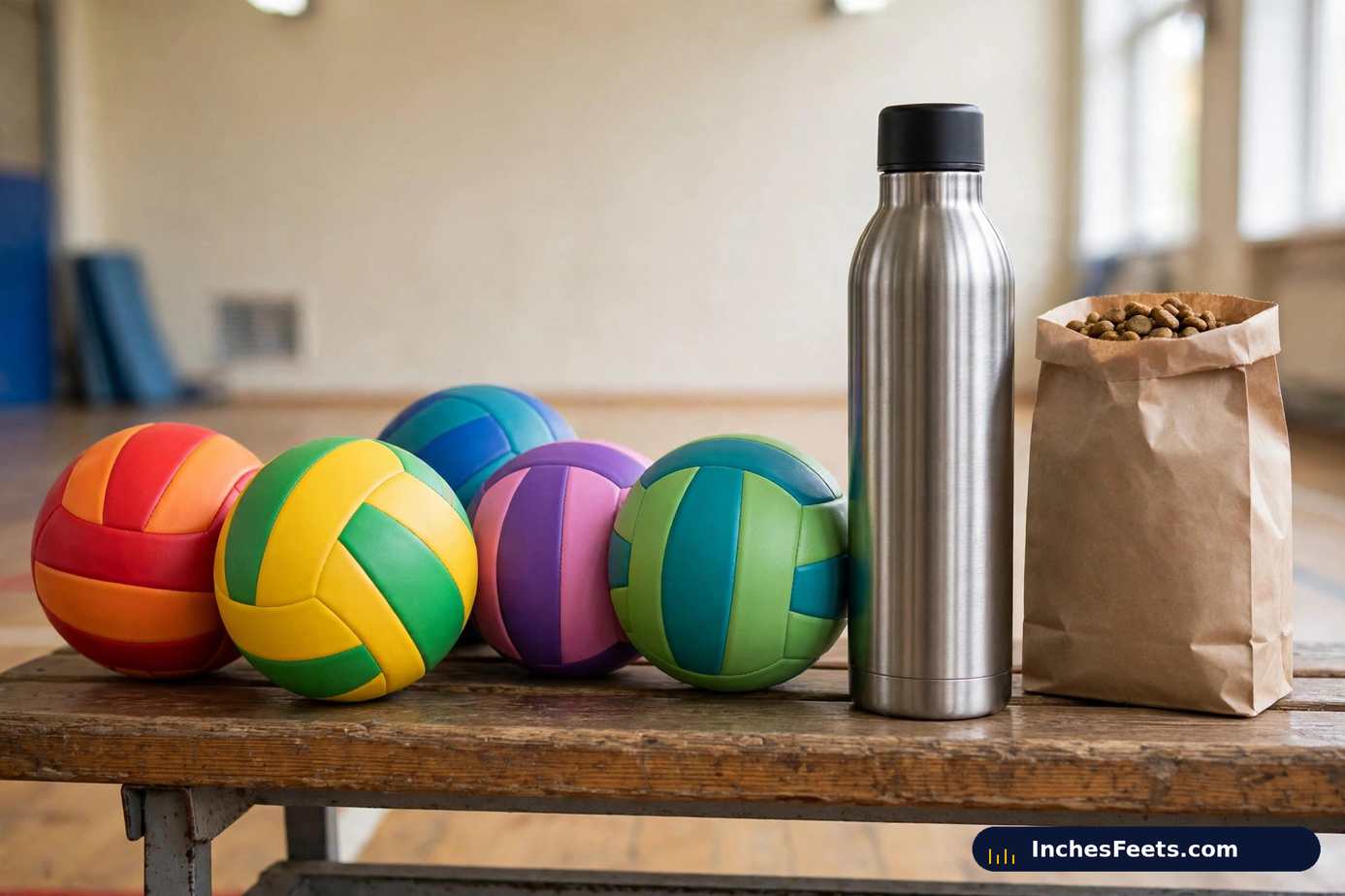
Counted: FLAGGED — the official FIVB band for five balls tops out at 49.38 oz, within 1.3% of 50 oz, with the full band (45.86–49.38 oz) printed here; five average balls at 270 g come to 47.6 oz.
Eight Raw Chicken Breasts
Chicken breasts have no standard size, and the spread is enormous. The USDA’s average raw boneless, skinless piece weighs 272 grams (9.6 ounces), so eight average breasts come to about 77 ounces; eight small 4-ounce breasts come to 32 ounces. Even the competitor’s own premise — breasts of 6 to 8 ounces — produces a set anywhere from 48 to 64 ounces, a range so wide it verifies nothing.
That is the same reason this run refuses “fully loaded” and “average piece” claims elsewhere: an example whose honest answer is “somewhere between 32 and 77 ounces” is not an example of 50 ounces.
Not counted: no standard breast weight exists; eight breasts total roughly 32–77 oz depending on the birds, with the USDA average piece pointing to about 77 oz.
Male Australian Shepherd Puppy
A puppy is a moving target, and the growth charts show how fast this one moves. Published Australian Shepherd charts put an 8-week-old male at 5 to 9 pounds (80 to 144 ounces); a male puppy passes 50 ounces — 3.125 pounds — at roughly three weeks old, and stays there for a matter of days on his way to a 50-to-65-pound adulthood.
The competitor’s “around 8 weeks” timing is therefore wrong by about five weeks as well as by weight: at eight weeks the puppy he describes is already two to three times this page’s weight.
Not counted: 50 oz is a passing moment at about three weeks of age, not a stage that can be listed; by eight weeks a male puppy weighs 80–144 oz.
Six Cups Of Milk
This section is the volume-weight trap in its purest form, and the competitor falls into it. Six cups is a volume — 48 fluid ounces, not 50 of anything — and he concedes the result is “slightly lighter” than 50 ounces. By weight it is not lighter at all: the USDA puts a cup of whole milk at 244 grams, so six cups of milk weigh 1,464 grams, which is 51.65 ounces. Six cups of milk overshoots 50 ounces by weight while undershooting it by volume.
The amount of milk that does weigh 50 ounces is about 5.8 cups (1,417.48 g ÷ 244 g). If you take one lesson from this page, take this section: a cup count never converts to ounces of weight until the ingredient’s density has had its say.
Not counted: six cups of milk is 48 fl oz by volume and 51.65 oz by weight — it misses on both readings, and the competitor’s “slightly lighter” is backwards.
12 Cups Of Flour
Flour is the other density lesson, and this one lands. King Arthur Baking’s standard — the reference most American test kitchens use — sets a spooned-and-levelled cup of all-purpose flour at 120 grams, so twelve cups weigh 1,440 grams: 50.79 ounces, within two percent of this page’s weight. The competitor’s own figure of “approximately 50.8 ounces” is, for once, right.
The basis deserves printing, because flour is the least stable cup in the kitchen: the USDA’s 125 g cup would make the same twelve cups 52.91 ounces, and a cup scooped straight from the bag packs in more still. Counted on the standard spooned-and-levelled cup, the claim holds.
Counted: FLAGGED — on King Arthur Baking’s standard cup of 120 g: 12 × 120 g = 1,440 g = 50.79 oz (+1.6%). The USDA cup basis (125 g) gives 52.91 oz and is disclosed here.
7 Cups Of Sugar
Sugar is denser and better behaved than flour: a cup of granulated sugar weighs 200 grams on the standard reference charts, so seven cups weigh 1,400 grams — 49.38 ounces, just 1.2 percent under this page’s weight. The exact amount for 50 ounces is a touch more, about 7.1 cups.
The competitor pairs this section with the flour section above as if the two behaved alike; in fact sugar’s crystals pack so much more tightly that seven cups of it nearly match twelve cups of flour. Same cups, different weights — density again.
Counted: 7 × 200 g = 1,400 g = 49.38 oz (−1.2%) on the standard granulated-sugar cup.
Bag Of Pet Food
The competitor says a small bag of pet food weighs “around 3.15 pounds,” and treats it as an estimate. It is better than that — it is a label. The standard small bag of dry cat food, Purina Cat Chow Naturals Indoor and its Friskies equivalents, is printed “Net Wt 50.4 oz (3.15 lb) 1.42 kg”: the contents are sold by weight at 50.4 ounces, within one percent of this page’s mark.
Two honest qualifications: the 50.4 ounces is the food, not the bag — on a scale, the packaging adds a little — and the next sizes up (13, 16 and 22 lb) leave this page far behind. The small bag is the standard trial size across the big brands, which is what makes it a standard rather than a coincidence.
Counted: as corrected — on the labelled net contents of the standard small bag, 50.4 oz (+0.8%); the bag itself adds a small amount on a scale.
50 Ounces Of Water, Weighed
This is the section the keyword actually asks for, so here it is with nothing rounded away. Fifty ounces by weight of water is 1,417.48 grams of water, and because water defines the relationship between weight and volume — a gram per millilitre — it measures 1,417.48 mL, which is 47.93 US fluid ounces, or 5.99 cups: a shade under six cups, not six and a quarter.
Run it the other way and the gap shows from the other side: pour 50 fluid ounces of water (1,478.68 mL) and put it on a scale, and it weighs about 52.16 ounces. Measured, 50 ounces of water and weighed, 50 ounces of water differ by more than two ounces — about a quarter of a cup — which is exactly the error hidden in most “50 ounces of water” advice.
Counted: exact by definition — 50 oz by weight = 1,417.48 g = 1,417.48 mL of water = 47.93 fl oz.
250 US Quarters
The US Mint strikes the quarter at exactly 5.670 grams, and the arithmetic is satisfyingly clean: 250 quarters × 5.670 g = 1,417.5 grams — 50.0 ounces, to within two-hundredths of a gram of this page’s exact weight. It is $62.50 in change, a heavy jar’s worth, and one of the very few everyday objects that hits 50 ounces dead on rather than near it.
Because the Mint’s figure is a specification and not an average, circulated quarters count at their minted weight for this page’s purposes; a pocketful of worn coins will read a fraction light, which is a fact about wear, not about the standard.
Counted: exact on the US Mint specification — 250 × 5.670 g = 1,417.5 g = 50.0 oz.
Ten Regulation Baseballs
Major League Baseball’s Rule 3.01 fixes the ball at “between five and five and one-quarter ounces” — so ten regulation baseballs weigh between 50 and 52.5 ounces, and ten balls at the light end of the legal band weigh exactly 50. Unlike a chicken breast, a baseball has a governing body and a printed tolerance, which is what makes a set of them a standard.
A single ball, at 5 to 5.25 ounces, is also the unit this site used on the 10-ounce page, where two baseballs made the count; here it takes ten of them.
Counted: 50 oz sits exactly at the floor of the official band — 10 × 5 to 5¼ oz = 50 to 52.5 oz (MLB Rule 3.01).
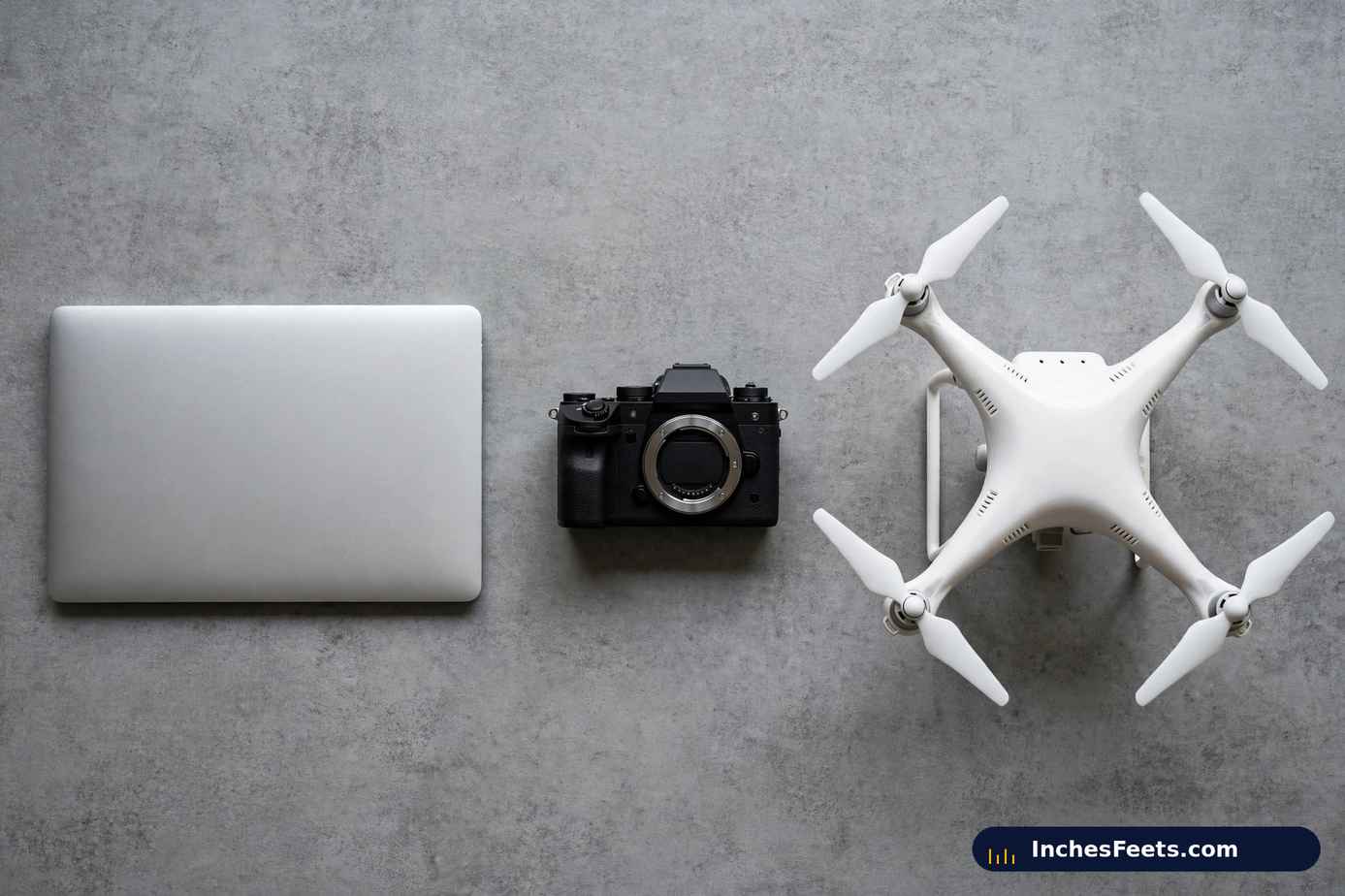
A Professional Camera Body
Canon’s flagship DSLR body, the EOS-1D X Mark III, is specified by Canon at approximately 1,440 grams including battery and memory card — 50.79 ounces, within two percent of this page’s weight. Stripped to the body alone it is 1,250 g, so the count belongs to the camera as it is actually carried and used: battery in, card in, ready to shoot.
Professional bodies are built this heavy on purpose — magnesium alloy, weather sealing and a built-in vertical grip — which is why the flagship sits here while a consumer mirrorless body, often under 700 g, does not come close.
Counted: on Canon’s specification of 1,440 g with battery and card = 50.79 oz (+1.6%).
A Camera Drone
DJI’s Phantom 4, the drone that defined the modern camera quadcopter, is specified by DJI at a weight of 1,380 grams with battery and propellers fitted — 48.68 ounces, 2.6 percent under this page’s weight. That is the full flight weight: everything the aircraft needs to leave the ground is already in the figure.
The disclosure is the mirror of the camera’s: this is a manufacturer’s specification for the complete aircraft, not a measured sample, and the later Phantom 4 variants sit within a few grams of it (the Pro is listed at 1,388 g).
Counted: on DJI’s specification of 1,380 g including battery and propellers = 48.68 oz (−2.6%), disclosed.

An 8-Inch Cast Iron Skillet
Lodge, the standard American maker, lists its 8-inch cast iron skillet — model L5SK3 — at 3.2 pounds in its own catalogue: 51.2 ounces, 2.4 percent over this page’s weight. It is the smallest of the classic skillet sizes, and it still outweighs most of the objects on this page, which tells you most of what you need to know about cast iron as a material.
For scale, the same catalogue puts the 10.25-inch skillet at about 5.6 pounds — useful if you are estimating an unlisted pan: in this range, two extra inches of iron cost you roughly forty ounces.
Counted: on Lodge’s catalogue weight for the L5SK3 of 3.2 lb = 51.2 oz (+2.4%), disclosed.
A 1.5-Litre Bottle Of Water
Here is where the competitor’s introduction got its “approximately 1.5 liters” from — and the bottle itself shows the slip. A 1.5-litre bottle holds 1,500 grams of water, and 1,500 grams is 52.91 ounces: the volume figure (1.5 litres ≈ 50.7 fluid ounces) and the weight figure (52.91 ounces) sit side by side on the same bottle, three percent apart, wearing the same name.
Counted here on the contents basis, with the number printed rather than rounded away: the water alone is 52.91 ounces, and the full bottle, with its PET plastic, reads higher still, around 54 ounces. If your target is exactly 50 ounces of water, the bottle to fill is the 1.42-litre one — see the weighed-water section above.
Counted: on the disclosed contents basis — 1.5 L of water = 1,500 g = 52.91 oz (+5.8%); the full bottle is heavier again.
An Adult Human Brain
The University of Washington’s Brain Facts and Figures — a standard reference compiled from anatomy textbooks — gives the average adult human brain at 1,300 to 1,400 grams: 45.86 to 49.38 ounces. The top of the published average band stops about half an ounce short of this page’s weight, which is close enough to count with the band printed, and honest enough to flag.
Individual brains vary well beyond the band in both directions — the reference is an average, not a limit — so the claim is precisely this: the average adult brain, at the top of its published range, weighs about what this page is about.
Counted: FLAGGED — the published average band (1,300–1,400 g, University of Washington reference data) tops out at 49.38 oz, within 1.3% of 50 oz; an average brain is a 46-to-49-ounce object.
A Quart Of Honey
Honey is the density lesson from the other direction: it is about 1.42 times as heavy as water, so a US quart of it — four cups — weighs far more than the quart of water’s 33.8 ounces. The USDA puts a cup of honey at 339 grams, so a quart weighs 1,356 grams: 47.83 ounces, about four percent under this page’s weight.
That is why honey is sold by weight in so many places, and why “a quart of honey” and “three pounds of honey” are nearly the same purchase: three pounds is 48 ounces, and the quart is 47.83.
Counted: on the USDA reference figure — 4 × 339 g = 1,356 g = 47.83 oz (−4.3%), disclosed.
Twenty-Five Large Eggs
Egg sizes in the United States are federal weight classes, not descriptions: a dozen Large eggs must weigh at least 24 ounces net, which fixes the class at 2 ounces per egg. Twenty-five Large eggs therefore weigh 50 ounces — exactly, on the standard, in the same way the quarters above are exact on the Mint’s.
Individual eggs vary a little around the class, and a carton is graded on the dozen, not the egg — but the class itself is a printed legal standard, which is precisely what this page counts.
Counted: exact on the USDA size-class standard — Large = 24 oz per dozen = 2 oz per egg; 25 × 2 oz = 50 oz.
A Full 32-Ounce Steel Water Bottle
Take the bottle from the volleyballs photograph: a 32-ounce Hydro Flask Wide Mouth. Hydro Flask lists the empty bottle at 15.2 ounces (431 g); fill it and the 32 fluid ounces of water inside weigh 946 grams, bringing the full bottle to 1,377 grams — 48.57 ounces, 2.8 percent under this page’s weight.
Beware the arithmetic that appears in reviews of this bottle, which adds 15.2 and 32 and announces 47.2 ounces: that sum mixes weight ounces with fluid ounces, the exact error this article exists to correct. Weighed properly, bottle and water together come to 48.57 ounces.
Counted: on the maker’s specification plus water’s density — 431 g bottle + 946 g water = 1,377 g = 48.57 oz (−2.8%), disclosed.
How to Visualize 50 Ounces
Picture the professional camera body from the list above, battery in and card in: that is 50 ounces, near enough, in one hand. Poured, it is the water in a 1.5-litre bottle with about three fluid ounces taken off the top — or, weighed exactly, just under six cups of water standing in a jug on the scale.
Out in the shops, the cleanest anchor is the pet-food aisle: one standard small bag of dry cat food, labelled 50.4 ounces, is this page’s weight in a single carry. At the post office it is a 3.125-pound parcel — a hardback book and a full steel water bottle in the same box will put you within an ounce or two of it.
And if you cook, you already know this weight by hand: it is the 8-inch cast iron skillet, empty, that lives by the stove — 51.2 ounces of iron that most cooks can lift one-handed, and none can lift carelessly.
50 Ounces Compared With Other Weights
Fifty ounces is 3.125 pounds, 1.41748 kilograms, 1,417.48 grams or 0.223214 stone — and against this site’s other weighed pages it sits at the small end of the shelf. It is five of the 10-ounce examples laid side by side. The 20 kilograms page works at 705.48 ounces, about fourteen of this page’s units; the 100 kilograms page works at 3,527.40 ounces, about seventy of them.
The held pages in between fill the ladder in the same units: 25 kilograms is 881.85 ounces (about eighteen 50-ounce units), 30 kilograms is 1,058.22 ounces (about twenty-one), 40 kilograms is 1,410.96 ounces (about twenty-eight), and 50 kilograms is 1,763.70 ounces — almost exactly thirty-five of the weight this page is about. Fifty ounces is also 0.0284 of the way to that last figure’s tonne-scale world, which is a reminder of how small a weight it is once kilograms enter the conversation: most of this page’s objects are things one hand can lift.
Against drinks measures, 50 ounces by weight of water (47.93 fl oz) is about a third of a US gallon (128 fl oz), and 50 fluid ounces is 6.25 cups — just over three US pints of volume.
How to Weigh 50 Ounces Accurately
Use a kitchen scale, and tare it: put the empty container on first, zero the scale, then add the contents, so the reading is the thing itself and not the thing plus its bowl. For water targets — the use this keyword usually means — weigh the bottle rather than trusting the printed fill lines: a bottle marked to 50 fluid ounces holds about 52.2 ounces by weight, and if the number on your plan is a weight, the scale is the only honest measure.
Check the scale itself with the cheapest calibration weight in the house: 250 quarters, which the US Mint’s specification fixes at exactly 50.0 ounces (1,417.5 g). If your scale reads 50 ounces for $62.50 in quarters, it is telling the truth at exactly this page’s weight.
Two warnings from the sections above bear repeating. Label weights are contents weights: the 50.4-ounce bag of cat food reads a little over 50.4 ounces on a scale because the bag counts too. And a cup measure is a volume, always: 50 ounces by weight of flour is about 11.8 cups, of sugar about 7.1 cups, and of honey under 4.2 cups — the ingredient decides, never the cup.
Conclusion
Fifty ounces is 3.125 pounds, exactly — and it is also, poured as water, 47.93 fluid ounces, which is why this number causes more quiet confusion than almost any other on the scale. Of the competitor’s twelve examples, six survive verification: the laptop on a named model’s spec sheet, the steam iron, the volleyballs at the top of their official band, the flour and sugar on their standard cup weights, and the bag of pet food on its own label. Six do not: the wine bottle is a 44-ounce object, the “small dog” breeds are five to nine times too heavy, the cooler bottle does not exist, the chicken breasts have no standard to stand on, the puppy passes 50 ounces in days, and the six cups of milk miss on both readings at once.
The eleven additions were chosen to be checkable rather than charming: a Mint specification, a baseball rule book, two manufacturers’ spec sheets, a federal egg class, a university reference table and the weighed water the keyword asks about. If you remember one figure, make it the bridge between the two ounces: 50 fluid ounces of water weighs about 52.2 ounces, and 50 ounces of water measures just under six cups.
That, finally, is the weight of the skillet by the stove: cast iron at 51.2 ounces for the 8-inch pan, close enough to this page’s mark to end it — a reminder that the objects which honestly weigh 50 ounces tend to be dense, standardised, and printed with a specification somewhere.
FAQs
How Many Pounds Is 50 Oz?
Exactly 3.125 pounds. There are 16 ounces in a pound, so the conversion is 50 ÷ 16 = 3.125 — true of anything you weigh, from flour to feathers.
How Heavy is 50 Ounces?
Fifty ounces is 1,417.48 grams, or 1.42 kilograms. In the hand it feels like a professional camera body with its battery in, a full-size steam iron, or the standard small bag of dry cat food — and noticeably more than a full bottle of wine, which is about 44 ounces.
How Much is 50 oz of Water?
It depends on which ounce you start with. Fifty fluid ounces of water is 1.48 litres by volume and weighs about 52.16 ounces. Fifty ounces by weight of water is 1.42 kg and measures 47.93 fluid ounces — just under six cups. The two are close, but they are not the same amount.
How Many Cups is 50 oz?
As a volume, 50 fluid ounces is 6.25 US cups. As a weight, it depends on the ingredient: 50 ounces of water is 5.99 cups, of flour about 11.8 cups on the standard 120 g cup, and of sugar about 7.1 cups — a cup measures space, and each ingredient fills it with a different weight.