
How Long Is 30 Feet? 14 Common Things That Are 30 Feet Long
If you are trying to picture 30 feet, here is the exact answer first: 30 feet is 9.144 meters — 914.4 centimeters, 360 inches, exactly 10 yards. It is the depth of a football end zone, written into the rulebook, and the length of a mid-size school bus.
Thirty feet is the scale where houses become buildings and vehicles become the big ones: three stories up, a fire truck long, a small whale long. It is also a size people routinely guess wrong, because the famous comparisons — the standard school bus, the shipping container, the giant crocodile — do not actually measure 30 feet, as this page shows.
This guide gives you the exact conversions first, then walks through the things whose sizes are checked against official standards, rulebooks, and manufacturer specifications — and corrects the popular comparisons, including several on the page this one replaces, that quietly get 30 feet wrong.

How Long Is 30 Feet?
Thirty feet is exactly 9.144 meters. It is 360 inches — ten yards on the nose — and a little under one-hundredth of a kilometer. Laid along a basketball court it covers just under a third of the court’s 94 feet.
30 Feet Comparison chart:
| Unit | Equivalent of 30 Feet |
|---|---|
| 30 Feet in Inches | 360 inches |
| 30 Feet in Yards | 10 yards |
| 30 Feet in Meters | 9.144 meters |
| 30 Ft in Centimeters | 914.4 cm |
| Millimeters | 9,144 mm |
| Kilometers | 0.009144 km |
| Miles | 0.005682 miles |
Two comparisons you will see elsewhere need correcting straight away. A full-size school bus is not a 30-foot vehicle: the big conventional buses run 35 to 45 feet, and 30 feet is the mid-size class below them. And five adults lying head to toe only make 30 feet if all five are six-footers — at the average adult height of about 5 feet 7 inches, five people stretch to roughly 28 feet. The honest anchors are below, starting with the one measurement on this page that is exact by law: the end zone of a football field is 10 yards deep, which is 30 feet to the inch.
Everyday Things That Are Exactly 30 Feet
If you only remember a short list, make it this one. Every entry below is 30 feet by an official standard, a rulebook, or a manufacturer’s specification — not by eyeballing:
- The depth of an NFL end zone — exactly 10 yards from goal line to end line, set by Rule 1 of the NFL rulebook.
- A mid-size (Type B) school bus — the 25-to-35-foot class; a 30-foot bus seats roughly 30 to 36 passengers.
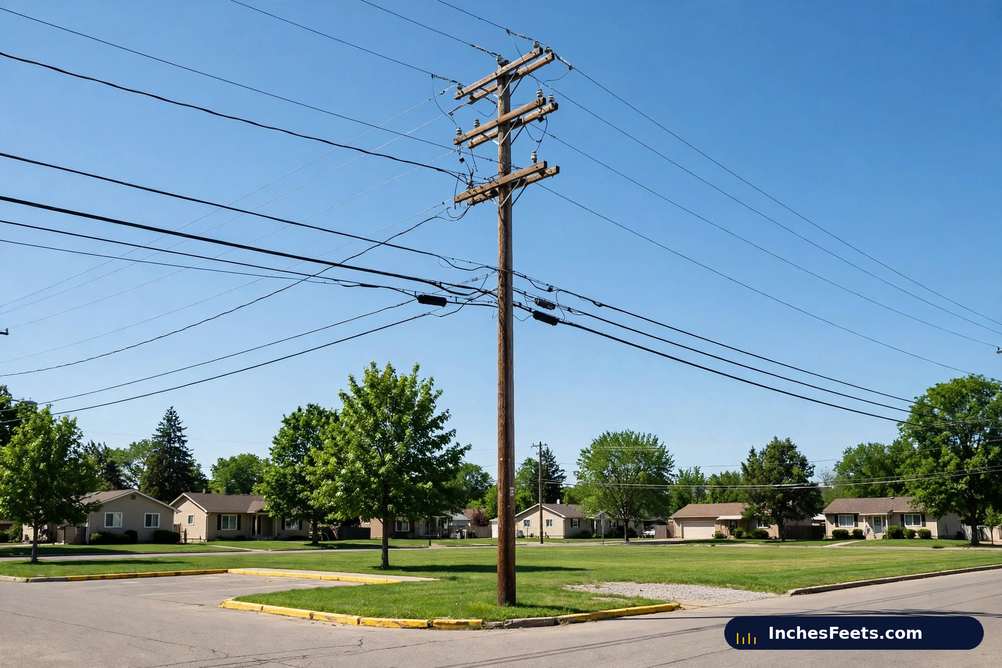
- A 30-foot wooden utility pole — a standard length in the ANSI O5.1 pole tables, in 5-foot steps.
- A custom-chassis fire pumper — the Fire Apparatus Manufacturers’ Association puts this class at 30 to 34 feet.
- A Thor Four Winds 28Z Class C motorhome — manufacturer specification: exactly 30 feet 0 inches long.
- A three-story residential building — at the standard estimate of about 10 feet per story, three stories stack to roughly 30 feet.
- A 30-foot commercial flagpole — a standard catalogue height for schools, dealerships, and parks, flying a 5×8 or 6×10 flag.
- A Catalina 30 sailboat — the best-selling cruising sailboat ever built measures 29 feet 11 inches overall, the 30-foot class to within an inch.
Two honest neighbours complete the picture. A full-size school bus runs 35 to 40 feet — a full bus-length over. And the largest crocodile ever reliably measured, Lolong, reached 20 feet 3 inches — a full third short of 30, which is why the crocodile section below is a correction, not an example.
14 Common Things That Are 30 Feet Long
Here is the full set. Each counted entry is checked against an official standard, a rulebook, or a manufacturer’s specification. Three of the most repeated comparisons on the internet turn out to be wrong at this size, and they are corrected in place rather than quietly dropped — which is why this list counts only the entries that check out.
School Bus
Counted — with the size class corrected. Thirty feet is a mid-size school bus: Type B buses, built on a stripped chassis with the door behind the front wheels, run 25 to 35 feet and carry about 30 to 36 passengers. The classic full-size bus most people picture — the Type C conventional — is 35 to 40 feet, and the largest Type D transit-style buses reach 45. So when a 30-foot bus pulls up, it is a real school bus doing real routes, just not the biggest one on the road. Claims that a “standard” school bus is about 30 feet understate the full-size fleet by a whole car length or more.
Telephone Pole
Counted — on the pole’s full manufactured length. Wood utility poles are classified under the ANSI O5.1 standard in 5-foot steps — 25, 30, 35, 40 feet and up — and 30 feet is one of the preferred standard lengths, stocked in most pole classes. One honest disclosure: the 30 feet is the whole pole, butt to tip. Utility setting tables bury a 30-foot pole about 5.5 feet deep, so roughly 24.5 feet of it stands above the ground. When you look up at the wires, you are seeing about 24 to 25 feet of pole; the full 30 is what the crew ordered, loaded, and set.
Limousine
Counted — as the heart of the stretch class. A limousine has no single length, because a stretch is built, not born: a coachbuilder cuts a sedan and inserts a section measured in inches. The published class figures put standard stretch limousines at about 25 to 35 feet overall — a 120-inch stretch on an 18-foot sedan lands near 28 feet, and larger SUV-based stretches run 30 to 40. Thirty feet sits squarely inside the working stretch range, which is why a 30-foot limousine needs the equivalent of about three ordinary parking spaces laid end to end.
Shipping Container
This one does not check out, and it is worth saying plainly because the container is the comparison everyone reaches for. The ISO 668 standard that governs the world’s freight containers defines the common lengths as 20 feet and 40 feet (with 45-foot high-cubes in some fleets, and 48- and 53-foot boxes in US domestic service). There is no standard 30-foot container — the page this article replaces says so itself, listing 20- and 40-foot sizes in its own text while filing the container under 30-foot examples. A container yard gives you a 20 or a 40 to picture, never a 30. Not counted in the 14.
RV (Recreational Vehicle)
Counted — on a named manufacturer’s specification. Thirty feet is a working size in the motorhome market, not a rounded guess: Thor Motor Coach’s Four Winds 28Z, a Class C motorhome on a Ford E-Series chassis, is specified at exactly 30 feet 0 inches long. Class C coaches as a family run from about 21 to 35 feet, so the 30-foot floor plans sit in the upper-middle of the range — big enough for a cab-over berth and a slide-out, still short enough for most campground sites. (The heading’s spelling of “Recreational” is the competitor’s own, kept as published.)
Fire Truck
Counted — at the start of the custom pumper range. The Fire Apparatus Manufacturers’ Association size tables put a custom-chassis pumper on a single rear axle at 30 to 34 feet long, and commercial-chassis pumpers start around 24 feet and run up through 30. Real trucks bear the figures out: FDNY’s Ferrara Super Pumper measures 30 feet 1 inch overall. The trucks that break well past 30 are the aerials — ladder trucks run 36 feet and up, and a tiller aerial can exceed 60 — but the engine that answers most calls is a roughly 30-foot machine.
Large Crocodile
This one does not check out either — by a third of the animal. The saltwater crocodile is the largest living reptile, and its verified record is nowhere near 30 feet: Lolong, the giant captured in the Philippines in 2011 and certified by Guinness World Records, measured 20 feet 3 inches (6.17 m). Biologists put the species’ realistic ceiling near 23 feet, and the famous 28-foot claims are unverified historical stories. The page this article replaces concedes the point in its own text — “up to 23 feet or more” — while still filing the crocodile under 30-foot things. Not counted in the 14.
Wind Turbine Blade
Not counted — because there is no 30-foot blade class to point at. Blade length follows the turbine, and the real sizes bracket 30 feet without landing on it: home and farm turbines carry blades of roughly 5 to 13 feet, small-utility machines in the 100–500 kW class reach about 20 to 30 feet only at their very top end, and the utility-scale blades on a modern wind farm run from about 130 feet to well over 280 feet. Thirty feet is the extreme edge of the smallest commercial class, not a size you can picture a turbine by — so this entry is corrected, not counted. Not counted in the 14.
Parade Float
Counted — as a documented build size inside a regulated range. Parade floats are built on trailers and trucks to whatever length the route allows: Thibodaux, Louisiana’s Mardi Gras ordinance, for example, permits floats from 20 to 60 feet long, and several cities cap floats at exactly 30 feet. Builders work at this size in practice — the Krewe of Nyx’s celebrated purse float in New Orleans was built 14 feet high, 10 feet wide, and exactly 30 feet long. The giant “superfloats” of the biggest krewes run to 50 feet, but the classic single float rolling past you is very often a 30-footer.
A Three-Story Building
Stand on the sidewalk and look up: a three-story residential building is the most available 30-foot measure in any town. The standard estimating figure for a residential story is about 10 feet floor to floor — an 8- or 9-foot ceiling plus the floor structure — so three stories stack to roughly 30 feet. Commercial stories run taller, 12 to 14 feet with their duct space, which is why a three-story office block can reach 36 to 42 feet. For houses and apartment buildings, though, “three stories” and “about 30 feet” are the same picture — and it is why the two-story house next door, at 20 to 25 feet, looks a full floor short of it.

The Depth of an NFL End Zone
The cleanest 30 on this page, because it is exact by rule. An American football field is 100 yards between the goal lines, and beyond each goal line sits an end zone 10 yards deep — and 10 yards at 36 inches to the yard is 360 inches, exactly 30 feet. Every touchdown ever scored was caught or carried inside a 30-foot-deep box. It is also the correction to a claim repeated elsewhere: 30 feet is not “one-third of the end zone” — it is the end zone’s full depth, goal line to end line. (On a basketball court, by contrast, 30 feet really is about a third: the court is 94 feet long.)
A 30-Foot Travel Trailer
The motorhome’s towed cousin lives at this size too. Airstream’s Flying Cloud 30 — the “30” is the model class — measures 30 feet 11 inches overall in manufacturer specifications, hitch included. That pattern is normal in the trailer world: the number in the model name is the class, and the tape measure adds most of a foot of coupler and bumper. So a “30-foot trailer” is a 30-class trailer, and the honest figure to plan a storage bay or a campsite around is just under 31 feet.
A Catalina 30 Sailboat
The best-selling cruising sailboat in history is a 30-footer to within an inch. Catalina Yachts built more than 6,500 of the Catalina 30 between 1974 and 2008, and its published specification gives a length overall of 29 feet 11 inches (9.12 m) with a 10-foot-10-inch beam. Marinas sell slips by exactly this class, so thousands of docks hold a boat whose hull is one inch shy of the number on its stern. If you have ever walked a marina, you have paced out 30 feet a hundred times.

A 30-Foot Flagpole
Flagpoles are sold in standard heights, and 30 feet is the standard commercial step: manufacturer guides built on the ANSI/NAAMM FP 1001-07 specification list the 30-foot pole as the typical choice for schools, car dealerships, parks, and mid-size commercial buildings, flying a 5×8- or 6×10-foot flag (the flag’s length runs about a quarter to a third of the pole’s height). One buying disclosure, parallel to the utility pole’s: a ground-set 30-foot pole is about 33 feet of metal overall, because roughly 3 feet of it sits in the foundation sleeve below grade.
A Large Male Orca
The ocean’s first honest 30-footer is the largest dolphin on Earth. NOAA Fisheries gives the orca’s maximum length as up to 32 feet, with adult males typically running 20 to 26 feet — which means the biggest bulls, the ones with the six-foot triangular dorsal fins, measure right around 30 feet from rostrum to fluke. A 30-foot orca is not the average animal; it is the old male at the top of the size range, and he is as long as the fire truck on land.

A Giant Squid
Counted — at the documented size of large specimens, tentacles included. The Smithsonian puts the longest giant squid ever recorded by scientists at almost 43 feet in total length, and estimates the maximum total length of a big female at about 43 feet and of a male at about 33 feet — most of it the two long feeding tentacles, since the mantle alone rarely exceeds 7.4 feet. A large squid of about 30 feet is therefore a real, documented class of animal: Smithsonian squid expert Clyde Roper estimated the famous Plum Island specimen at roughly 30 to 33 feet intact. Picture the tentacles, not the body — the 30 feet is mostly reach.
A Whale Shark
The largest fish in the ocean is, at its typical adult size, a 30-foot animal. Published estimates put the average adult whale shark at about 9.7 meters — roughly 31.8 feet — with most adults falling in an 18-to-33-foot band and maturity reached at around 29.5 feet. Exceptional individuals run far past it (the largest verified specimen measured 41.5 feet, and reports go higher), but the working picture is the typical grown shark: about 30 feet of slow, spotted filter-feeder, roughly the length of the mid-size school bus at the top of this page.
How to Visualize 30 Feet Without a Ruler
Start with the walk: 30 feet is about twelve ordinary walking steps, or ten long strides. If you have already paced out the objects in our guide to twenty feet, pace that span and add half as much again — twenty plus ten lands you on thirty.
Build it from smaller anchors. Thirty feet is 360 inches: one hundred eighty lengths of the everyday objects in our guide to how long is 2 inches laid end to end, or — a stack with real theatre to it — thirty-six cans from our Pringles can dimensions guide piled one on another, since each standard can stands about 10 inches tall. On the ground, two mid-size family cars parked nose to tail come to roughly 30 feet, and on the field, stand in an end zone: goal line behind you, end line 30 feet ahead, no measuring required.
30 Feet vs 40 Feet: What’s the Difference?
Ten feet sounds like a small step until you stand it upright: 40 feet is a full third longer than 30, and it is exactly one more story of a house, or one more mid-size bus stacked behind the first. The two numbers also divide the vehicle and container world into classes. Thirty feet is the mid-size school bus; 40 feet is the big transit bus and the full-size Type C’s upper reach. Thirty feet is the custom pumper; 40 feet is where the aerial ladders start. And in freight, 40 feet is the standard big box itself — the FEU — while 30 feet is not a container size at all.
In practice, the gap decides what fits. A 30-foot motorhome takes most campsite pads; a 40-foot coach is restricted to the long sites. A 30-foot flagpole is a catalogue order; at 40 feet the foundation engineering gets serious. When a product line offers both numbers, the 30 is almost always the largest size that still behaves like the ordinary version of the thing.
When an Exact 30 Feet Matters
Some 30s are pictures to estimate with; others are specifications with money or safety on them. Utility work is the sharpest case: a 30-foot pole set 5.5 feet deep leaves about 24.5 feet above ground, and wire-clearance rules are calculated from the height above ground — order or set the wrong pole class and the clearance fails inspection. Flagpoles run the same trap in miniature: foundation depth follows the “10 percent of height plus 2 feet” rule, so a 30-foot pole wants about a 5-foot foundation, and its buried sleeve section is part of the metal you pay for.
Vehicles and vessels are classed, not measured, and the difference bites at booking time. A “30-foot” Airstream is 30 feet 11 inches overall; a “30-foot” motorhome floor plan can run over or under the badge number; a Catalina 30 fits a 30-foot slip because it is an inch under. Campground sites, storage bays, and marina slips are sold by the class number but enforced by the tape, so measure the real thing before you reserve. Fire departments write the same lesson into purchase specifications, capping overall length — sometimes at 32 feet — because a truck that does not fit the bay or the turning circle does not answer calls.
Conclusion
Thirty feet is 9.144 meters, exactly 10 yards, and — once you know where to look — a measurement with a rulebook, a standard, or a spec sheet behind it: the depth of an end zone, a mid-size school bus, a custom pumper, a three-story house, the biggest male orcas. The honest list matters because the internet’s favourite comparisons at this size include a container that is only ever built at 20 or 40 feet and a crocodile whose all-time record is a full third short.
Keep two anchors and you will rarely guess wrong: picture the three-story building for anything tall, and the mid-size school bus for anything long. And on your own street, the wooden utility pole overhead was very likely manufactured to exactly this length — 30 feet of pine, five and a half of them in the ground, quietly holding the wires at the height this whole page has been describing.
FAQs
What Does 30 Feet Look Like?
It looks like a three-story house, a mid-size school bus, or the depth of a football end zone. Note what it does not look like: a two-story house is only about 20 to 25 feet tall, so 30 feet stands a full story above one.
How Far is 30 Feet?
Exactly 10 yards, or 9.144 meters. On a football field it is the full depth of one end zone, goal line to end line — and on a 94-foot basketball court it is just under one-third of the court’s length.
How Big is 30 Feet?
Big enough for the working giants: a fire pumper, a Class C motorhome, a parade float, a grown whale shark. It is about a third of a basketball court, three stories of house — and a third longer than the largest crocodile ever measured.