How Long Is 5 Inches? 13 Things That Are 5 Inches Long
Five inches is exactly 12.7 centimetres — 127 millimetres, or 0.4167 feet. The objects that match it exactly are a small, knowable set of 5 inch items: the long side of a 3×5 index card, the short side of a 5×7 photograph, and a cocktail napkin folded into its serving square.
It is a hand-scale length — roughly the width of an adult palm, short enough to hide under your hand — and that is exactly why the internet describes it so loosely. Pages listing “things that are 5 inches long” routinely include a credit card, a golf tee and a paperclip, and on checking, not one of those three objects is anywhere near five inches.
This guide gives you 13 things that genuinely measure 5 inches, each checked against a maker’s specification, an official standard or reference data. Just as usefully, it keeps the popular claims that fail the check and prints their real sizes beside them.
5 Inches at a Glance: The Verified List
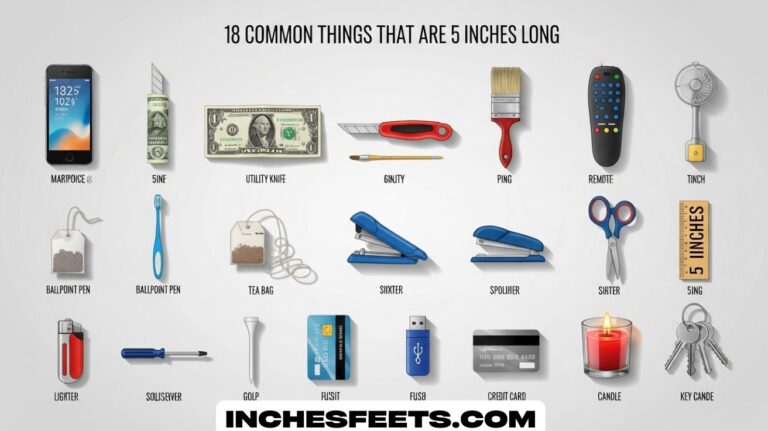
- A smartphone screen (the classic 5.0-inch class — counted as corrected, on the diagonal basis)
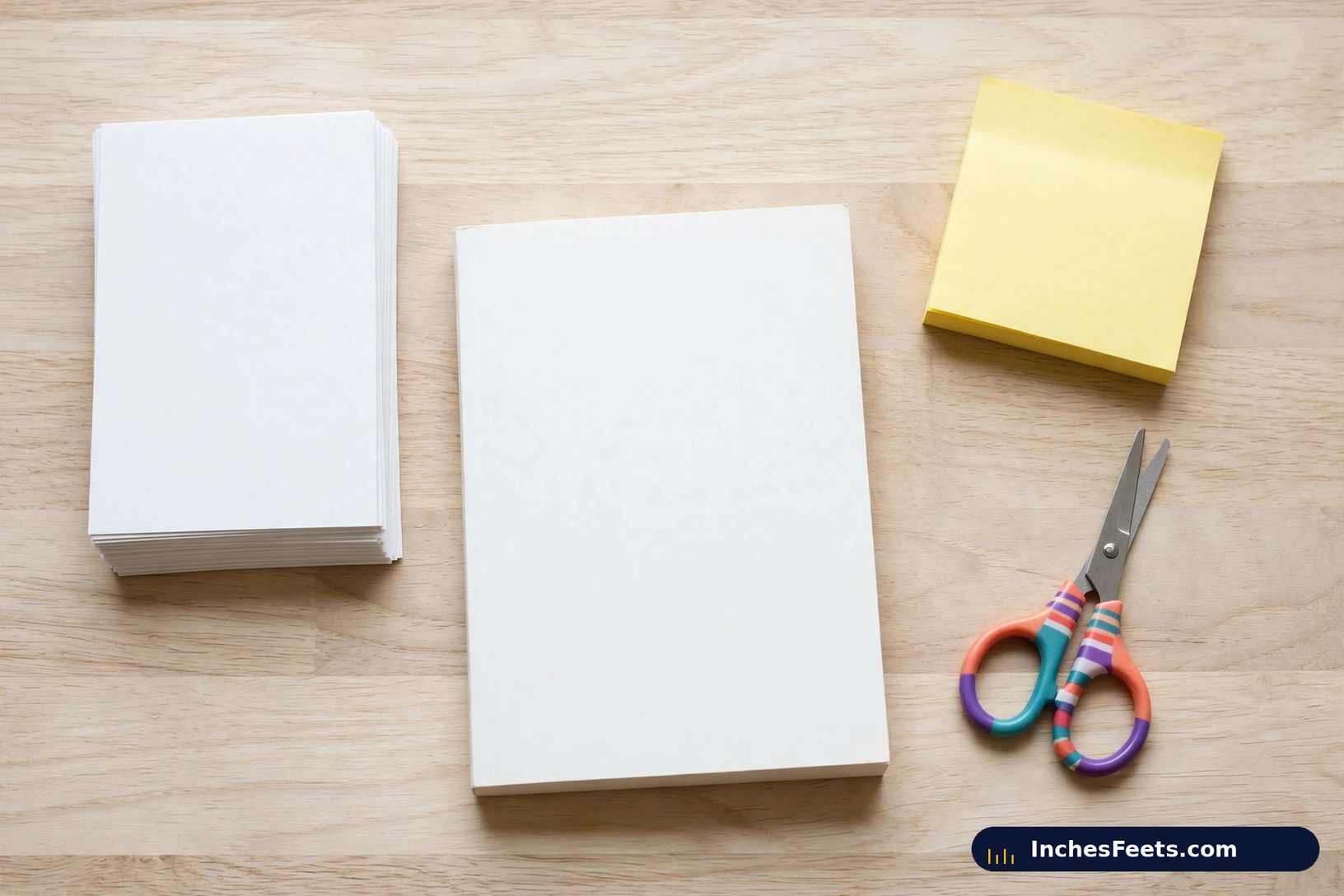
- A 3×5 index card (its long side, exactly 5 inches)
- Post-it Notes, 3×5 (the long side of the standard pad)
- A 5×7 photograph (its short side)
- A trade paperback book (the 5 × 8 inch trim size)
- A junior legal pad (its 5 × 8 inch sheet)
- A cocktail napkin, folded (5 × 5 inches as served)
- Kids’ scissors (the standard 5-inch school size)
- A margin trowel (its 5-inch blade)
- A 5-inch sanding disc (the standard random-orbit size)
- An embroidery hoop (the standard 5-inch size)
- A caster wheel (the 5-inch class)
- A 5-inch K-style gutter (its width across the top)
Every item on this list is checked in its own section below. The claims that did not survive checking stay in the article too, with their real sizes printed beside them — knowing that a jumbo paperclip is two inches, not five, is nearly as useful as the list itself.
13 Common Things That Are 5 Inches Long
The competitor’s list below is kept in his order, headings and all — but seven of his eight examples fail verification, and each failure is printed openly in its section rather than quietly dropped. The list is then completed with twelve added objects that do measure five inches. (Two further claims from his list introduction — a coffee cup standing “around 4 to 5 inches tall” and succulents growing “to about five inches” — name no standard object at all: mug heights and plant growth vary by design and by plant, so neither can be counted or corrected to a single figure, and neither is given a section.)
Credit card
This heading opens the competitor’s list, and it fails on the standard itself. A credit card is built to ISO/IEC 7810 ID-1: 85.60 × 53.98 millimetres — 3.370 inches long and 2.125 inches wide. Even corner to corner, its diagonal is only about 3.98 inches. The competitor’s own text gives the width as 3.37 inches and then calls that “a closer measurement to 5″” — it is not: 3.37 is closer to 3 than to 5, and no dimension of a credit card, on any axis, reaches five inches. A card is a fine pocket reference for three and a half inches. For five, use the index card further down this page — which is, not coincidentally, the card that really is five inches long.
Not counted: a standard credit card is 3.370 × 2.125 inches (ISO/IEC 7810 ID-1), diagonal ≈ 3.98 inches. Corrected figures printed above.
Smartphone screen
This one survives — with two corrections that change what the claim means. First, the basis: a phone screen’s size is its diagonal, corner to corner, not its length or width. Second, the era: the competitor writes as if five-inch phones are the current small standard, but modern phones run to six inches and beyond. The five-inch screen is a classic class, and its defining model is exact: Samsung’s official specifications for the Galaxy S4 list a 5.0-inch Full HD Super AMOLED display — five inches on the diagonal, by the maker’s own spec sheet. That is the honest version of this heading: a named phone whose screen is exactly this page’s length, measured the way screens are measured.
Counted: as corrected — on the display-diagonal basis: the Samsung Galaxy S4’s display is exactly 5.0 inches per Samsung’s official specifications; the “current small phone” framing is corrected above.
Standard slice of bread
A slice of bread has no standard of its own — its width is set by the pan it was baked in. The standard home loaf pan for a one-pound loaf is 8.5 × 4.5 inches (the size the pan makers, USA Pan among them, sell as the standard 1 lb loaf pan), so a standard slice is about 4.5 inches across, not five. The larger 9 × 5 and 10 × 5 pans exist precisely as the bigger sizes. A slice cut from one of those loaves can indeed reach five inches — but that is the large loaf, and calling it the “standard slice” overstates the standard by half an inch.
Not counted: a standard slice is ≈ 4.5 inches across, set by the standard 8.5 × 4.5 inch loaf pan. Corrected figure printed above.
Adult finger
The competitor’s measurement here is not a finger at all: “from the tip of the thumb to the tip of the middle finger” is a span across two different fingers, not the length of any single one. Measured properly, no adult finger comes close to five inches. A peer-reviewed biometric study (Anatomy and Cell Biology, 2024) puts the middle finger — the longest — at 70.7 ± 5.2 millimetres, about 2.8 inches, and the thumb at 49.5 millimetres, about 1.9 inches. Your hand is still useful for estimating this page’s length, but the honest gauge is the palm’s width and the index card in your pocket, not a finger: the longest finger you own is a little over half of five inches.
Not counted: the longest adult finger (middle) averages ≈ 2.8 inches; the competitor’s thumb-to-middle-finger span is not a finger measurement. Corrected figures printed above.
A typical golf tee
This one fails on the rulebook. The USGA’s Equipment Rules state that a tee “must not be longer than 4 inches (101.6 mm)” — a five-inch golf tee would be non-conforming equipment, illegal in competition. Ordinary tees are shorter still: the standard wooden tee is 2¾ inches, with 3¼-inch tees the common long option. Four inches is the longest tee the rules allow, and even that falls a full inch short of this page.
Not counted: the USGA caps tees at 4 inches; standard tees are 2¾ inches. Corrected figures printed above.
A standard business envelope (height)
The competitor’s own figures give this one away: he prints the standard business envelope at 4.125 inches in height — which is correct, and is not five. The standard #10 envelope measures 4⅛ × 9½ inches; its height is 4.125 inches, and its length overshoots this page entirely at nine and a half. His rescue line — that folded, it “fits into a 5-inch space” — has no basis in any envelope specification: folding a letter changes the letter, not the envelope. No dimension of a #10 envelope is five inches.
Not counted: a standard #10 business envelope is 4.125 inches high and 9.5 inches long. Corrected figures printed above.
A paperclip (large size)
A large paperclip is about half the claimed size. The big end of the paperclip range — the jumbo clip sold by ACCO, Staples and every office supplier — is 2 inches long (50 mm). The standard clip is smaller still, at about 1⅜ inches. There is no five-inch paperclip in any office catalogue; a clip that long would be a different tool. The competitor’s “about 5 inch” is out by three inches on a two-inch object.
Not counted: a jumbo paper clip is 2 inches long. Corrected figure printed above.
A standard USB drive
A standard USB flash drive is a two-to-three-inch object. SanDisk’s own specification for the Ultra USB 3.0 — as standard a drive as exists — gives its length as 2.72 inches; the smaller Ultra Flair is 1.69 inches. The competitor reaches five inches only by adding “its casing and keychain loop,” which is measuring the keyring, not the drive. No mainstream flash drive approaches five inches on any honest measurement.
Not counted: a standard USB drive is ≈ 2.7 inches long (SanDisk Ultra, maker’s specification). Corrected figure printed above.
A 3×5 Index Card
Here is the anchor of this whole page — the one object whose five inches are definitional. The standard index card is 3 × 5 inches: three inches on the short side and exactly five inches — 127.0 millimetres — on the long side. It is the size the format is named for, the card in every recipe box and library catalogue drawer, and the most reliable five-inch gauge most people own: hold a 3×5 card against anything and you are holding exactly this page’s length. If you remember one object from this list, make it this one.
Counted: exact — the long side of a standard 3 × 5 index card is 5 inches (127.0 mm) by the format’s definition.

Post-it Notes, 3×5
The same format, in the other famous office product. 3M’s Post-it Notes come in a 3 × 5 inch size — the lined and unlined pads sold everywhere (model 655 family) — and retailer specifications state the sheet plainly: width 5 inches, length 3 inches. A single sheet off the pad is five inches on its long side, and the pad itself is the same footprint, so the yellow stack on your desk is a five-inch reference you can peel.
Counted: exact — the standard 3 × 5 Post-it Note sheet is 5 inches on its long side (3M’s product size; retailer specification sheets list Width 5 in, Length 3 in).
A 5×7 Photograph
The 5×7 is one of the standard photographic print sizes — listed in Adobe’s guide to standard photo sizes alongside 4×6 and 8×10 — and its short side is exactly five inches. It is the desk-frame size, the greeting-card size, the print a lab hands back a step up from the standard 4×6. Turn one sideways and its height is this page’s length, to the fraction: 5 × 7 inches is 12.7 × 17.78 centimetres.
Counted: exact — the short side of a standard 5 × 7 photo print is 5 inches (a defined standard print size).

A Trade Paperback Book
Books are printed to trim sizes, and one of the standard trade paperback trims is 5 × 8 inches — listed first among the regular trim sizes in Amazon KDP’s own paperback specifications. The book’s width, spine to fore-edge, is exactly five inches. It is the smaller of the two common US trade sizes (its bigger sibling is 6 × 9), the size of a slim novel or a short non-fiction paperback, and it sits on millions of shelves as a five-inch-wide object.
Counted: exact — 5 × 8 inches is a standard trade paperback trim size (Amazon KDP’s published trim list); the width is 5 inches.
A Junior Legal Pad
The junior legal pad is the notepad version of the same footprint. TOPS — the maker whose pads fill American offices — specifies its junior legal pads at a sheet size of 5 × 8 inches (retailer specification sheets list Sheet Width 5 in, Sheet Length 8 in). Half the width of a letter-size legal pad and made to ride in a briefcase or a hand, its sheets are five inches across — the second paper product on this page whose short dimension is exactly this page’s length.
Counted: exact — the junior legal pad’s standard sheet size is 5 × 8 inches (maker/retailer specification), so its width is 5 inches.
A Cocktail Napkin, Folded
Napkins are specified folded and unfolded, and the cocktail — or beverage — napkin’s serving size is a five-inch square: manufacturers and suppliers list beverage napkins at 5 × 5 inches folded, opening to 10 × 10 inches. It is the napkin under every drink at every reception, folded in quarters from a ten-inch sheet into the small square that does the work — and in that working form, both of its sides are exactly five inches.
Counted: exact — the standard beverage/cocktail napkin is 5 × 5 inches folded (10 × 10 inches open), per manufacturer and supplier specifications.
Kids’ Scissors
The standard school scissors are a manufactured five-inch size. Fiskars’ blunt-tip kids’ scissors — the classroom standard — are published at a tip-to-tip size of 5 inches, and retailer specification sheets for the product state “Overall Length: 5.” One marketplace listing gives the same scissors’ item dimensions as 5.07 inches; the count stands on the maker’s published 5-inch size class, with that listing disclosed here rather than rounded away. Either way, the scissors in the school supply box are built to this page’s length — sized, deliberately, for a child’s hand.
Counted: FLAGGED — on the maker’s published basis: Fiskars’ blunt-tip kids’ scissors are a 5-inch product (tip-to-tip size 5 in; specification sheets state Overall Length 5 in); one marketplace listing’s 5.07 in item dimension is disclosed above.
A Margin Trowel
The margin trowel is the small flat trowel masons and tilers use for edges and tight corners, and its standard size is printed on the maker’s data: Marshalltown’s margin trowel (parts 52D/97) has a blade of Length 5 inches, Width 2 inches. It is a tool specified the way this page counts — a working blade exactly five inches long, with the handle behind it. The 5 × 2 is the standard margin trowel size across the trade, the small one in the bucket next to its bigger pointing and gauging siblings.
Counted: exact — the standard margin trowel’s blade is 5 inches long (Marshalltown’s published data: Length 5 in, Width 2 in).

A 5-Inch Sanding Disc
Hook-and-loop sanding discs are sold by diameter, and five inches is the standard size for random-orbit sanders: Diablo’s DCD050 series — the red discs in every hardware store — carries a manufacturer specification of Diameter 5 in. It is a size class with no ambiguity at all: a 5-inch disc fits a 5-inch sander pad, a 4½-inch or 6-inch disc does not, and the whole accessory trade (backup pads, interface pads, dust-extraction discs) is built on the disc being exactly this page’s length across.
Counted: exact — the standard random-orbit sanding disc is 5 inches in diameter (manufacturer specification, Diablo DCD050 series).
An Embroidery Hoop
Embroidery hoops are made in a ladder of standard sizes, and five inches is one of the steps: hoop makers (Nurge, Dritz and their class) list 5-inch hoops in ranges that run from about 3 inches up to 14. The hoop’s size is its diameter — the working circle of fabric it holds — so a 5-inch hoop frames a five-inch circle, the size used for small motifs, monograms and ornaments. Like the sanding disc above, it is a diameter that has to be exact to work with its own fittings and patterns.
Counted: exact — 5 inches is a standard manufactured embroidery hoop diameter (a standard step in the makers’ size ladder).
A Caster Wheel
The wheels under office chairs, carts and equipment stands are sold in a five-inch class, and the class is dimensioned, not approximate: industrial suppliers’ specification drawings for 5-inch stem casters print the wheel diameter at 5.000 inches. One disclosure belongs in print: much caster production is metric, and metric-made wheels in this class are built to 125 mm nominal — 4.92 inches — so a wheel measured off a metric production line can read a hair under the class figure. The count stands on the standard class basis, dimensioned at exactly 5.000 inches in the US specification drawings.
Counted: FLAGGED — on the standard size-class basis: the 5-inch caster class is dimensioned at 5.000 in wheel diameter in supplier specification drawings; metric production at 125 mm nominal (4.92 in) is disclosed above.
A 5-Inch K-Style Gutter
The biggest object on this page is measured across its top. The standard residential rain gutter in the United States is the 5-inch K-style: gutter makers form it to a profile 5 inches wide × 3¾ inches deep, it is the default size in the SMACNA sizing tables the trade works from, and it hangs under the eaves of most American houses. The “5-inch” is the width of the channel opening — front lip to back edge — and it is a manufactured profile dimension, consistent along every foot of every run, not an estimate.
Counted: on the standard-size basis — the 5-inch K-style gutter profile is 5 inches wide (maker profile specifications; the standard residential size in SMACNA sizing tables).

How to Visualize 5 Inches
Start with the exact figures. Five inches is 12.7 centimetres, 127 millimetres, 0.127 metres, 0.4167 feet or 0.1389 yards — and the table below prints them together, because at this size the metric figure is the one most people can check against a ruler’s other edge.
| Unit | Equivalent of 5 Inches |
|---|---|
| Inches (in) | 5 in |
| Centimeters (cm) | 12.7 cm |
| Millimeters (mm) | 127 mm |
| Meters (m) | 0.127 m |
| Feet (ft) | 0.4167 ft |
| Yards (yd) | 0.1389 yd |
Then picture the card. A 3×5 index card held in your hand, long side horizontal, is five inches you can see and touch — no imagining required. Half of 10 inches is the same picture from the other direction: take the length of a standard dinner knife’s full span of coverage in our ten-inch guide and cut it in half. Or use your own hand as a rough gauge — an adult palm is about three and a half to four inches wide, so five inches is your palm plus about a finger’s width — and then check it against the card, because the card is the one that is exact.
5 Inches Compared With Other Lengths
Five inches sits at the small, useful end of this site’s ruler. It is two and a half times two inches — the credit-card length that opens our shortest guide — and it falls two inches short of 7 inches, the sandwich-and-smartphone length. Against 8 inches, it is five-eighths of the chef’s-knife span; against 16 inches, it is a little under a third. In the units of the rest of the house: it is 12.7 centimetres where 40 cm is nearly sixteen inches, and it is 0.4167 feet where a foot is twelve inches — a little over two-fifths of a foot.
The comparisons that stick are the trade sizes: five inches is the width of the standard gutter over your porch, the diameter of the disc on your sander, and the long side of the card in the recipe box — three trades, one measurement.
How to Measure 5 Inches Without a Ruler
Use the index card. A 3×5 card’s long side is exactly five inches by definition, which makes it the best ruler substitute in the house — better than any body part and better than most “close enough” objects. Keep one in the kitchen drawer and one in the toolbox.
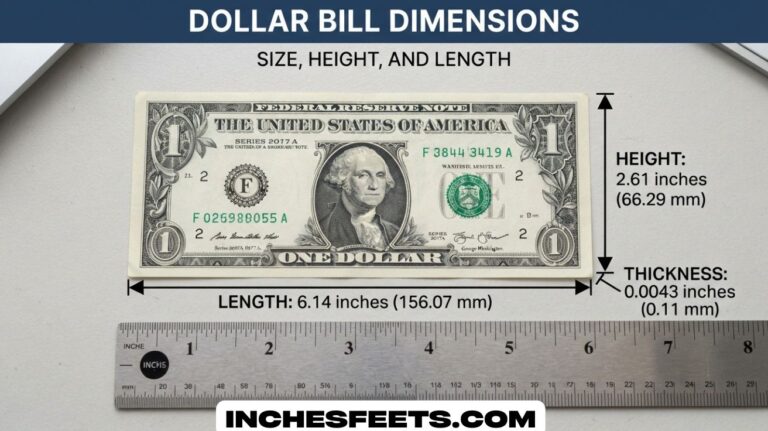
Failing that, work from known paper: a 5×7 photo’s short side is exact, and a junior legal pad’s sheet is five inches across. A US dollar bill is 6.14 inches long — useful as a ceiling, not a match: five inches is the bill minus a little over an inch. What not to trust: your fingers (the longest averages under three inches, as the finger section above shows), a credit card (3.37 inches long — it belongs to the two-inch guide’s neighbourhood, not this one), and any phone app that has not been checked against a real ruler — an uncalibrated screen measure is a guess with a nice interface.
Conclusion
Five inches is 12.7 centimetres of everyday precision: the long side of an index card, the short side of a 5×7 photo, a folded cocktail napkin, a margin trowel’s blade and the width of the gutter over the porch. It is also a length surrounded by confident mistakes — a credit card three inches long wearing a five-inch label, a golf tee the rulebook caps at four, and a paperclip out by three inches on a two-inch object.
Checked properly, the honest list is a practical one, and its most useful member is the humblest: keep a 3×5 index card wherever you measure things, and you will never have to estimate this length again.
FAQs
How Long Is 5 Inches in Centimeters?
Exactly 12.7 centimetres — 127 millimetres. One inch is defined as 2.54 centimetres, so five inches is 5 × 2.54 = 12.7 cm, with no rounding involved.
How Big Is 5 Inches?
About the width of an adult palm plus a finger’s width — a hand-scale length. The exact everyday anchors are the long side of a 3×5 index card and the short side of a 5×7 photograph.
What Household Item Is Exactly 5 Inches Long?
The 3×5 index card: its long side is exactly 5 inches by the format’s definition. A 3×5 Post-it Note sheet matches it, and a folded cocktail napkin is a 5-inch square.