How Long Is 50 Feet? 14 Common Things That Are 50 Feet Long
If you are asking how long is 50 feet, here is the exact answer first: 50 feet is 15.24 meters — 600 inches, or 16.67 yards — the width of an NBA basketball court and the height of a five-story building.
Fifty feet is a working measurement: the size of utility poles, boxcars, fire hose sections, and mature desert cacti. It is also a size people routinely get wrong, because several famous comparisons — the semi-trailer, the shipping container, the Olympic swimming pool — do not actually measure 50 feet, as this page shows.
This guide gives you the exact conversions first, then walks through fourteen things whose sizes are checked against official standards, manufacturer specifications, and agency records — and corrects the popular comparisons, including several on the page this one replaces, that quietly get 50 feet wrong.
Everyday Things That Are Exactly 50 Feet
If you only remember a short list, make it this one. Every entry below is 50 feet by an official standard, a manufacturer’s specification, or a verified agency record — not by eyeballing:
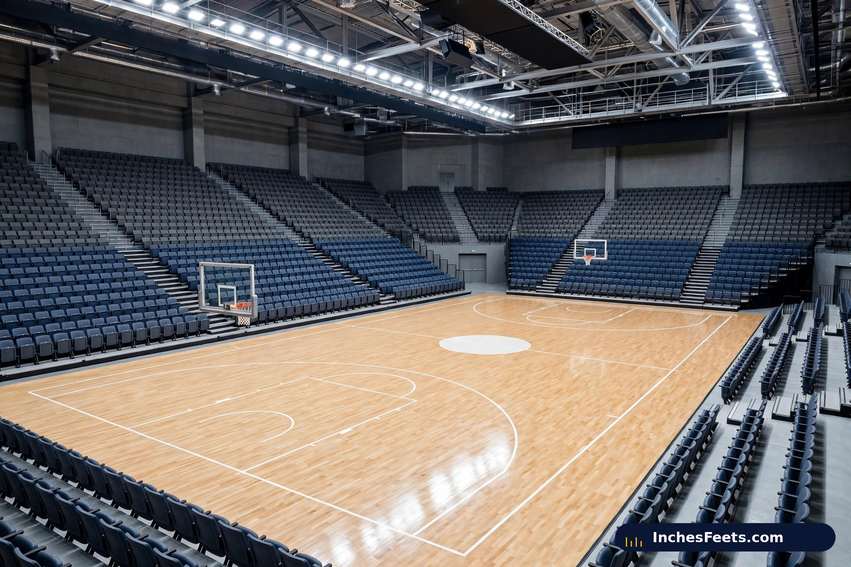
- An NBA basketball court, sideline to sideline — the NBA rulebook fixes the court at 94 feet long by exactly 50 feet wide.
- A 50-foot utility pole — wood pole lengths are standardized in 5-foot steps under ANSI O5.1, and 50 feet is one of the standard lengths.
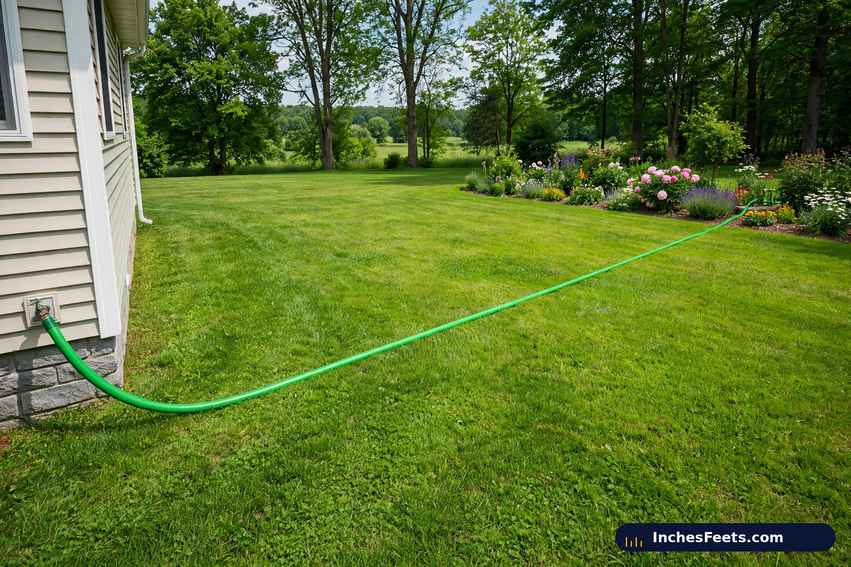
- A 50-foot garden hose — hoses are sold in a standard ladder of lengths, and 50 feet is the middle rung.
- A 50-foot tape measure — long tapes are manufactured at exactly 50 feet by the major tool brands.
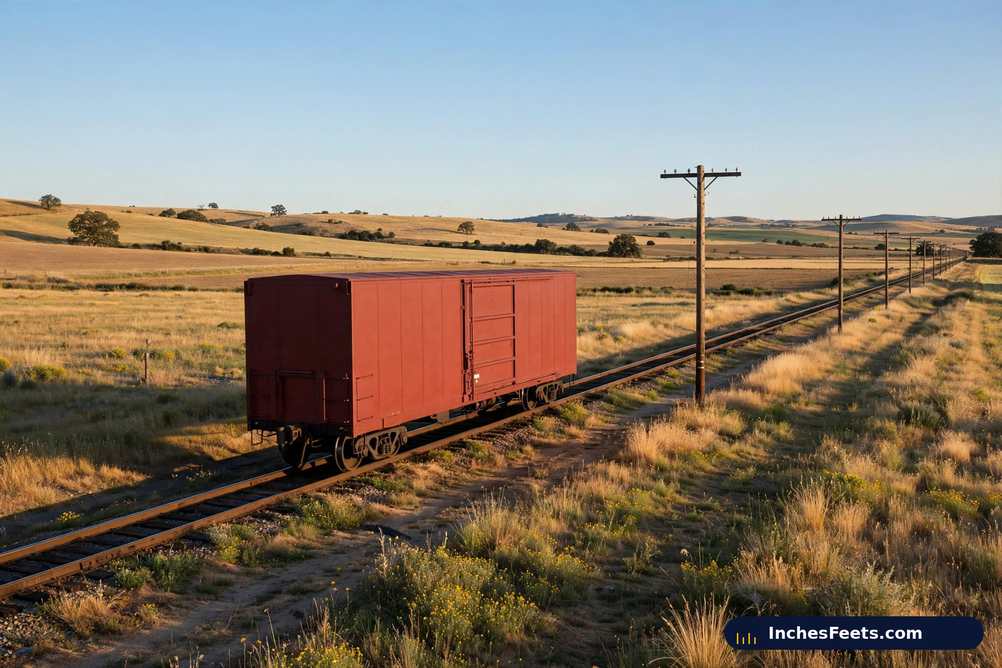
- A 50-foot boxcar — the standard boxcar class is named for its roughly 50 feet of inside cargo length.
- A mature saguaro cactus — the National Park Service notes that an adult saguaro may stand as tall as 50 feet.
Three comparisons you will see elsewhere need correcting straight away. A semi-trailer is not 50 feet: the standard dry van is 53. A shipping container never comes in 50 feet at all — the ISO boxes are 10, 20, 40, and 45 feet. And an Olympic swimming pool is 50 meters long, which is 164 feet — more than three times this page’s measurement, and the most common 50-feet mistake on the internet.
How Big Is 50 feet?
Fifty feet is roughly the distance of twenty long walking strides — an average stride runs about two and a half feet — and just under three standard parking spaces end to end, since a space runs about 18 feet. Standing it on end, it is five ordinary residential stories, or the full width of the biggest basketball court in the sport.
One comparison usually offered for this size needs a second look. A bowling lane feels like it should fit here, but it overshoots: a lane measures about 60 feet from the foul line to the head pin, so 50 feet stops a full ten feet short of the pins. If you pace out a bowling lane and call it 50 feet, you have given away a fifth of the measurement before you start.
50 Feet Comparison
50 Feet Comparison chart:
| Unit of Measurement | Equivalent of 50 Feet |
|---|---|
| Inches | 600 inches |
| Yards | 16.67 yards |
| Meters | 15.24 meters |
| Centimeters | 1,524 cm |
| Millimeters | 15,240 mm |
| Kilometers | 0.01524 km |
| Miles | 0.00947 miles |
Note the meters figure: 50 feet is 15.24 meters — not the round “16 meters” quoted on some pages, which overstates the distance by two and a half feet. The yards figure is worth a glance too: a third of a yard is exactly one foot, so 16.67 yards is just 50 feet divided by three, arithmetic anyone can check.
Things That Are 50 Feet Long
Here is the full set. Each counted entry is checked against an official standard, a manufacturer specification, or a verified record. Four of the comparisons on the page this article replaces turn out to be wrong at this size, and they are corrected in place rather than quietly dropped — which is why this list counts only the entries that check out.
5-Story Building
Counted — on the standard building basis. Residential stories run about ten feet floor to floor once the ceiling height and the floor structure are counted, and five of them make exactly 50 feet. This is not just a rule of thumb: a measured survey of more than 300,000 buildings put the median story at 3.07 meters (10.1 feet), with real five-story buildings clustering in a band whose lower half starts just under 50 feet to the gutter. Taller floor-to-ceiling heights — offices, hospitals — push a five-story building well past 50, but the ordinary five-story apartment block is this page’s height standing on end.
50-Foot Yacht
Counted — on a named model, with the small print disclosed. “Fifty-foot” is a class name in boating, and individual boats land within inches of it either way: Jeanneau’s Prestige 500 Fly, one of the best-selling boats in the class, has a published length overall of 15.20 meters — 49 feet 10 inches — and American broker listings for the same boat give her length as 50 feet (15.24 m) outright. She sleeps six in three cabins, which is the honest version of the “carries six to ten people” line: six berths is the specification, and the two-inch gap between the class name and the tape is disclosed here rather than rounded away.
Standard Semi-Trailer Truck
This one does not check out — and the page it comes from contradicts itself saying so. The standard semi-trailer, the dry van behind most of the trucks on the highway, is 53 feet long; the original text says 53 feet in one sentence and calls the trailer “slightly shorter than 50 feet” in another, which cannot both be true. Fifty-three is three feet longer than this page’s measurement. Shorter trailers exist — the 28-foot pup — but there is no 50-foot standard semi-trailer, and the 50-foot part of a big rig is neither half of it: the tractor alone runs 20 to 25 feet. Not counted in the 14.
NBA Basketball Court Width
Counted — exactly, by the rulebook. The NBA’s Rule No. 1 fixes the court at 94 feet long by 50 feet wide, so the distance from sideline to sideline — across the court, under the basket-to-basket traffic — is this page’s exact measurement, painted on the floor of every arena in the league. College and high-school courts keep the same 50-foot width and only shrink the length, which makes a basketball court the most reliable 50 feet most people will ever stand inside: next time you cross one sideways, you have walked exactly 50 feet.
Standard Fire Truck Ladder
Counted — on a corrected basis, because the honest 50 on a fire truck is a different ladder from the one usually pictured. The aerial ladder, the long powered ladder on a turntable, starts around 75 feet and runs past 100, and no aerial is ever “extended halfway” to make a measurement — halfway up an aerial is just a ladder at an angle, not a 50-foot standard. The real standard is the ground ladder crews carry to the building: the longest of them is the 50-foot Bangor extension ladder, a designated size with its own section in fire-service ladder manuals, raised by a crew of four or more with the staypoles — tormentors — that ladder standards require on extension ladders of 40 feet and up. A designated 50-foot ladder, carried on trucks across the country: counted, on the ground-ladder basis.
High Cube shipping container
This one does not check out at all, because no such container exists. Freight containers are built to the ISO standard in set lengths — 10, 20, 40, and 45 feet — and “high cube” describes their height, a 9-foot-6 box instead of the standard 8-foot-6; high cubes come in the 20, 40, and 45-foot lengths only. The claim that containers run “40 to 50 feet” invents a size the shipping industry does not make. The one bigger box on the road, the 53-foot domestic container, is a North American non-ISO size — and it is 53 feet, not 50. Not counted in the 14.
Circus High Wire
This one does not check out either, because there is no standard height to check it against. A wire rigged more than about 20 feet up already counts as a high wire; beyond that, the height is whatever the act, the tent, or the venue dictates — arena wires are commonly rigged a few dozen feet up, Nik Wallenda’s outdoor truss towers average around 50 feet, and the famous outdoor crossings run into the hundreds of feet, most famously a wire strung between the Twin Towers more than 1,300 feet above the street. Fifty feet sits inside that wide range, but printing it as the height of a circus high wire is a guess dressed as a standard. Not counted in the 14.
Telephone Pole
Counted — as a standardized length under the industry’s own rulebook. Wood utility poles are specified under ANSI O5.1, which sets pole lengths in 5-foot steps — 30, 35, 40, 45, 50 feet and up — and 50 feet is a stocked standard size for distribution lines. What surprises people is how much of it they never see: the setting-depth rule (ten percent of the length, plus two feet) puts a 50-foot pole seven feet in the ground, per utilities’ own setting tables, so about 43 feet stands above ground carrying the crossarm. The pole on the delivery truck is a true 50; the pole on your street shows you 43 feet of it.
Rescue Helicopter Winch Cable
This one does not check out — it is wrong by a factor of four or five. A rescue hoist needs enough cable for the helicopter to stay clear of cliffs, masts, and sea swell while the winch operator works below, so real hoists carry far more than 50 feet: aircrew manuals put usable cable at around 245 feet on a typical rescue hoist, training material for American hoists cites about 200 feet of usable cable, and procurement guidance runs up to 300 feet. A 50-foot cable would leave the aircraft hovering dangerously close to the casualty it came to lift. Not counted in the 14.
A 50-Foot Garden Hose
Counted — as a standard manufactured length. Garden hoses are sold in a fixed ladder of lengths — 25, 50, 75, and 100 feet — and 50 is the middle rung, the size that reaches the far beds of a typical yard from a single spigot: Swan’s FlexritePRO line, to take one major maker, catalogues its 5/8-inch hose at exactly those four lengths. Gardeners learn this measurement by failure — the 25-foot hose that stops ten feet short of the tomatoes is why the 50-footer is the best-selling step up.
A 50-Foot Tape Measure
Counted — exactly, and it is the most literal entry on this page. Long tape measures, the closed-case and open-reel tapes that surveyors, landscapers, and site crews unroll across lots and playing fields, are manufactured at exactly 50 feet: Crescent Lufkin’s FE050 fiberglass long tape and Keson’s MC1850 are both catalogued at 50 feet, between the pocket tapes and the 100-foot reels. If you need to lay out this page’s measurement on real ground, this is the tool made for the job — 50 feet of printed ribbon, wound in a case that fits in one hand.
A 50-Foot Extension Cord
Counted — as a standard stocked length. Extension cords are sold in a fixed ladder too — 25, 50, 75, 100, and 150 feet — so fixed that manufacturers’ own safety tables, the ones that match wire gauge to load, are organized by exactly those lengths. Fifty feet is the job-site standard: long enough to run a saw from the house to the far fence, and the length at which the gauge printed on the jacket starts to matter, because voltage drop over 50 feet is the difference between a tool running right and a tool running hot.
A 50-Foot Boxcar
Counted — as the standard class, on the railroad’s own naming basis, with the full measurement disclosed. Boxcars are classed by their inside length, and the standard class is the 50-foot car: railroad references describe the 50-foot model as the most common boxcar on the rails, with an inside length of 50 feet 6 inches, and an Army lease specification for “The 50′ Standard Boxcar” lists 50 feet 7 inches inside. The disclosure is the steel: measured over the couplers, the same car runs about 55 feet 5 inches outside. The “50” is the cargo space the railroad sells — the box itself — and it is genuinely fifty feet of it.
A 50-Foot Section of Fire Hose
Counted — exactly, as a manufacturing standard. Fire hose is not made in continuous rolls cut to taste; under the NFPA 1961 standard and fire-service practice, attack and supply hose is manufactured in 50- or 100-foot sections, and the traditional North American section is 50 feet. That is why firefighters talk in lengths: a crew stretching “three lengths” of attack hose has laid 150 feet, counted in 50-foot standards, and a hose bed’s capacity is reckoned the same way. Every coupling on the line marks another one of this page’s measurements.
An Adult Sei Whale
Counted — at the top of its documented typical range. The sei whale is the third-largest of the baleen whales and one of the fastest, and NOAA Fisheries’ species profile gives its length as 40 to 60 feet overall, with adults typically running 12 to 15 meters — 40 to 50 feet — and adult females averaging about 15 meters (49 feet). So a big adult female sei is, to within a foot, a 50-foot animal: this page’s measurement with a fluke, cruising at speeds few whales can match.

A Bull Sperm Whale
Counted — inside its documented mature range, with the average disclosed. Sperm whale bulls keep growing long after the cows stop, and the Alaska Department of Fish and Game’s species profile puts adult males at an average of 52 feet, reaching physical maturity at 15 to 16 meters — 49 to 52 feet. Fifty feet, in other words, is a middling mature bull: a touch under the class average, squarely inside the documented band, and attached to the largest brain and the loudest voice of any animal on Earth.
A Mature Saguaro Cactus
Counted — on the National Park Service’s own figure. The saguaro grows with famous slowness — a ten-year-old plant may be an inch and a half tall — but it gets there in the end: the Park Service notes that an adult saguaro, at roughly 125 years old, may be as tall as 50 feet, and mature plants run 40 to 60 feet, with the tallest ever recorded at 78. The classic desert sentinel with its arms raised, the one on every Arizona postcard, is standing at this page’s height.

A Mature Red Maple
Counted — at the middle of its documented mature range. The red maple, Acer rubrum, is one of the most common shade trees in eastern North America, and the references agree on its adult size: the Missouri Botanical Garden and Cornell University’s woody plant database both give a typical mature height of 40 to 60 feet. A red maple in the middle of that band — an ordinary, fully grown street or yard tree — stands right around 50 feet, which is why it towers over the house it shades in a way the 25-foot dogwood never will.
How to Visualize 50 Feet Without a Ruler
Start with your own feet: about twenty long walking strides cover 50 feet, since an average stride is roughly two and a half feet. It is a rough instrument — stride length varies with height and pace — but it will get you within a foot or two, which is close enough to settle most arguments about whether the fence run or the garden bed fits.
Build it from lengths you have already paced out. Fifty feet is twenty feet plus thirty feet laid end to end — or, if the shorter guide is the one you know, two lengths of 25 feet back to back. Indoors, picture the width of a basketball court; outdoors, look up at a five-story building and tip it over in your mind until its roofline touches the ground 50 feet away.
Your last resort is the object itself: a 50-foot tape measure costs less than a pizza and settles the question permanently, which is why it appears in the list above as both a measuring tool and a measured thing.
50 Feet vs 40 Feet: What’s the Difference?
Ten feet — one building story, roughly — and at this scale it changes the category of almost everything. At 40 feet you have the largest standard shipping container, the 40-foot ISO box, and the home ground of the full-size school bus, which runs 35 to 45 feet. At 50 feet you have passed every school bus on the road — the law caps them at 45 — and stepped into five-story, 50-foot-pole territory.
The difference also matters because the standards step unevenly here. Utility poles climb in five-foot steps straight through both numbers — 40, 45, 50 — so each is its own stocked class with its own setting depth. Hoses skip 40 entirely, jumping from 25 to 50. Forty feet is the top of the container world and the middle of the bus world; fifty is a class boundary of its own.
When an Exact 50 Feet Matters
Some 50s are pictures to estimate with; others are specifications with money or safety riding on them. Utility work is the clearest case: the setting-depth rule ties a 50-foot pole to a seven-foot hole, and a pole planted at a shorter pole’s depth is a pole that leans, then falls. The class is stamped on the pole’s brand — guessing at it is not an option the standard allows.
Firefighting runs on the same exactness. Working lines are built from 50-foot sections, so a crew that has coupled ten sections together knows it has 500 feet of hose between the hydrant and the fire — and whether that is enough is arithmetic, not estimation. Zoning writes the number into law as well: many residential districts cap building height at or near 50 feet, so whether a five-story design measures 49 feet 6 inches or 50 feet 6 inches to the ridge decides whether it can be built at all.
Conclusion
Fifty feet is 15.24 meters, 600 inches, and 16.67 yards — and once you know where to look, it is a measurement with a standard, a spec sheet, or an agency record behind it: the NBA court’s width by rulebook, the pole by ANSI standard, the hose section by NFPA standard, the saguaro by the Park Service’s own description. The honest list matters because the internet’s favourite comparisons at this size include a 53-foot trailer wearing a 50-foot label, a container size that has never been manufactured, and a winch cable a quarter of its real length.
Keep two anchors and you will rarely guess wrong: picture the basketball court’s width for anything long, and the five-story building for anything tall. And out on the rails between them, the boxcar — classed by the fifty feet of cargo space inside its steel walls — is this page’s ruler on wheels.
FAQs
How Far is 50 Feet Visually?
Across an NBA basketball court, sideline to sideline, or up the face of a five-story building. It is longer than any school bus — the biggest are capped at 45 feet — and it is exactly 15.24 meters, not the 16 meters sometimes quoted.
How High is 50 Feet?
Five residential stories, at the standard ten feet each. A 50-foot utility pole is the same measurement standing up — though seven feet of it is buried, so about 43 feet shows above ground.
What Does 50 Feet Look Like?
A 50-foot boxcar’s cargo box, a garden hose stretched the length of a big lawn, or a mature saguaro against the sky. If it fits across a basketball court’s width, it is 50 feet or less.
How Much Is 50 Feet?
Exactly 15.24 meters — 600 inches, 16.67 yards, 1,524 centimeters, or 0.00947 miles. It is not 50 meters: that is an Olympic pool, and it is 164 feet.