How Long Is 1 Inch? 14 Things That Are 1 Inch Long
A one inch example you can reach for right now is the small paperclip in a desk drawer — the little 25 mm size is made at almost exactly an inch long. One inch is exactly 2.54 centimeters, about the width of the top joint of an adult thumb, and it is small enough that most objects claimed for it miss by more than people expect.
That gap between “about an inch” and an actual inch is where this measurement gets interesting. A U.S. quarter looks like a one-inch coin and is not. A standard die looks close and is barely five-eighths of an inch. The objects that truly measure an inch tend to be the ones manufactured to the size — buttons, tools and fasteners whose inch is printed in their specifications.
This guide gives the exact conversions first, then 14 things verified at one inch against a maker’s specification, an official standard or the arithmetic of a sizing system. It also keeps the famous claims that fail the check — the quarter, the bottle cap, the LEGO brick — and prints their real sizes beside them.

How Big Is 1 Inch?
One inch is a small unit with an exact modern definition: since 1959 the international inch has been fixed at precisely 25.4 millimeters, so there is no rounding anywhere in its conversions. Two claims often made about it need tidying up. The inch is not the width of a paperclip — a paperclip’s inch is its length, covered in the list below. And it is not the height of a smartphone, which runs five to six inches tall. What is true is the older story: several historical inch-like units were based on a thumb’s breadth, which is why a thumb still works as a rough field estimate — roughly, never exactly.
One inch is also a little more than 2 cm — exactly 1.27 times that length — and a twelfth of a foot, which is why it survives as the working unit for small hardware, sewing notions and tool sizes across the United States.
How Much Is 1 inch?
| Unit | Equivalent to 1 Inch |
|---|---|
| Centimeters (cm) | 2.54 cm |
| Millimeters (mm) | 25.4 mm |
| Feet (ft) | 0.0833 ft |
| Yards (yd) | 0.0278 yd |
| Meters (m) | 0.0254 m |
| Kilometers (km) | 0.0000254 km |
| Miles (mi) | 0.00001578 mi |
| Micrometers (µm) | 25,400 µm |
1 Inch at a Glance: The Verified List
- A small paperclip — the 25 mm manufactured size
- A 40-ligne (40L) coat button — exactly one inch by the button trade’s own unit
- A jumbo 25 mm die — the largest standard dice size class
- A 1-inch hole saw — its designated cutting diameter
- A 1-inch ring binder — its designated ring size
- A 1-inch paint brush — its designated bristle width
- A 1-inch combination wrench — its jaw opening is the size
- 1-inch grosgrain ribbon — a standard manufactured width
- A 1-inch binder clip — the designated 25 mm clip size
- A 25 mm split key ring — sold in the US as the 1-inch size
- The bore of a 6205 ball bearing — 25 mm on SKF’s datasheet
- 1-inch hook-and-loop tape — a standard manufactured width
- 1-inch elastic — a standard sewing width
- 1-inch round labels — a standard label diameter
14 Common Things That Are 1 Inch Long
An inch is easy to overlook precisely because so many small objects cluster near it without reaching it. The honest list below starts with the claims usually made for this size, checked one by one — only one of the nine survives, and only in a corrected form — then adds the manufactured objects whose specifications genuinely read one inch.
U.S. Quarter Coin
The quarter is the most repeated one-inch claim in America, and the United States Mint’s own specification settles it: a quarter dollar measures 0.955 inches (24.26 mm) in diameter and weighs 5.67 grams. That is a real, official figure — and it is 4.5% short of an inch, a visible gap of 1.14 mm against a ruler. “Approximately one inch” is fair as a memory aid for estimating other things; as a counted example of a one-inch object, the quarter fails its own mint’s measurement, so it is not counted here. The coin that overshoots instead — the golden dollar, at 1.043 inches — is no closer.
Not counted: the U.S. Mint specifies the quarter at 0.955 inches in diameter — 4.5% under an inch.
HP Keyboard (Ctrl) Key
No keyboard maker publishes a specification for the width of a Ctrl key, and there is no standard for one to meet. Keyboards are built on a key unit of about 19 mm (0.75 in) per single key, and a Ctrl key spans one-and-a-quarter to one-and-three-quarter units depending on the model — roughly 24 to 33 mm — so on one HP keyboard the key can land near an inch and on the next it clearly does not. A claim that changes truth from model to model cannot be verified as stated, which is why this familiar example is not counted.
Not counted: no published specification exists, and the key’s width varies by keyboard model from roughly 24 to 33 mm.
Bottle Cap
The bottle cap is a trap of two different diameters. The standard crown cap belongs to the “26 mm” closure family — the European standard EN 17177 is literally titled “Crown caps, 26 mm diameter” — but 26 mm names the bottle finish the cap seals, not the cap you hold: the metal shell itself measures about 32 mm across, roughly 1.26 inches, which is where the familiar “about 1.25 inches” figure comes from. Plastic screw caps vary again with their neck finishes. Neither the designated 26 mm (1.02 in, a finish dimension) nor the physical shell (about 1.26 in) is a one-inch object in the hand, so the cap is not counted.
Not counted: the standard crown cap is designated 26 mm for its bottle finish, while the shell itself measures about 1.26 inches across — neither is one inch.
Paperclip
Here the usual claim survives, but only in its corrected, specific form. Paper clips are manufactured in graded sizes, and the small size is made at 25 mm long — the one-inch class of the range. The clip on most desks is longer: the IMPA stationery datasheet lists its No. 1 paper clip at 28 mm (1.10 in) and its No. 3 at 22 mm, and regular retail clips commonly run 28 to 33 mm. So “a paperclip is an inch long” is wrong as a blanket statement and right about exactly one manufactured size — the small 25 mm clip, which is the form counted here, with the longer standard sizes disclosed rather than hidden.
Counted: FLAGGED — the small manufactured clip size is 25 mm long (0.98 in); the common No. 1 desk clip is 28 mm and is NOT the inch, disclosed here and in the section.
Thumb Knuckle Width
A thumb is a person, not a product, and it shows in the numbers: the range usually quoted for thumb-knuckle width runs from 0.8 to 1.5 inches, which means some thumbs are an inch wide, many are not, and the same source that offers the example concedes the spread. There is no standard thumb to verify against, and a measurement that depends on whose hand you borrow is an estimating trick, not a one-inch object. Use it to guess; do not count it.
Not counted: thumb-knuckle width is quoted across a 0.8–1.5 inch range — a body estimate with no standard size, not a measurable one-inch thing.
Airpods
Apple’s published dimensions untangle this one. An AirPods Pro (2nd generation) earbud measures 1.22 inches high, 0.86 inch wide and 0.94 inch deep (30.9 × 21.8 × 24.0 mm). The “0.94 inches” that circulates as the earbud’s height is actually its depth, front to back — and even that closest axis is 5.5% short of an inch. The 0.71-inch width quoted alongside it belongs to a different generation (the 3rd-generation AirPod is 0.72 inch wide but 1.21 inches high). No side of any AirPod is one inch, so the earbuds are not counted.
Not counted: Apple’s own figures give the earbud’s closest axis as 0.94 inches — its depth, not its height — and no dimension reaches one inch.
LEGO Brick (2-stud length)
LEGO geometry is exact, publicly documented — and nowhere near an inch here. Bricks are built on an 8 mm stud pitch, and every part is made 0.2 mm shorter than its grid, so a 2-stud length is 15.8 mm, or 0.62 inches. (The figure of 1.2 cm sometimes printed for it is wrong in metric too; 15.8 mm is 1.58 cm.) No whole number of studs lands on an inch either — three studs make 23.8 mm and four make 31.8 mm — so LEGO cannot supply this example at any brick size.
Not counted: a 2-stud LEGO length is 15.8 mm (0.62 in) on the system’s own 8 mm grid — nearly 40% short of an inch.
Dice Edge (standard size)
The standard die is smaller than its reputation. The ordinary board-game d6 is a 16 mm cube — 0.63 inches, the figure behind the “about 0.6 inches” sometimes quoted — and casino dice are 19 mm (0.75 in). Calling the standard die “approximately half an inch” understates even that. The die that does belong on this list is the jumbo size class, counted separately below; the standard edge is not counted.
Not counted: a standard die’s edge is 16 mm (0.63 in) and a casino die’s is 19 mm — neither is the one-inch class.
Small Magnet (fridge type)
This claim refutes itself: the guides that offer the fridge magnet as a one-inch example describe the same magnets as measuring 2 to 3 inches. Both cannot be true, and the larger figure is the honest one for typical decorative fridge magnets, which are sold by their picture size. Small disc magnets exist at many diameters, but no standard one-inch fridge magnet exists to verify, so the magnet is not counted.
Not counted: fridge magnets of the type described measure about 2 to 3 inches by their own descriptions — no standard one-inch size exists.

A 40-Ligne (40L) Coat Button
The button trade measures buttons in its own unit, the ligne — spelled “line” in the American trade — defined as exactly one-fortieth of an inch (0.635 mm). The arithmetic is therefore definitional: a button sized 40L measures 40 × 0.635 mm = 25.4 mm = exactly 1.000 inch in diameter. The 40L size is a real, stocked coat and jacket button size, the largest in everyday garment use, and it is the cleanest count on this page: the inch is built into the sizing system itself.
Counted: exactly 1 inch — the button trade defines 40 lignes as one inch (40 × 0.635 mm = 25.4 mm).
A Jumbo 25 mm Die
Dice are sold in a ladder of size classes — 12 mm mini, 16 mm standard, 19 mm casino — and the top of the everyday ladder is the jumbo class at 25 mm, marketed in the trade as the 1-inch size. A 25 mm cube measures 0.984 inches on an edge, 1.6% under a true inch, disclosed rather than rounded: this is the same metric step that appears on the bearing and the key ring below, and it is the closest manufactured dice size to an inch that exists.
Counted: FLAGGED — the jumbo dice class is designated 25 mm = 0.984 in, 1.6% under an inch, disclosed here and in the section.

A 1-Inch Hole Saw
A hole saw is bought by the hole it cuts, and the 1-inch size — sold by Milwaukee, Lenox, DeWalt and every other maker of the Hole Dozer class — is specified at a cutting diameter of exactly 1 inch (25.4 mm). The designation is the measurement: a hole saw that cut anything else would be mislabelled. (The trap to avoid is the 1-inch pipe hole, a different thing entirely — nominal pipe sizes are names, not dimensions.)
Counted: exactly 1 inch — the designated cutting diameter on makers’ specifications.
A 1-Inch Ring Binder
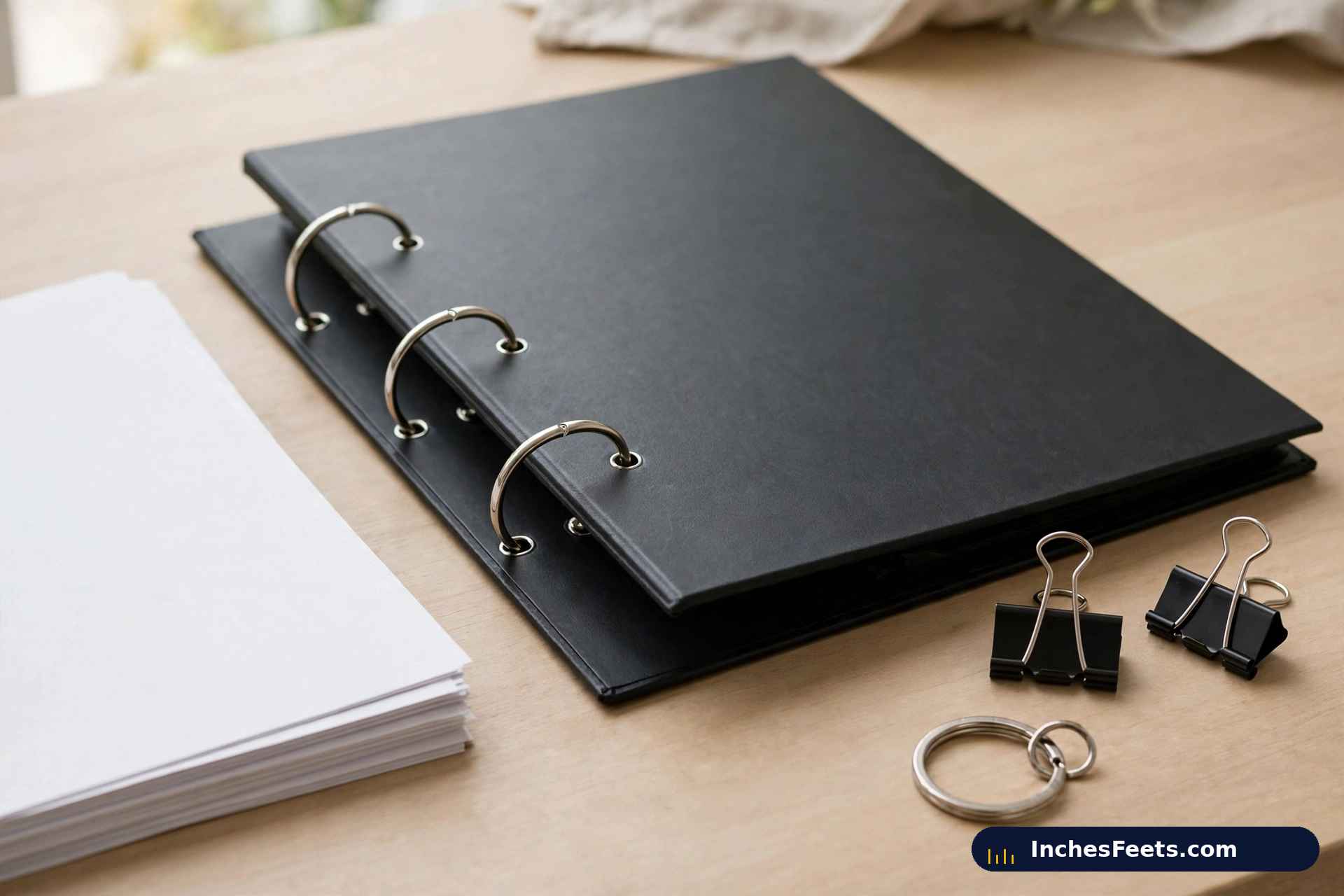
The ring binder on a school shelf is sized by its rings, and the 1-inch binder — the standard classroom size from Avery, Cardinal and their competitors — is specified with a ring diameter of 1 inch, rated for roughly 175–225 sheets depending on the maker. As with the hole saw, the named size is a real dimension of the product: the inside diameter of the closed ring.
Counted: exactly 1 inch — the designated ring diameter on makers’ specifications.
A 1-Inch Paint Brush
Paint brushes are sized by bristle width, and the ladder of standard widths — half-inch, 1, 1½, 2, 2½, 3 — puts a 1-inch brush at the small end, the size sold for trim, touch-ups and crafts. Purdy, Wooster and the other brush makers list the width as the product’s defining specification, and the 1-inch step is exactly 1 inch across the bristle stock.
Counted: exactly 1 inch — a standard designated bristle width on makers’ size ladders.
A 1-Inch Combination Wrench
A wrench is the rare tool whose name is a measurement you can check with calipers: a 1-inch combination wrench is forged with a jaw opening of exactly 1.000 inch, sized to turn a 1-inch fastener head. The designation follows the SAE sizing system, so the inch is not approximate — a jaw opened wider or narrower would fail the fastener it is named for.
Counted: exactly 1 inch — the jaw opening is the SAE size designation itself.
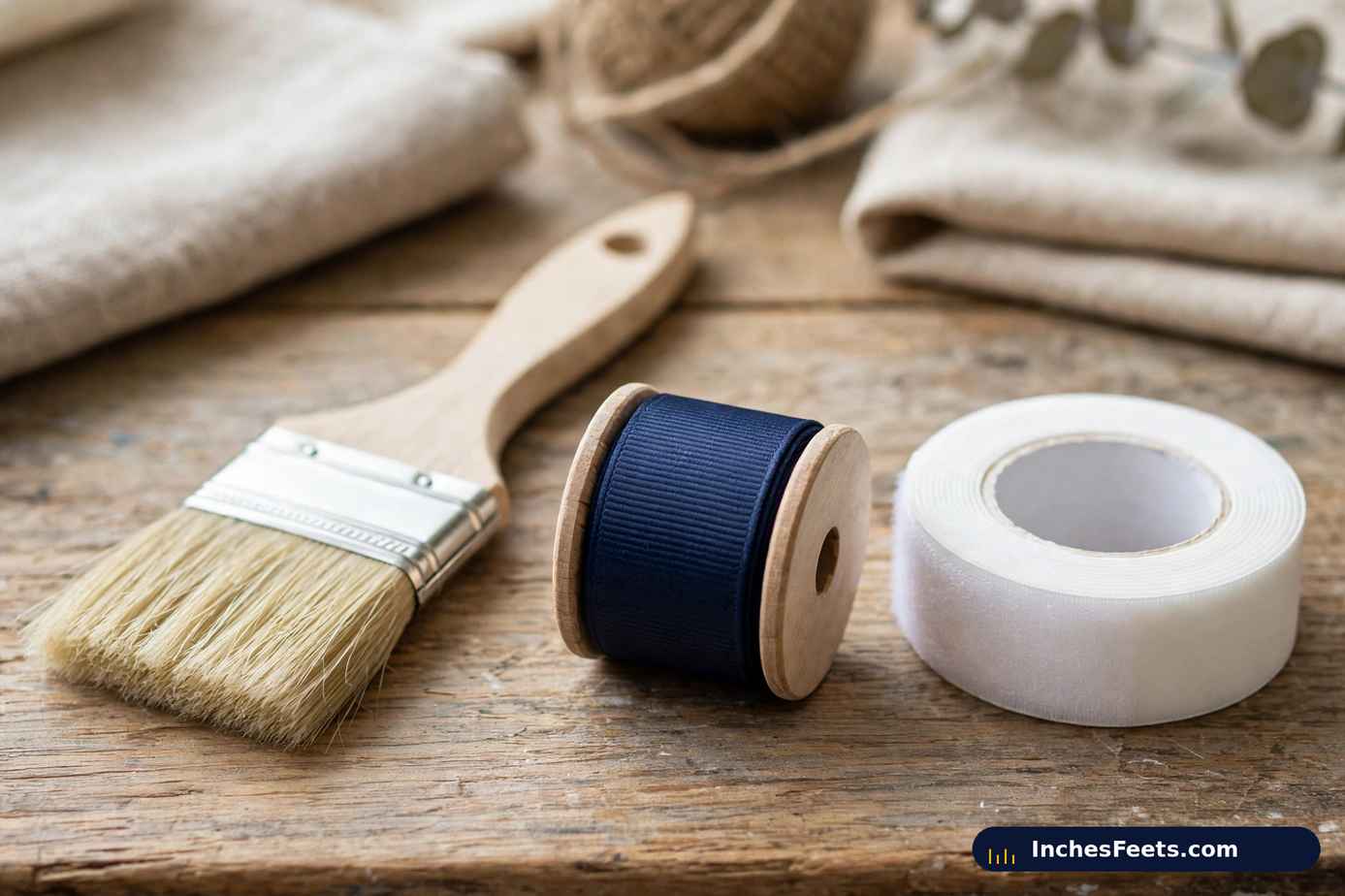
Grosgrain Ribbon (1-Inch Width)
Craft ribbon is woven and sold in a fixed ladder of widths — 3/8, 5/8, 7/8, 1, 1½ inches and up — and the 1-inch width is one of the standard steps, stocked by Offray and every craft supplier in grosgrain, satin and organza. The width is the product’s defining specification, woven to size on the loom.
Counted: exactly 1 inch — a standard manufactured ribbon width.
A 1-Inch Binder Clip
Binder clips are graded by width, and the 1-inch size — specified at 1 inch (25 mm nominal) across the body, between the ¾-inch small and the 1¼-inch medium — is a standard stocked step from office suppliers. The width in the size name is the width of the clip itself, measured across the folded steel body.
Counted: exactly 1 inch — the designated width of the 1-inch clip size class.
A 25 mm Split Key Ring
The split ring that holds a house key is sold in graded outside diameters, and the commonest size in the United States is the ring listed at 1 inch — made to the metric step of 25 mm outside diameter, 0.984 inches, disclosed here rather than rounded up. It is the same honest 1.6% gap as the jumbo die: the US trade name says one inch, the manufactured step is 25 mm.
Counted: FLAGGED — the standard key-ring size is designated 25 mm outside diameter = 0.984 in, disclosed here and in the section.
The Bore of a 6205 Ball Bearing
Inside machinery, an inch hides in a metric part. The 6205 is one of the world’s commonest ball bearings, and SKF’s datasheet gives its bore diameter — the hole the shaft passes through — as 25 mm, with an outside diameter of 52 mm and a width of 15 mm. The bore converts to 0.984 inches: 1.6% under an inch, the standard metric step below it, printed here with its exact figure rather than a rounded claim.
Counted: FLAGGED — SKF specifies the 6205 bore at 25 mm = 0.984 in, disclosed here and in the section.
1-Inch Hook-and-Loop Tape
Hook-and-loop fastener tape — the VELCRO Brand class — is manufactured in standard widths, and 1 inch is one of the stocked steps, sold in sew-on and adhesive-backed forms. The width is the specification on the roll: a 1-inch tape measures 1 inch across, edge to edge.
Counted: exactly 1 inch — a standard manufactured tape width.
1-Inch Elastic
Sewing elastic is likewise woven to a ladder of standard widths, and the 1-inch width — the waistband standard, stocked by Dritz and every notions supplier in braided, woven and knit forms — is specified at exactly 1 inch across. It is measured flat and unstretched; the width is the product’s defining dimension.
Counted: exactly 1 inch — a standard manufactured sewing width.
1-Inch Round Labels
Avery and its competitors sell round labels by diameter, and the 1-inch round — the size used for envelope seals, jar lids and pricing dots — is specified at a diameter of exactly 1 inch on the product datasheet. A label is a pure dimension product: the stated diameter is the whole specification.
Counted: exactly 1 inch — the designated diameter on makers’ datasheets.
How to Visualize 1 Inch
Picture the top joint of your thumb, thumbnail included — for most adults that segment runs close to an inch, which is why the thumb became the folk ruler in the first place. Picture a coat button at its largest everyday size, or the ring of a school binder. On a standard ruler, an inch is the longest marked division, split into 16 sixteenths. And against your phone: an inch is roughly the width of two app icons side by side — a comparison that stays honest because icon grids are laid out on a fixed pitch, unlike the phone’s marketing dimensions.
1 Inch Compared With Other Lengths
Scale is easiest to feel in multiples. One inch is exactly half of two inches — the length of the small paperclip’s bigger No. 1 brother, roughly — and twelve of them laid end to end make the foot that 12 inches measures. Against metric lengths on this site, an inch is one-fifteenth-and-a-bit of 40 cm (40 cm is 15.748 inches, so an inch is about 6.35% of it). Turned the other way, the objects that failed this page’s check show the scale’s tightness: the quarter at 0.955 and the golden dollar at 1.043 bracket the inch within a twentieth of an inch on either side, and both still miss it.
How to Measure 1 Inch Without a Ruler
Use the manufactured inch, not the body estimate, whenever one is in reach. A 40L coat button, a 1-inch binder ring or a roll of 1-inch tape is a gauge that was made to the size. Five small paperclips end to end give you 5 inches to scale from — but check the clips first, since only the small 25 mm size is the inch; the standard desk clip will quietly add a tenth of an inch per clip. The thumb joint remains the fallback: fine for choosing a plant pot, useless for cutting material, because the same hand that measures 0.8 inches at one knuckle measures 1.5 at another.
Conclusion
One inch is exactly 2.54 centimeters — and, checked properly, it is also a specific, countable set of things: a button size defined by the ligne, a hole saw’s cut, a binder’s ring, a wrench’s jaw, and a short ladder of woven widths and designated tool sizes, with the small paperclip rescued in its one true manufactured size. Just as instructive is what did not survive: the quarter misses by 4.5% on its own mint’s figures, the bottle cap’s two diameters straddle the inch without touching it, the standard die is five-eighths of an inch, and the LEGO brick cannot reach an inch at any stud count.
The habit worth keeping is to ask “one inch by whose specification?” — a maker’s datasheet, a trade unit like the ligne or an official standard will name the objects that truly measure an inch, and everything else is a guess wearing a familiar face.
FAQs
How Long is an Inch?
An inch is exactly 2.54 centimeters (25.4 mm) by international definition, and one-twelfth of a foot. There are 16 sixteenth-marks in an inch on a standard ruler.
What Does an Inch Look Like?
About the length of a thumb’s top joint, a large coat button (the 40L size), or the ring of a standard school binder. On a ruler it is the longest numbered division.
What Are Common 1 Inch Objects?
The verified ones: a 40L coat button, a 1-inch hole saw, ring binder, paint brush and wrench, 1-inch ribbon, tape and elastic widths, 1-inch round labels, a jumbo 25 mm die and the small 25 mm paperclip. Two popular answers are wrong: a U.S. dime is 0.705 inches across — nowhere near an inch — and a soda bottle cap’s shell is about 1.25 inches, a quarter too big.